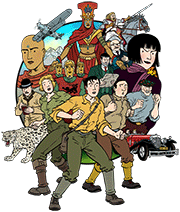


This blog began in 1997 as a single news page called Nucelus. In 2005, during a long wait to move into a new house, I decided to learn some php and MySQL and write my own blogging system, which became inkyBlog and which now powers this, my own Webbledegook blog.
Thank you to my brother, Murray Ewing, for help with some of the more challenging aspects!

A little earlier, in October 2025, Affinity/Canva released their new, and free, combined design/publisher/photo app, replacing the three individual Affinity apps (which I had bought at version 1 in 2015). I also owned ClipStudio Paint (I originally bought Manga Studio EX 4 in 2009, updating it eventually to ClipStudio) and used it very occasionally, mostly for their perspective rulers, severely lacking in Photoshop since I had largely moved to digital in 2016.
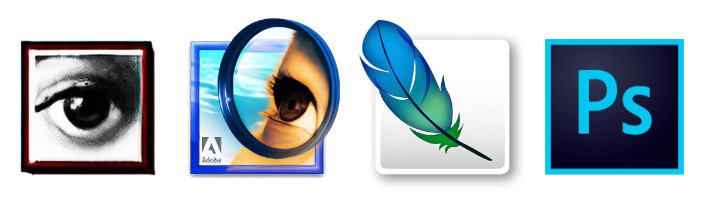
I'd been a Photoshop user since version 3, circa 1997 (version 4 was out by then but I bought a second-hand copy to begin with), and worked my way through at least a couple of huge manual-guides, becoming - if I do say so myself - quite proficient in it. For the next 28 years Photoshop was my right arm - I used it every day in a multitude of ways, it became a natural environment I hardly had to think about.
To leave that behind has been painful - more than I thought actually. Ending my Photoshop subscription caused them to offer me a couple of free months, so I kept it on as I tried to familiarise myself with a new work flow. I thought it would be relatively easy, but - as similar as Affinity is - it's different enough to get frustrating very quickly, especially when you're so familiar with the alternative. I haven't quite taken to it.
Photoshop disappeared from my hard drive for good in April of this year and I've struggled to slot into a new work-flow. Now, July, I think I'm just about there. ClipStudio has become my drawing app - actually it has a lot more going for it as a drawing app than Photoshop did, not surprising really as it was originally created specifically as comics creation software, and remains that today.
I'm not a fan of many of its short-cut manga tools and don't use them - but I'm beginning to get used to the interface at last. My process remains essentially the same as when I drew on paper, just now it's on a glass screen instead.
ClipStudio's lettering tools don't work well for me - I have a style for that already in place and can't replicate it in CS. So that's when I move over to Affinity, where the master page is assembled and I layout the balloons and lettering in its Vector Studio.
So far this year has not been productive for The Brambletye Box - it has partly been this work flow upheaval, but my schedule has also been kept off-track through some work (much-needed), some family health issues, and, yeah, some creative struggles here and there due to all of the above. But you can't regret what's been, so I'll move forward, refine the workflow more as I go, and carry on - I'm still as excited about this new Julius Chancer story as ever.
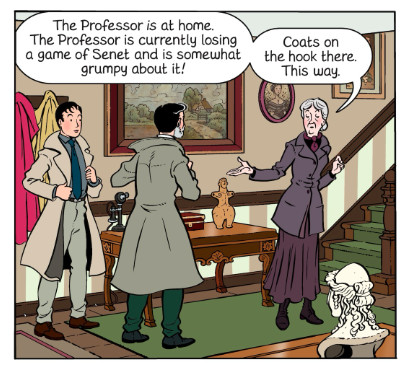
More progress was made on The Brambletye Box, though not nearly as much as it should have been. However, it was just not possible under the circumstances - I intend for 2026 to be way better on that front.
Work was difficult, especially as AI 'images' continue to stamp all over human creativity and spread itself to every corner, polluting the internet. Work did pick up a little more towards the end of the year, but my career definitely needs a rethink in the face of these new challenges. I have some ideas, we'll see where they lead.
The world is really taking a hammering at the moment, but we can keep doing what we love, creating, taking control of the things we can control and not letting the things we can't dictate our outlook. Acts of art, acts of kindness - the small things matter.
I wish you all a successful, healthy and happy 2026.

Logos For Shows is my little side-business of providing theatre art for schools, amateur companies and professionals to use for their show publicity. It started back in 2011 out as a reaction to seeing my Oliver! logo being stolen and used all over the place (sadly that still happens) and a chance to license my artwork and make it affordable for those on a budget.
The next thing to do is to increase the number of shows I have available. I already have a second Grease design and some Peter Pan artwork at the sketch stage, and plans for quite a few more to come - it's just a matter of making the time for it!

AI art is not created, it is not made. It is churned out in a mechanised production line largely by those who do not have the ability or the patience for craft - organ grinders expecting applause for the complex sonata that emanates from the lever they push while not understanding a scale, chord or key.
AI users have to reign themselves in, for producing so much would reveal too readily what it really is - machine-produced mass content. It's the plastic tat of the gift shop, shiny but valueless, tawdry, throw-away.
AI art is for that friend who wanted to be your agent, your manager; you'd be the talent, do the work, and they'd rake in the cash. Now they've got AI there's no pesky artist in the way wanting creative control, just an acquiescent machine with which to overpopulate Amazon, Etsy and Ebay with colouring books, calendars, notebooks and art prints.
Some fall victim to the machine completely, believing they are the artists themselves. They will claim the 'text prompt' is a hard-won skill only a handful have mastered. Then some will claim there is no AI in their art at all. Out of nowhere they are producing full paintings, two or three a week, one a day if they're not careful, merely adding the flourish of a signature to make it theirs. Perhaps a previously amateur artist, now bursting with a brand-new style, but we never see the roughs, we never see the sketches, there is no video of their process.
Here they come ... festival brochures, event leaflets, book covers, comic strips, movie posters. The incredible wood sculpture made by a six-year old, the amazing historical photo no one has seen before, the viral video narrated by someone who may or may not be Morgan Freeman. The compromising picture of a loved celebrity, the off-mic comment made by a political opponent ... the video proof to justify a war.
AI art is trash and in that there is some hope, because those that use AI to promote their book festival, or their children's fun event, or their new novel, are broadcasting a certain set of values that most would reject if they knew: low-quality, cheap, insincere. The danger lies in an audience whose senses have been bludgeoned by a constant scrolling stream of thirty-second videos, forty-word posts, deepity-memes, and an internet media already full of charlatans, grifters, and conspiracy-pushers (it's no coincidence they are some of the biggest users of AI images).
Art is beautiful because it has been made by a fellow human being. Life is infused into human art. It is the mind laid bare for all to see. When you see art you like, you immediately think of the person who made it, you wonder about them - it is connection. Machine art is devoid of everything we relate to in human life. AI content is a climate disaster for the internet, an invasive species, a complete corruption of humanistic values. Reject it.

I mention it here because I very much enjoyed making the logo and cover art for this book, a montage of scenes and characters that populate the story. To learn more and get yourself a copy, visit Orson Teller's website here, where you'll see a second volume of Alice's adventures is already in the works.


I wanted a decent record of all the work I did, so I've made a one-off art book (through Blurb), a portfolio, just for my own archive. Although there are no other copies (the art remains the copyright of Maschinen-Mensch), I did make a little video of a flip-through the book, so you can have a peek for yourself.

You can read the comic and see the accompanying resources here, including teachers' notes and a BSL-interpreted video of the strip.

The comic was principally researched and written by Dr. Kate Loveman, Associate Professor in English Literature, 1600-1789, at the University of Leicester, and an expert and author on Samuel Pepys, and all done as part of the Reimagining the Restoration project. Also directing the project was the Museum's Learning Manager, James Harrod.

It was great fun to do, with plenty of detail to research - and it was wonderful to have a couple of real experts on hand to advise and provide material and context for the visuals.
Many thanks to both Kate and James for a terrific working experience, and for bringing me into the project.

It should be good for desktops, tablets and phones, so give it a whirl ... and let me know if anything is broken or you spot a typo .... there's always one lurking about somewhere.


