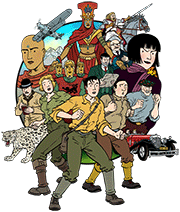


This blog began in 1997 as a single news page called Nucelus. In 2005, during a long wait to move into a new house, I decided to learn some php and MySQL and write my own blogging system, which became inkyBlog and which now powers this, my own Webbledegook blog.
Thank you to my brother, Murray Ewing, for help with some of the more challenging aspects!
A little earlier, in October 2025, Affinity/Canva released their new, and free, combined design/publisher/photo app, replacing the three individual Affinity apps (which I had bought at version 1 in 2015). I also owned ClipStudio Paint (I originally bought Manga Studio EX 4 in 2009, updating it eventually to ClipStudio) and used it very occasionally, mostly for their perspective rulers, severely lacking in Photoshop since I had largely moved to digital in 2016.

I'd been a Photoshop user since version 3, circa 1997 (version 4 was out by then but I bought a second-hand copy to begin with), and worked my way through at least a couple of huge manual-guides, becoming - if I do say so myself - quite proficient in it. For the next 28 years Photoshop was my right arm - I used it every day in a multitude of ways, it became a natural environment I hardly had to think about.
To leave that behind has been painful - more than I thought actually. Ending my Photoshop subscription caused them to offer me a couple of free months, so I kept it on as I tried to familiarise myself with a new work flow. I thought it would be relatively easy, but - as similar as Affinity is - it's different enough to get frustrating very quickly, especially when you're so familiar with the alternative. I haven't quite taken to it.

Photoshop disappeared from my hard drive for good in April of this year and I've struggled to slot into a new work-flow. Now, July, I think I'm just about there. ClipStudio has become my drawing app - actually it has a lot more going for it as a drawing app than Photoshop did, not surprising really as it was originally created specifically as comics creation software, and remains that today.
I'm not a fan of many of its short-cut manga tools and don't use them - but I'm beginning to get used to the interface at last. My process remains essentially the same as when I drew on paper, just now it's on a glass screen instead.

ClipStudio's lettering tools don't work well for me - I have a style for that already in place and can't replicate it in CS. So that's when I move over to Affinity, where the master page is assembled and I layout the balloons and lettering in its Vector Studio.
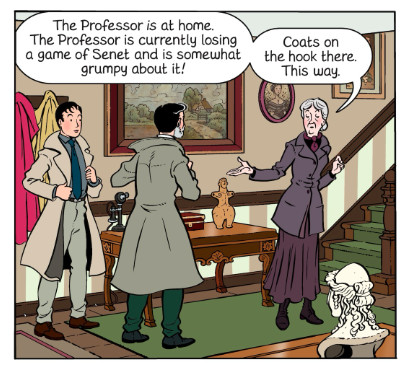
So far this year has not been productive for The Brambletye Box - it has partly been this work flow upheaval, but my schedule has also been kept off-track through some work (much-needed), some family health issues, and, yeah, some creative struggles here and there due to all of the above. But you can't regret what's been, so I'll move forward, refine the workflow more as I go, and carry on - I'm still as excited about this new Julius Chancer story as ever.


Cameron and Chromosome 13
At the end of my article Who Were Donald Cameron's Parents? I mentioned a DNA puzzle that may hold the key to Donald's ancestry where the genealogical record is missing.
The link became apparent as I started connecting a number of Cameron DNA matches on Ancestry in the 4th-cousin range (23-37 cM), who I could place as descendants of my 3xg-grandparents, Donald Cameron (c.1810-1887) and Catherine Campbell (c.1815-1889), and noted a number of mutual matches in the 17-31 cM range who I could not identify.
If this sounds like gobbledegook, let's pause for a quick explanation. Every person has DNA - the genetic code that makes you ... you! You get half from your mother and half from your father. They, in turn got half from each of their parents, meaning that your DNA is also made up of a quarter from each of your grandparents, an eighth (or thereabouts) from your great-grandparents, and so on. The further back you go, the wider the variation in those segments of DNA because inheritance amounts are not precise.
As an example, let's take a fourth cousin - that's someone who shares a set of 3xg-grandparents with you. Mathematically, that would mean you'd each share 3.125% of the 3xg-grandparent's DNA, though the reality, due to the randomness of inheritance at this distance, means it's actually anywhere from 0 to up to around 1.7%. But your 4th cousin will have their own DNA inheritance from this ancestor, which may include some of the same segments you've received, or may not. Many people are surprised to learn that you don't share DNA with everyone you're related to, and you will usually share DNA with only half of your 4th cousins, and 10-15% of your 5th cousins (remembering of course, you'll have many more 5th cousins than 4th cousins). The amount of DNA you share can also be measured in centimorgans (cM), and for a 4th cousin that would be mostly in the 20-85 cM range, averaging about 35cM (0.5%).
Back to the mystery matches ... after some research into their trees, where they had them, I found the majority were descended from one Alexander Lamont (1761-1845) and his wife Eunice Currie (1771-1859) who hailed from Kingsburgh on the Isle of Skye, a completely separate geography from my Perthshire Camerons. The Lamonts had a couple of children on Skye before they emigrated on one of Lord Selkirk's vessels, the Polly, landing at Prince Edward Island in 1803 where they had more children and lived out the rest of their lives.
As my research continued I discovered some of these Lamont/Currie descendants on other DNA platforms that, unlike Ancestry, had chromosome browsing available, where you can see a visualisation of the DNA segment match, so I was able to identify the common DNA segment as being on chromosome 13 (chr13). But how is that useful?
Not including the X and Y sex chromosomes, we each have 22 pairs of 'autosomal chromosomes', the pairs being one maternal and one paternal. In this case the matches are on my paternal chromosome 13.
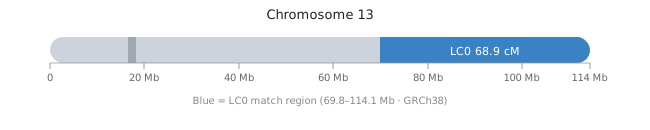
The diagram below represents the full length of my paternal chr13 and the blue area is where my paternal aunt (LC0) matches me on that chromosome - that is to say we share the same sequence of genetic markers in that segment. We're closely related, sharing 24.4% in all (though 38.7% of chr13), the expected amount for an aunt, uncle, grandparent or half-sibling.
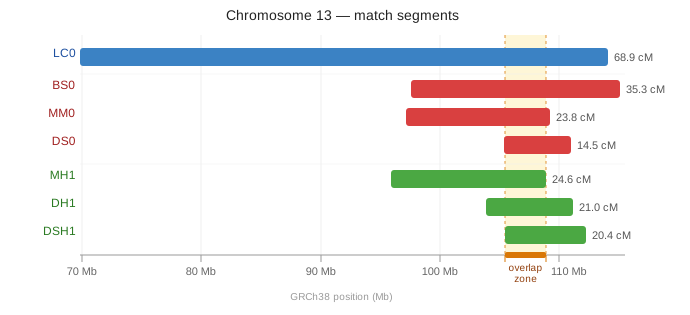
Knowing which chromosome, and where on that chromosome your DNA match coincides can tell you who they're related to. If you know how you're related to a match - in this case my aunt and fourth cousins - then anyone else who matches in that same area will share the same ancestral root. We all received the chr13 segment, in various lengths, passed down through the generations intact from the same person. In other words, we're related. The next thing to work out is how we're related.
I had hoped this would be the break-through moment - perhaps finding that one of the Lamont/Currie parents was a McDonald or a Cameron who had a niece or nephew who would turn up in the Little Dunkeld area of Perth, revealing themselves as one of Donald Cameron's parents. But instead of narrowing down the search, the more I dug, the more chr13 matches I found - currently around 75 - and the wider the pool seemed to get. To add to the pool there are also all the mutual matches on Ancestry where I don't have chromosome data, but who do share DNA and help to confirm the general genealogical picture.
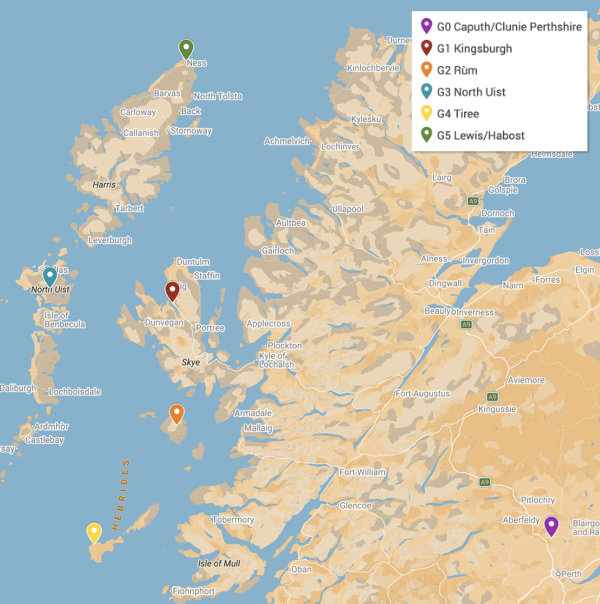
With this data other family groups emerged who have no obvious link to the Lamont/Currie families and after a few years of on-and-off research, I organised these into seven groups (G0-G6), as follows:
Group 0 (G0) - these are my known Cameron cousins, descendants of Donald Cameron (1810) & Catherine Campbell (1815) of Clunie, Perthshire. While I currently have almost 30 Cameron DNA matches, I've only been able to confirm four of them as having the chr13 segment, though there are a handful of others that are mutual matches on Ancestry with members of other groups, mostly G1. Catherine Campbell's DNA will also show up within this group, of course, but I feel fairly confident the chr13 signal comes through Donald as Catherine's ancestry points strongly to Caithness for both parents and Caithness is not a prominent presence in the matching groups - all possibilities remain open, however, so Catherine's ancestry can't be totally dismissed.
Group 1 (G1) - descendants of Alexander Lamont (1761) & Eunice Currie (1771) of Skye that emigrated to Prince Edward Island. This group has some of the strongest cM matches - as high as 31cM (in the 4th-6th cousin zone) - though any common ancestor with my line must predate Alexander and Eunice as they moved abroad well before any of their descendants had families of their own. Some in this group have subsidiary lines that lead into G5 territory. 21 matches so far, with eight confirmed as chr13.
Group 2 (G2) - three descendants (all chr13) of Norman McLean (1792) and Ann McKinnon (1792) of the Isle of Rum, victims of the 1826 clearance who ended up in Cape Breton, specifically Whycocomagh. Another line of this group (for two of the matches) leads to McDonalds of Dull, Perthshire, which feels significant, but might be a red herring.
Group 3 (G3) - descendants of Angus McLellan (1781) & Marion Monk (1795) of North Uist with descendants in both Scotland and Nova Scotia. This is a sparsely matched group (just 5, all closely related to each other, but 4 known to have the chr13 segment) and has other lines that wander into G5 territory, so the group could do with a few more matches to help confirm the right direction.
Group 4 (G4) - nine descendants (four chr13 confirmed) of Allan Cameron (1776) and Mary McLean (1762) of Tiree, Argyll, with emigrant branches ending up in the US and Canada, or staying in Scotland. The Cameron name seems very significant, but, again, could be a red herring. Allan Cameron does have a brother, John Cameron (1778) who would be the right generation to father Donald of Clunie, but so far it looks like he may have married and had family in Tiree - though that's not a solid confirmation, and needs to be kept open. There's also a strong McLean line and the Tiree families are peppered with Lamonts which might point back to G1, but, so far, not obviously so.
Group 5 (G5) - a large endogamous group with multiple common ancestors from the Isle of Lewis, particularly Barvas and Stornoway. Common names include McLean, McKenzie, Morrison, Murray, McDonald, McRitchie, McLeod and Campbell to name a few. An absolute nightmare to sort out when you have, for example, a Norman McLean marrying a Catherine Morrison whose parents were Norman Morrison and Catherine McLean, or a Donald McKenzie of Eorodale who married Margaret McKenzie of Habost, right next to a Margaret McKenzie of Eorodale who married a Donald McKenzie of Habost. Ancestry trees from this group are littered with errors and wrong turns. I've identified 21 matches so far who share various common ancestors in this group, six of whom I've been able to confirm as having the chr13 segment.
Group 6 (G6) - this is populated by any match who I've been as yet unable to home. It includes 45 confirmed chr13 matches, and a large number of Ancestry mutuals.
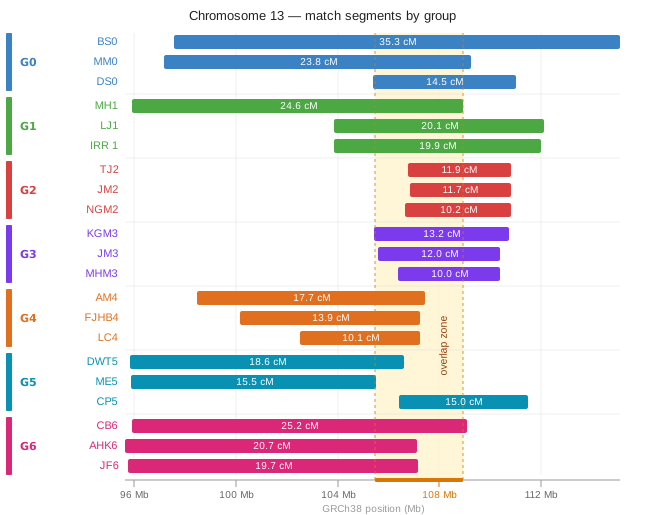
Match segments with my chromosome 13, three from each group
One of the most important things to confirm with these groups is whether or not they triangulate - in other words, not only is the same chr13 segment common to all of them, but do they also match each other at that genetic location? I validated this by creating a match matrix.
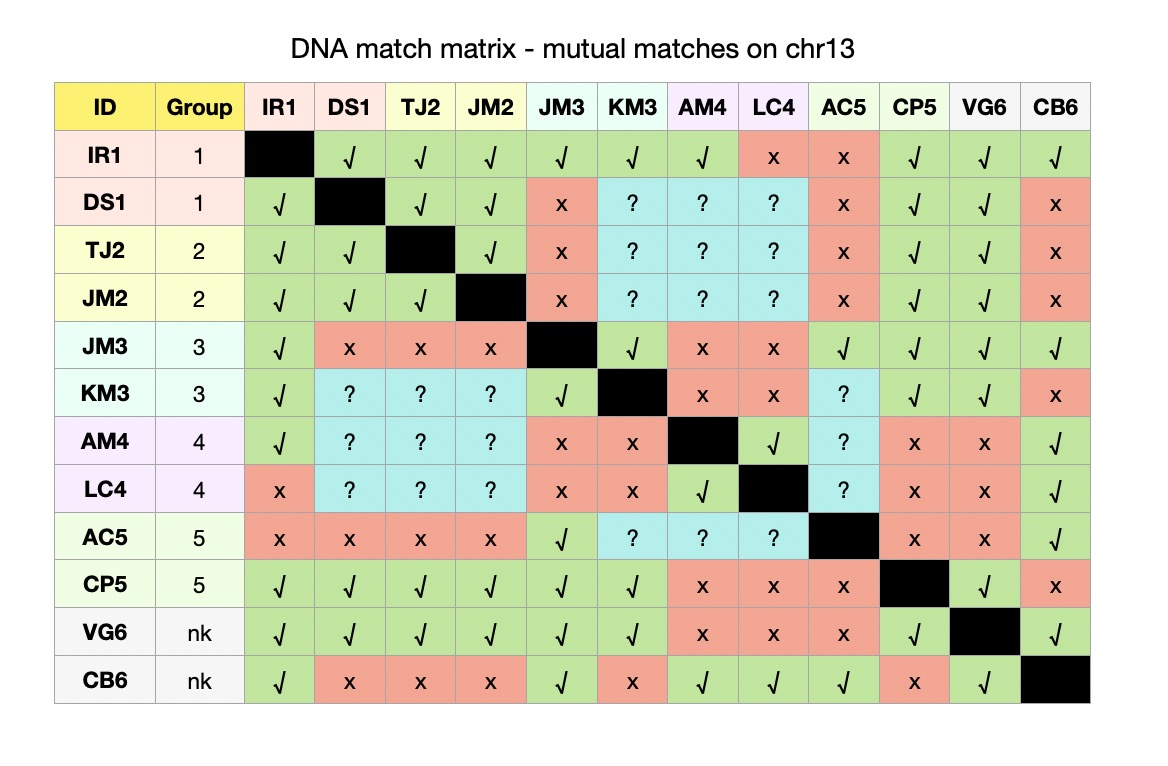 Two chr13 representatives from each group; green (tick) means they match; red (x) means they don't match; and blue (?) means I was unable to compare them due to different platforms
As you can see from the above table, representatives of each group match across all other groups, the conclusion being that, even though I have not been able to link the groups, they must all share a common ancestor, or at least an ancestral population, somewhere back in time.
But having taken many of the groups back to the mid to late 1700s no clear common ancestor has emerged. Hebridean records are very poor, even in the 1800s, and largely non-existent back into the 1700s, so it is pretty much a foregone conclusion that the originator of the chr13 segment that was passed down into all these groups, as well as into my own Cameron line, will remain unknown.
We can guess that any common ancestor to all these groups must be at least a couple of generations before the earliest we have identified, which would place them in the early 1700s, and possibly more safely into the late 1600s. At that distance we'd be looking at matches who are in the 8th or 9th cousin range with very few of them having any shared DNA at all, and only then in tiny segments. Having said that, the likelihood of perceptible DNA showing up is made more possible purely through the sheer number of 8th or 9th cousins that exist - likely in the tens-to-hundreds of thousands.
Another factor that would increase the cM count from such a distance would be endogamy, which is already very apparent in the G5 Isle of Lewis trees where many matches appear with multiple common ancestors - it's a group made up of a number of sub-groups, a well-recognised phenomenon within such a closed geographical kin network that leads to reduced genetic diversity.
In some ways it might seem as though all this research (and it has been a lot) has got us no closer to identifying Donald Cameron's parents, and, while that may be true, it has actually shone a light into a new and significant direction.
We cannot be certain of the names of Donald Cameron's parents, only that his death certificate records them as John Cameron and Ann McDonald and that the accuracy of this cannot be validated. Certainly McDonald is a strong Hebridean name, particularly connected with Skye and Uist, spreading later into Lewis. Cameron features strongly in G4, though it doesn't necessarily mean we're looking at the paternal ancestor here - it is not originally a Hebridean name - and it could just as easily be the female McLean line that passed it down.
But one thing it does tell us, and it is very useful new information, is that Donald Cameron has heritage that originates outside of Perthshire, specifically from a Hebridean ancestral population. One route to Perthshire from the islands might be through the military - especially as we know Donald married a soldier's daughter and it was not uncommon for military families to form connections. But that is just one theory to keep in mind.
As John Donne wrote, "no man is an island", and Donald Cameron did not exist in isolation. Obviously he had parents, and they very likely had siblings, some of whom must have had families. Donald may have had siblings or half-siblings himself, though we can't be sure of that. A footprint must surely lie hidden somewhere awaiting discovery.
I would very much welcome any feedback or comments from my fellow Cameron (or Lamont, Currie, or other Hebridean) researchers. Do you have matches that might appear in any of these groups, or do you have the same chromosome 13 segment appearing in your DNA mutuals?
The search for footprints continues ...
At the moment it features the treble and bass clefs, but I'd like to add the alto clef and a key quiz (ie. the sharps and flats from the circle of fifths) at some point.
You can give it a go here.

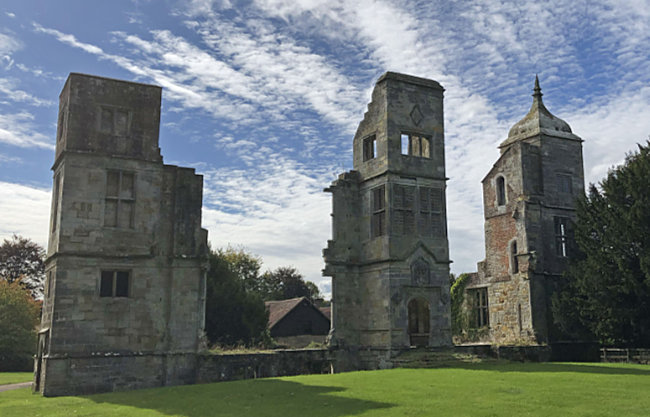
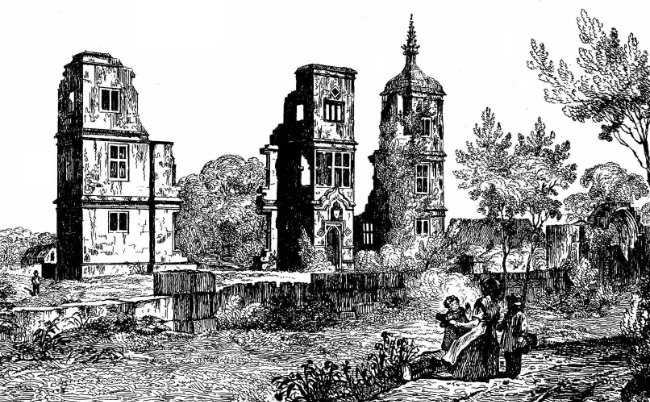
It's short and sweet so I didn't really get into the nuts and bolts of its history. We perhaps played up the mystery of its demise a little, which is all good, even though research shows when it came into the hands of the Biddulph family, in the 1670s, they focussed on their other properties and it just gradually went to ruin, with portions of it carted away for other local building projects. But the intrigue remains!
I also mention a painting of the ruin from 1782 - that's the date you see everywhere for it, but I've subsequently pinpointed it more accurately to 1773. In the wake of this interview, fresh with all my research, I wrote up my big Genealogy of Brambletye piece, where you can learn much more about its thousand-year history.
Thanks to Simon Furber for the interview on a very pleasant day and his magical editing to make it all sound good, and also to BBC journalist Fiona McCarthy for the contact request and organisation. Check out the Secret Sussex website for much more! Update: There is also a supporting article over on the BBC News website.
More progress was made on The Brambletye Box, though not nearly as much as it should have been. However, it was just not possible under the circumstances - I intend for 2026 to be way better on that front.
Work was difficult, especially as AI 'images' continue to stamp all over human creativity and spread itself to every corner, polluting the internet. Work did pick up a little more towards the end of the year, but my career definitely needs a rethink in the face of these new challenges. I have some ideas, we'll see where they lead.
The world is really taking a hammering at the moment, but we can keep doing what we love, creating, taking control of the things we can control and not letting the things we can't dictate our outlook. Acts of art, acts of kindness - the small things matter.
I wish you all a successful, healthy and happy 2026.

As previously mentioned on this blog, High and Low is probably my favourite Kurosawa film, in fact one of my favourite ever films, so I come at Spike Lee's interpretation with some biased baggage, I admit.
It's different enough to be interesting in its own right. I liked the set up of King being a record company executive rather than for a shoe company, and I liked the whole cultural shift into the area of US black music. As you might expect, the soundtrack is rather good though it dominates the film, sometimes a little too much. Denzel Washington is great to watch, as he so often is, and his performance marks a lot of the movie's high points.
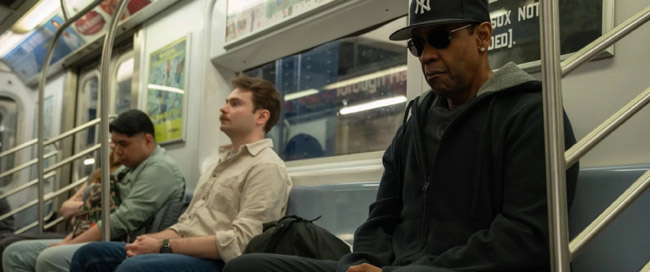
Some of the story changes didn't work so well for me. Making King and his chauffeur close buddies makes it less of a sacrifice when King finally decides to give up a large part of his fortune to save his friend's mistakenly kidnapped son. I also felt that decision came too easily - at first he's totally against it, which seems out of character for someone who appears to have such strict family values, then he relents and ... that's it, unlike Mifune who seems to carry some agony at the cost throughout much of the rest of the film.
With Kurosawa, the kidnapper's associates are explained and dealt with, but with this modern telling the associates are useful for one scene - the moped chase - and then they disappear for good. Related to this, King's dropping of the bag of money from the train is slightly ridiculous as it's dropped by accident right into the arms of one of the associates - was that the plan? And the police accompanying King on the train are very obvious - maybe they're not even trying to be undercover, but that does tone down the tension somewhat.
As for the kidnapper, Yung Felon, the motivation is interesting and I didn't mind it - in fact it's more specific than the more general hatred of Takeuchi. But that hatred seems more real in the earlier film, more visceral - the kidnapper is tortured by it. I didn't get the feeling of Felon coming from the absolute depths of society as in High and Low - he's in a relationship, he's talented, he has a nice recording studio. He didn't appear to be hiding away much after the successful kidnap.

And then it's an American film so, of course, the hero has to be the one to save the day, as King goes in himself (with his trusty chauffeur sidekick) to confront the kidnapper where, rather ludicrously, they engage in a kind of rap battle. It's true that in the original Ed McBain story, King fights the kidnapper, but he's accompanied by the police and his violence is a result of anger at them trying to steal his fortune.
Most of my criticisms are plot-related and comparing it to Kurosawa. Taken as it's own thing, it's a decent enough film with solid performances, stylistic and entertaining.
I write this as news came yesterday of the death of Tatsuya Nakadai on 8th November, at age 92. He was the Chief Detective in High and Low, but is more famous as the samurai villain in both Yojimbo and Sanjuro. Other major films include Kobayashi's The Human Condition trilogy, Kwaidan, and Harakiri, as well as Kurosawa's Kagemusha and Ran. This is just a tiny part of his film output - a real giant of Japanese cinema.

It starts with the Norman conquest and Domesday, and follows the knights, earls, lords, ladies and gentry as they experienced Agincourt, the Wars of the Roses, the Reformation, the Civil War, the Restoration, then into its ruin in the 18th century, and under the ownership of bankers and solicitors into the 19th and 20th centuries and beyond.
You can read A Genealogy of Brambletye here.
I have to say that these days I do not go looking for reviews of my work - positive or negative. Positive ones make me squirm and feel unworthy, and negative ones make me feel bad - neither is enjoyable (though I am very grateful for the positive ones).
The book looks really interesting, despite the fact I'm a little wary of the overanalysing of an author's works. But the intersection of clear line comics, a highly narrative form of storytelling, and parallel philosophies in film is quite fascinating (and one of the directors Barros looks at is Yasujiro Ozu, a favourite of mine).
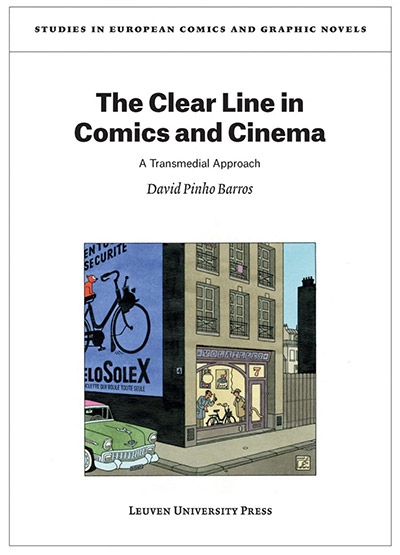
cover for The Clear Line in Comics and Cinema, art by Joost Swarte
I am jumping the gun, I have not read it yet, though I do intend to. But I did screw up my courage and skim-read the section on The Rainbow Orchid, and here I saw a statement that I want to address as I do feel it misrepresents my motivations.
Firstly I should say I'm a great believer in the idea that once you've finished a work and it goes out into the world, it is no longer your possession. It belongs to whoever picks it up and reads it, and they can bring all their thoughts, beliefs, prejudices, biases and feelings to that work and interpret it however they want. They may not align with the author's, and they may read things into the story the author never intended or meant, and that has to be the way it is.
In chapter 3, 'The clear line after Tintin et les Picaros', Barros says: "I propose to look at two [authors] in particular: the French Olivier Marin and the British Garen Ewing. In both cases, their use of the clear line is mostly a consequence of a selling strategy, which, by proclaiming a graphic affiliation with the classic series, aims at attracting the nostalgic reader and, simultaneously, surprising him or her with contemporary representations of topics which were proscribed in the youth magazines of the likes of Tintin, such as highly eroticised renderings of the female body."
That last bit about the "female body" refers to Olivier's work more than mine, but I'm a little perturbed that isn't clear, especially as I made the decision not to sexualise any aspect of the characters or story in that book. And that idea is connected to the main point - that The Rainbow Orchid uses the clear line style as a 'selling strategy'.
This could not be further from the reality of the comic's origins. Back in the 1990s I was looking more seriously at working in comics. I had done a lot of fanzine work and felt my art was improving so I was getting a portfolio together and going to comics shows and meeting professional artists and editors.
Thanks to this I went through a process of realisation - I didn't think I actually wanted to get into professional comics after all. While I had enjoyed working with various writers, I knew the main thing I liked doing was creating and writing stories, and being the illustrator for someone else's vision did not fulfil that aspiration. And this wasn't a reaction to a lack of success, in fact it came about when I started to have some succes - having work accepted for Heartbreak Hotel, doing a full US superhero comic for Blue Comet Press, and particularly after having an enthusiastic response at a convention with a DC editor and an invitation to contact them for work on a new black and white imprint they were starting.
I never followed up on that last one because I was coming to the realisation that this was not what I wanted. I found drawing hard, I wasn't naturally talented and I wasn't fast (essential for comics) - but I did enjoy it, and I really loved the comics medium. After some soul-searching I decided to concentrate on a career as an illustrator and leave the comics as a spare-time pursuit, something I could just enjoy for my own gratification.
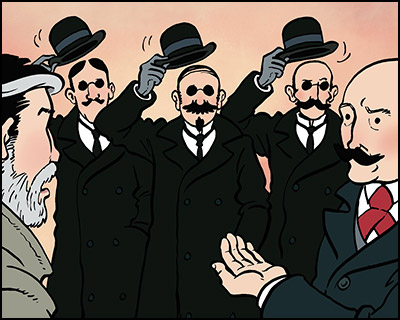
Mr Tardy, Mr Tardy and Mr Tardy, The Brambletye Box by Garen Ewing
What did I enjoy? Big fat escapist adventure stories! Also I wanted an antidote to all the gritty 'adult' comics that were everywhere at the time. My art was naturally cleaning up, particularly after adapting The Tempest I was appreciating simplicity, reduction and clarity. I'd had my first paying job, for a newspaper, and was able to complete my collection of Tintin books - the staple (along with Asterix) of my comic-reading childhood. More importantly I had just discovered Blake and Mortimer, and had bought my first Jacques Tardi book.
So, I'd decided. I would not work towards a career in mainstream comics but instead concentrate on working as a commercial illustrator, the comics would be purely for my own enjoyment, self-published for whatever small readership would gather in front of me.
Things changed when the internet arrived. I got on it in about 1998 and started putting The Rainbow Orchid up as part of my website in about 2005. Without much publicity (I was still treating it as a hobby) it started to gain traction anyway and largely thanks to some much larger web-comics coming across it and linking to it, the readership escalated.
It's another story, but this kind of exposure lead to an agent and eventual mainstream book publication and, of course, vast wealth (yeah, joking on that last one). I chased none of these things, they came to me, though I was very happy about it, of course.
That's an overly-long ramble to the statement that my use of the clear-line is the "consequence of a selling strategy". I do resent that idea, and it's explicitly because that makes it seem like the decision was rather a calculating scheme to elicit sales in the marketplace - the opposite of what actually happened.
I don't want to have a go at David Pinho Barros for his remark. Although I have talked about the origin of The Rainbow Orchid I can't expect him to seek out everything I've ever said. He does quote the following I wrote for my website many years ago (still there in my faq) ...
"I wanted to invoke the atmosphere I loved from European adventure albums such as Hergé's Tintin, Edgar P. Jacobs' Blake & Mortimer, Yves Chaland's Freddy Lombard, and Tardi's Adèle Blanc-Sec, to name just a few. Most British readers cite Tintin because not many other ligne claire comics have made it over from France and Belgium, but it is an entire school of comic strip storytelling with many creators working in the style, just like manga often has a certain look to it. The Rainbow Orchid has been compared stylistically to Floc'h's Trilogie Anglaise or Jacobs' La Marque Jaune. The better you know Tintin, the more apparent the differences, but I don't refute the similarities - it was a conscious decision."
... and I can certainly see how a 'conscious decision' to invoke the style of Hergé and Jacobs might be seen as a commercial choice, though actually it was merely one born out of enthusiasm for exploring the form for myself. I guess that's the bit missing - I wanted to invoke that atmosphere for myself.
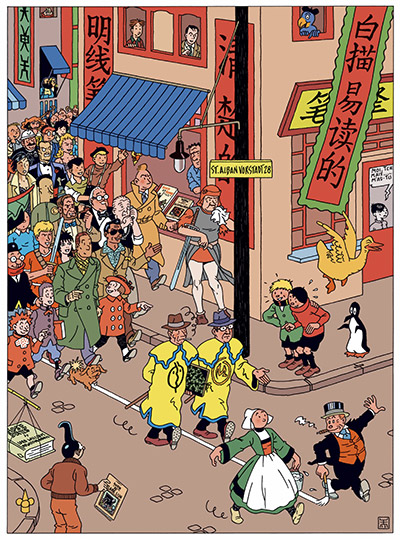
Art by Exem for the Cartoonmuseum Basel
There's nothing wrong with making an artistic decision in order to maximise revenue, but it does have the feeling of an accusation, and offers the idea that money, not art, is the driving force, something that is generally frowned upon. And not that I'm against making monery off my art - far from it - and I strongly dislike the conceit that 'true art' can only go hand-in-hand with poverty.
Since having the book out, and even being lucky enough to have it appear translated in the Franco-Belgian world that inspired it, I have seen the more commercial side of the ligne claire. It certainly has an aspect of marketability in Europe. In the UK my largest audience was children (although not explicitly a children's book), whereas in France, the Netherlands and Germany, the largest audience I saw was people like myself, older, mostly male, and nostalgist collectors (not exclusively, and also not a problem by any means!).
This is partially due to the publishers, smaller, boutique publishers who cater to that audience with reprints and classic series. With a much bigger publisher in the UK (Egmont) the readership was hugely varied, children, teens, adults, quite strong in both male and female readership.
I actually suspect the style I've chosen to work in has been a hindrance in my own country, as so many people are familiar with Tintin, and nothing else, that I can appear merely as a copycat or fan-artist. While I was making Orchid I purposefully didn't look at a Tintin book - for years - wanting to develop my own ligne claire style. Of course it's always going to be compared to Tintin, and fair enough.
Now I have returned to the point I was at twenty years ago - a new Julius Chancer book and I'm doing it for myself. I haven't signed with a publisher and don't strongly mind whether I do or not - it would be preferable, of course, but I'm happily prepared to self-publish. I'm more aware of the 'clear-line scene' now, and certainly I've changed since The Rainbow Orchid, the comics scene has vastly changed, so my comics have changed.
Anyway, that answers the point I wanted to address about my book's motivations! Whether it's a wise thing to do I'm not certain, but, especially as I get older, I see my creativity as part of my identity, and feel the record should be corrected, even if just here on my blog.
I hope I haven't misinterpreted Barros's writing, and I do look forward to reading his book, which looks fascinating. I'm enormously flattered he even chose The Rainbow Orchid for inclusion, it's a privilege to be part of it whether praise or criticism. You can download the book yourself from here.
The Brambletye Box had a bit of a pause over the summer due to all kinds of things, a bit of everything in fact - illness, family stuff, work, holidays - all those ingredients of life! Some new art did go up on my Patreon page a couple of days ago, so that's the place to see anything new at the moment.

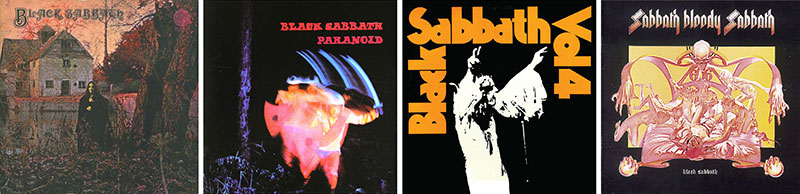
Discovering Led Zeppelin directed me to other bands, musical brethren and cousins, with Sabbath inevitably being one of those. Paranoid was my first of their albums, probably still my favourite, though I think Vol. 4 is another of their best alongside their 1970 debut, Black Sabbath.
When I started to learn bass guitar, Paranoid was the first song I worked out and learned on the instrument, going on to then learn NIB and Snowblind. We didn't do any Sabbath songs in my first group as some close friends of ours were in a Sabbath covers band, and we didn't want to stray into their territory, though I did return to Paranoid for a much later band. I also recall learning Symptom of the Universe for a pub jam night where I had to detune my bass by a whole tone so the vocalist could comfortably sing it - my E-string was like a rubber band it was so loose!
Obviously Ozzy was a massive part of the Sabbath sound, and they weren't the same when Ronnie Dio came in (as decent as his albums were), and it was more Geezer Butler and Tony Iommi who I really admired. I did have two Ozzy solo albums (1980s Blizzard of Oz, actually bought because I was interested in Lee Kerslake and Bob Daisley's contribution, both members of Uriah Heep, and 1987's Tribute), but neither got a lot of play, I must admit.
Parts of Ozzy's character were very problematic, but it's sad to see anyone decline, as he has, in recent years. How nice he had such a good send-off at the Back to the Beginning concert just a few weeks ago. I'll definitely be getting some of those early Sabbath records out for a spin over the coming days (and I've also been greatly enjoying Brown Sabbath and their cover versions in recent months).