

This blog began in 1997 as a single news page called Nucelus. In 2005, during a long wait to move into a new house, I decided to learn some php and MySQL and write my own blogging system, which became inkyBlog and which now powers this, my own Webbledegook blog.
Thank you to my brother, Murray Ewing, for help with some of the more challenging aspects!

HMS Invincible - 31 May 1916 age 32
EWING, Alexander
14th Bttn. Black Watch - 4 Dec 1917 age 21
EWING, James
3rd Bttn. Seaforth Highlanders - 2 Mar 1917 age 32
HOLLAND, Henry
5th Leicestershire Rgt. - 29 Aug 1918 age 32
PHILLIP, William
8th Bttn. Black Watch - 19 Jul 1918 age 23
PHILLIP, Alexander
205th Field Company Royal Engineers - 17 Dec 1917
SHERRIFF, Thomas
2nd Bttn. Lancashire Fusiliers - 1 Jul 1916 age 24
STEWART, Henry Walter Betsworth
5th Bttn. Highland Light Infantry - 14 Jul 1915 age 20
STEWART, Andrew Phillip, MC
9th King's Own Scottish Borderers - 2 Jun 1918 age 21
You can see a page dedicated on my website here, with Commonwealth War Graves Commission links for each name [update 2018: it currently contains 31 names]. Not all of these men have been fully researched yet, but one of the latest I have learned about is the last on that alphabetical list, Andrew Phillip Stewart, who was the second eldest son of my gg-aunt Betsy. He is also the only relative I know of (so far) who won a gallantry award, the Military Cross.
Andrew was born in Glasgow in June 1896 to Samuel Stewart (a gymnastics instructor and teacher) and Betsy Phillip (who had worked in her father's home-run market garden store before getting married). When the war came he was already a Private in the 5th Scottish Rifles, and after joining the Expeditionary Force worked his way up to Lieutenant in the 9th King's Own Scottish Borderers. As far as his MC goes, I have found the citation in a supplement to the London Gazette from July 1918, but as yet have no real context (or date) for the action...*
"For conspicuous gallantry and devotion to duty in a difficult rearguard action, when his tactical handling of men caused the enemy to suffer heavy casualties and enabled his own men to withdraw with a minimum of loss. He was wounded just as the last remnant of his command had reached safety."
*Edit: I have since discovered this event took place at Combles on 24 March 1918 and the MC was awarded posthumously.
Andrew was invalided home, and after his recovery he made his way to Ireland where he accidentally drowned while bathing in Loch Corrib on 2nd June 1918. He is buried in the Western Necropolis of Glasgow Cemetery. There is a great photograph of Andrew that I came across in my late great-auntie Jean's photo album, which I saw for the first time a few months ago, showing him wearing one of the emergency issue winter goat-skin coats (also known as 'woolly bears') that were first issued in the winter of 1914-15. His cap badge shows this was taken when he was with the Scottish Rifles.
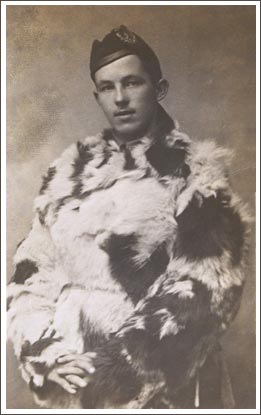
Through researching Andrew, I discovered that his elder brother, Henry (known as Harry) also died in the war, being killed at Gallipoli, while serving with the 5th Battalion Highland Light Infantry, on 14 July 1915.
This is my fifth annual Remembrance Sunday post, you can see the previous years' entries from 2007, 2006, 2005 and 2004.