

This blog began in 1997 as a single news page called Nucelus. In 2005, during a long wait to move into a new house, I decided to learn some php and MySQL and write my own blogging system, which became inkyBlog and which now powers this, my own Webbledegook blog.
Thank you to my brother, Murray Ewing, for help with some of the more challenging aspects!
As you may have read in my previous post, I recently received the results of a DNA test, so my mitochondrial DNA (mtDNA) has now had its haplogroup identified, the relatively rare J1b1 (subclade J1b1a1b) - or if you want to be a bit more romantic about it, the daughters of 'Jasmine'. This reignited my interest in looking at my maternal line to see if I could get back any further than Susanna - maiden name unknown and a 'brick wall' in my research. I think I have, but it's a puzzle, so I'm going to use this article to set out the facts, sort out my thoughts, and show a bit of process along the way.
Susanna's daughter, my three-times great grandmother, was Mary Harrison, born in 1813 in Radmore Lane, Gnosall, Staffordshire. In 1831 she married John Ecclestone in near-by Norbury and they had 13 children over the next twenty years or so. Mary's parents, according to her baptism record, were Joseph and Susanna Harrison (sometimes recorded as Harris) and, while I found six children for them, I could not find their marriage, and therefore had no idea of Susanna's family name.

Part of Radmore Lane, 1880.
Often a clue to the parent's antecedents can be found in their children's names, which in the case of Jospeh and Susanna were Benjamin, Joseph, Gregory, Samuel, Mary and Thomas - all born in Gnosall between 1799 and 1815. Presuming Benjamin was indeed the first child, I'd likely be looking for a marriage in the years closely preceding his birth, so perhaps 1797 or 1798, and probably in the local area - the main parishes being Gnosall, Norbury and Forton. Of course none of this is definite - Joseph and Susanna could have migrated into the area from Cornwall, had a previous six children - records now lost, and changed their names to escape a forbidding father-in-law. Going from experience, that would be an extreme rarity - the vast majority of my ancestors in that period married and had children in the same local area their parents came from.
Searching for a Staffordshire marriage with the names of Joseph Harris/on and Susanna within a fairly wide timeframe turned up only one result - Joseph Harrison, a shoemaker, marrying a widow, Susanna Hall, in Stafford in December 1819. Although it's perfectly conceivable they could have had all their children in Gnosall and then moved the seven miles to Stafford to marry, a search for children for this couple turned up five, all born in Stafford, starting with a Benjamin in 1820 - baptised three months after the marriage.

St Lawrence's Church, Gnosall, where Joseph and Susanna's children were baptised.
One thing to be wary of when searching old records is that you're relying on searching an index that has been transcribed from original documents by people who may have had trouble reading the unfamiliar and variable handwriting of the 17/1800s. This has led to one of my ancestors recorded as Thinford when the original document reads Winifred, the family of Morrisroe being transcribed as Morrison, Mudie as Micdie, Balle as Bailie, and the Youngs as the Trurys, to name a handful. There are mistakes in original documents as well of course - it took me years to find my Higson family in the 1841 census until I searched without the family name and concentrated on the fairly unique grouping of their first names and ages to discover them recorded as Jackson.
To tackle this you can search with more open terms. While many genealogy sites have algorithms that will return known variants (eg. a search for Ann will also return Anne, Annie, Nancy or Hannah) you can also use wildcards, for instance using H*k*n* for Hodgkins to account for archaic and alternative spellings such as Hoskins, Hodgkinson and Hodkins, etc.
Dropping the surname and searching within the expected timeframe for a Jos* marrying a Sus*an* in Staffordshire returns 100 results, rather a lot to examine in detail, but manageable enough to see if anything in the list stands out, for instance an obviously mistranscribed surname or something in the expected locality. While there were a couple within the wider local area (eg. Joseph Howl marrying Susannah Clever in Eccleshall in 1796), there was one in the exact area I'm interested in - Joseph Addison marrying Susannah Rodes at Forton in 1798.
It's not inconceivable that Addison could be a mistranscription of Harrison, so I needed to see an image of the original document, but that did not turn up with the results, just the text transcription from the more general 'England Marriages 1538-1973' database. But I know there is excellent coverage of Staffordshire images at findmypast, and opening the search more widely revealed the Banns record for 'Joseph Addisson' and 'Shusanah Roden' at All Saints Church, Forton. Looking at the image reveals one dashed hope and one raised hope: there's no doubt the name is written as 'Addison', not Harrison ... but one of the witnesses is a Benjamin Harrison - enough to intrigue and warrant further investigation.

The 1798 Banns and Marriage of Joseph Addison and Susannah Rodes.
Immediately a number of questions are thrown up which point the way to further research. If these are my ancestors, why would an Addison become a Harrison and name his children Harrison? Was he adopted by Harrisons? Was there a debt of gratitude owed to the Harrison family? Did Joseph Addison want to leave his past behind? Was Susanna Rhodes related to influential Harrisons?
A search for other Staffordshire Harrison/Addison relationships turned up nothing (a single marriage in 1873). But then a surprising result - I searched my own family file for any mentions I'd recorded of the name Addison and found that my ggg-grandmother, Mary Harrison (Joseph and Susanna's daughter), had her Will proved in 1890 by her son, Henry, and one Samuel Thomas Addison. The trail just got a little warmer.
There were now four families to research and see if any link would emerge: those of Joseph Addison, Samuel Thomas Addison, Susanna Rhodes, and Benjamin Harrison. I did have burial dates and ages for Joseph and Susanna Harrison (under the name Harris, residents of Sutton), showing - if accurate - that my Joseph was likely born around 1768, and his wife was likely born around 1782.
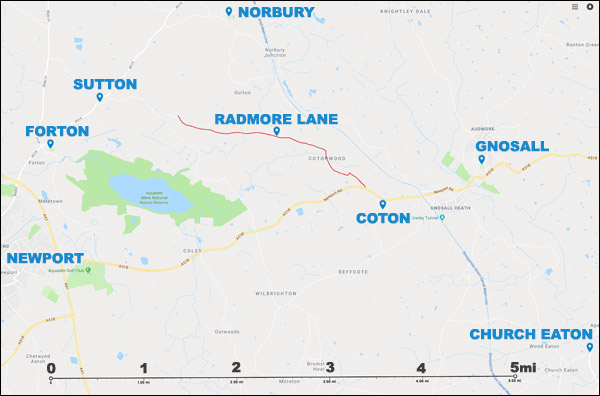
The local area showing places related to the families of Harrison and Rhodes.
No obvious birth for Joseph Addison could be found - one in London, one in Norfolk, one in Cumberland and one in Westmorland - not impossible candidates, but unlikely. Next I tried searches for a Joseph Harrison born in the same period in Staffordshire - returning 18 possibilities with one who stood out, born in 1767 to a Gregory and Sarah Harrison in Church Eaton. Church Eaton is just a couple of miles from Gnosall, and my Joseph and Susanna named their third son Gregory - a relatively rare name for the period (between 1780 and 1820, in Staffordshire, just over 2000 boys were named Gregory, compared to roughly 580,000 Johns, 460,000 Thomases, 280,000 Josephs, 172,000 Samuels, and 75,000 Benjamins). Not much else stood out with the Church Eaton Harrisons - I could identify six children in all, but no other names chimed any bells - no Benjamin, for instance.
As for Samuel Thomas Addison, he was a farmer* who lived in the close neighbourhood of Mary and her Ecclestone family. I'd already established there was no local Joseph Addison in the records, but Samuel's family did hail from Gnosall and, it seems, Eccleshall before that. His father was George and his grandfather was Samuel Addison - Joseph and Susanna Harrison named their fourth son Samuel, so that is another point of interest, though it's not as unusual as Gregory.
Looking at Susanna Rhodes, a few more lights go on. Firstly she was born in 1782 which fits perfectly with Susanna Harris's age at death. Her parents were Samuel Rhodes and Mary Bellingham - both first names that were also used for Harrison children. A more detailed examination of her siblings is where things start to get a little more interesting. The Rhodes children were all born in Norbury and married in the local communities of Norbury, Gnosall and Forton. Susanna's immediate older sister was called Frances, and in 1797 Frances Rhodes married one Benjamin Harrison, so this explains his presence as a witness on the Addison/Rhodes marriage - he was Susanna's brother-in-law. Frances died in 1816 at just 39 years old, and it's interesting that three of the Joseph/Susanna Harrison children (Benjamin, Gregory and Mary) all named daughters Frances (aka Fanny).

Baptism entries for sisters Frances Rhodes (1777) and Susannah Rhodes (1782), St Peter's, Norbury.
Of the four other Rhodes siblings, all had their children baptised in Gnosall or Forton, but if you look more closely at the original records - all those born after 1812 (which, thanks to the Rose Act, recorded more detail), whether Gnosall or Forton, show Radmore Lane as the parents' residence. They had children in the same place and during the same timeframe as Joseph and Susanna Harrison. The youngest brother, Edward Rhodes, even named one of his children Joseph, born nine months after the death of Joseph Harrison (though that may have been his father-in-law's name too).
This could all be coincidence! But there are a couple more interesting pieces to place. At first I was not able to positively identify a birth or baptism for the Addison/Rhodes marriage witness, Benjamin Harrison. However, though his first wife died in 1816, he seems to have remarried the following year and can be found on both the 1841 and 1851 census still living at Coton. The 1851 census gives his birth place as Church Eaton - and that takes us back to Gregory and Sarah Harrison who had a son, Joseph Harrison in 1767, and who are, in fact, the only Harrison family having children in Church Eaton between 1740 and 1780. Opening up the search a bit I eventually found Benjamin - transcribed as Benjamin Hornson, but a closer look at the original image reveals it is in fact Benjamin Harrison, son of Greg and Sarah and baptised in April 1765. And for that extra little push, three of the Joseph/Susanna children (Benjamin, Gregory and Thomas) all named daughters Sarah.

Baptism entries for brothers Benjamin Harrison (1765) and Joseph Harrison (1767), St Editha's, Church Eaton.
Before the conclusion, let's just add in one more little fact. Joseph Addison and Susanna Rhodes published their first marriage banns on October 14th 1798. Eight months later saw the baptism of my four-times great uncle, Benjamin Harrison, first recorded child of Joseph and Susanna Harrison.
My conclusion from all this is that the marriage of Joseph Addison and Susannah Rhodes in 1798 is indeed the marriage of my gggg-grandparents, Joseph and Susanna Harrison. As every good genealogist should, I tried to disprove my theory but couldn't conclusively do that - I can say there were no children born to a Joseph and Susanna Addison (at least not until a couple with the same names had children in the 1840s and 50s in Norfolk) and there are no matching local burials that fit either.
The fact that the married Rhodes children largely lived together in Radmore Lane or very close by, the family names of Gregory, Mary, Samuel, Frances and Sarah, the matching birth years for Joseph and Susannah with their Harrison and Rhodes counterparts, and the Church Eaton connection, with two Harrison brothers (Joseph and Benjamin) marrying two Rhodes sisters (Susanna and Frances) - all little things that, together, hold a fair bit of weight.

Rhodes and Harrison baptism entries (1813 and 1814) showing place of residence as Radmore Lane.
In the light of all that, I now believe the name Samuel Thomas Addison on Mary Harrison's Will is a coincidence. In which case, the question remains - why the Addison name on the marriage? I do have a theory, though it's not a strong one ... if you look at the original document image above you see the Banns is written in a different hand to the entry for the marriage below it. The Banns handwriting is less confident and more scrawling than the marriage entry - indeed Susanna's name is written 'Shusanah Rodse'. Perhaps the Banns was written in by the church warden, whereas the curate (Rev. Richard Wingfield) recorded the actual marriage, copying the warden's interpretation of Addison, but correctly reproducing the witness's surname at the time of the ceremony. That's just a theory, I don't know. Perhaps Joseph had a really bad cold on the day of the Banns!
There will always be a part of me that would like something more substantial than all these little jigsaw pieces, because it doesn't add up to a complete picture (but does genealogy ever do that?), and I will continue to try and verify this hypothesis. DNA may help - either in finding Harrison, Wenlock, Rhodes** or Bellingham connections through autosomal results, or through a less likely encounter with a mtDNA match from the maternal line. But, overall, I feel fairly confident that I can now take my mtDNA line a bit further back with a couple more Ms to add in ...
Margaret > May > Minnie > Mira > Mary > Susanna > Mary > Mary ... and my new brick wall: Frances.
Update: * It turns out that Samuel Thomas Addison was a local worthy, and Mary Harrison/Ecclestone was probably a tenant on one of his farms - which could explain his presence on the Will. ** I have since found DNA matches with the Harrison/Rhodes family and further back with the Wenlock line, plus I eventually found the Will of Samuel Rhodes in which he names his daughters, Susanna and Frances Harris.


Recently my curiosity got the better of me and I've had my results almost two months now. Since then I've been on a steep but fascinating learning curve. I've used my raw data with a number of third-party tools and databases and I'm beginning to see some interesting stuff.
A number of companies now offer various DNA testing services and their databases are expanding enormously, week by week. Many folk are not necessarily interested in genealogy, but rather in the so-called 'ethnicity results' - a pretty inexact science that offers to tell you what percentage you are in relation to various geographical locations. While the results of these should be taken with a large pinch of salt, they can be interesting and used as a rough guide.
I have a number of results from my own data being uploaded to various testing sites, so let's have a look ... Here's Ancestry's ethnicity estimate for me: Great Britain 39%, Ireland/Scotland/Wales 33%, Europe West 16%, Scandinavia 6% and Iberian Peninsula 4%. You can dig down into these results and see that my Great Britain percentage is largely from the West Midlands and Yorkshire Pennines, and the Ireland/Scotland/Wales result is largely Northeast and Central Scotland. The Europe West area includes France, Belgium, Germany and Switzerland, among others, but also takes in a chunk of South-East England.

Ancestry's 'ethnicity estimate'
FamilyTreeDNA gives my overall origins at 100% European, breaking it up into 81% British Isles and 19% West and Central Europe - not far off the Ancestry results. DNALand assigns me 100% West Eurasian, of which 91% is Northwest European, 8% is Southwestern European, and 1.1% is 'ambiguous'.
One of the more interesting is LivingDNA who have a very good UK reference set to draw from. They put me at 100% Great Britain and Ireland and break that down as 59.8% Central England, 22.6% Aberdeenshire (this is a wide area, not just the county), 8.4% Southeast England, and then tiny amounts (<3%) from other UK areas.
One thing I was curious about before I decided to do the DNA test was whether any Asian, particularly Northwest Indian, would show up. The reason for this is that I have a rather strong branch of Romani Gypsies in my ancestry (whose ethnic origin goes back to this part of the world about 1500 years ago). However, while waiting for the results I did some reading and realised anything here probably wouldn't show up - the 22 pairs of autosomes that are analysed will have gone through so much recombination that not much can be detected from more than a few generations back.
So how accurate are the above ethnicity results? Luckily I have a good amount of research behind me so I decided to do my own 'ethnicity test' based on the genealogical record, rather than the genetic one.
To discern my genetic make-up I went back five generations to my sixty-four gggg-grandparents and looked at their birth counties. To start with the big picture, I'm 51.56% English and 48.44% Scottish. This reflects the fact that while my mother's ancestry is all English (back to the 1700s), my father's side is all Scottish - with the exception of one Englishman who got very briefly involved back in 1826.
Taking a regional view, that Scots 48.44% is all Mid Scotland - originating in the Tay and Forth areas of Perthshire, Angus and Fife. The English side contains 35.94% from the Midlands, 12.5% from the North West, and 1.56% each from East Anglia and Mid-North. You can see the breakdown at county level in the pie chart below, with Fife and Staffordshire taking the biggest slices.

My own 'ethnicity estimate' using genealogy rather than genetics
So the commercial ethnicity estimates are not quite correct at a detailed level, but they're not far off in broad strokes. Ancestry gives me roughly half each on Scotland and England, and the European mainland parts have to be taken as noise (my one French-born ancestor, around the time of Waterloo, had Scottish parents). The same goes for the others, though LivingDNA underestimated my Scots make-up by a fair chunk. One thing's for certain - I am unexotically very British.
Using the autosomal part of the DNA test for genealogy has already proved fruitful. With millions of people in the databases, your results can be compared and close and distant connections flagged up. With this I've been able to confirm a lot of my genealogical research genetically - which is a relief, especially for some of the more complicated relationships I've had to untangle (Gypsy ancestors, I'm looking at you!). I've even been using DNAPainter to start recording which bits of which chromosomes came from which ancestors (eg. a 24cM chunk of my maternal chromosome-14 from the Pritchards).
One match, rather astonishingly, suggested a DNA link with a known 8xg-grandparent, going back about 350 years - my match and I would be 9th cousins. I thought this would be well beyond the reach of autosomal DNA - and it might be, it's possible we could have a closer link on a separate, unrecorded branch of the family. But I read up on it, and it is also a fairly reasonable possibility.
While any chunks of DNA passed down from that long ago would be vanishingly small, it is also true that ancestors that far back will - if their lines survived into modern times - have thousands and thousands of descendants. So the chances of any one person having recognisable DNA from that long ago are tiny, but the huge number of possible carriers makes it likely it has survived intact somewhere (see Genetic Genealogy and the Single Segment).
It's still early days for my analysis of all these matches, and while I have yet to break down any of my personal research 'brick walls', a number of tantalising clues have been thrown up in a few places (the Worrilows from the little village of Haughton in the 1600s are definitely trying to get my attention!).

DNA seems to suggest a connection with the Worrilow family in Haughton - where my Lees come from. This 1625 parish record of a marriage between John Leighs and Jane Warrilow may be the connection.
Apart from our 22 autosomes, we also have either an X and Y chromosome (if we're male) or two X chromosomes (if we're female). And we have mitochondrial DNA - this comes only from our mother, while the Y comes only from our father. Analysis of these can tell us about the paternal edge of our family tree (which usually also includes our surname back into history), and the maternal edge of our ancestry - our mother's mother's mother's mother, etc.
Y-DNA can give you your male line haplogroup - for me it's R-L21 with a subclade of R-S3058. The R haplogroup is extremely common and has its origins in Central Asia, possibly around 27,000 years ago. About 18,000 years ago haplogroup R1b formed, mutating and moving into Europe. Another 'ancestor' of my haplogroup is R-M269, the most common Y-DNA lineage among European males. R-L21 is several steps below this, a signature of a Bronze Age people, the 'Atlantic Celts', and common today in the populations of Ireland, Scotland and Wales. Coming further down the line, my subclade of R-S3508 (also romantically known as R1b1a2a1a2c1g4) is approximately 3,800 years old.
I was actually able to analyse a little bit further and get an estimated sub-subclade of R-S190, a haplogroup whose members would share a common ancestor about 1,850 years ago and is a marker for a group known as the 'Little Scottish Cluster'. My earliest known Y-DNA ancestor is one James Ewan/Ewing, born around 1765, probably in Perthshire, so it's all pointing in generally the right direction. (Update: new test results from 23andMe have confirmed R-S190 as my haplogroup; update II: further testing has put me in the R-Z17999 subclade, well within the Little Scottish Cluster.)

Migration of my mtDNA haplogroups (female) and Y-DNA haplogroups (male)
My mitochondrial DNA (mtDNA) comes to me from a woman named Susanna - I don't yet know her surname (update: it's Rhodes), but she was probably born in Staffordshire circa 1780. I can say something about her maternal ancestors though, as they gave me my mtDNA haplogroup: J1b1 (subclade J1b1a1b).
J1b1 is most common in Britain and Ireland but is still quite a rare haplogroup, being found among only 1.2% of the English population. If you've ever read Brian Sykes' 'The Seven Daughters of Eve', the imagined matriarch of this group is known as Jasmine. She probably lived somewhere along the Euphrates in what is now Syria about 45,000 years ago, and is thought to be among the early adopters of agriculture. The subclade J1b1a1b is probably just over 4,000 years old.
Learning about DNA and analysing my genetic fingerprint has been fascinating in these early weeks of having the results, and I'm sure there's a lot more to come from it yet.

Kurosawa is my favourite director and this is the second of his films that Murray and I have looked at, the first being part of the Adventure Films Podcast series, The Hidden Fortress.
He can whip what he likes"
- 'You've Got to Pick-a-Pocket or Two' from Oliver! by Lionel Bart
A couple of weeks ago the local theatre 'What's On' guide popped through my letterbox. I flicked through it and immediately came across a very familiar image ... the Oliver! logo I designed back in 1998 for a local production of the famous musical, now being used to advertise a brand new 2018 production by a completely different company. Only, it wasn't quite what I originally designed, it was a crude copy - though this too has become just as familiar to me thanks to its use by a large number of amateur theatre groups over the past few years.

Top row, left: the original Oliver! logo; right: the latest copyright infringement; bottom row: four of the templates I license for my design
The copy is pretty horrible - at some point, possibly around twelve years ago, someone saw my version online, small and low-res, and decided they needed to make their own print-res copy, obliterating much of the detail in the process (perhaps by tracing the low-res file into a vector format). This version got whisked up the Google Image rankings higher than my original, and it has been found and used and re-used, and sometimes re-copied or edited with even less detail, by countless others. I can't help but think, what does it say about the quality of your show if you're happy to use such badly rendered graphics to promote it?

Four deformed copies of my original artwork, top-right is the most often-used, possibly dating from 2006

Comparison detail of my original (left) and the most often-used copy (right). License my original!
But the first time I came across an unlicensed use of my Oliver silhouette it was a fully detailed copy of my original artwork. Once I started looking I found others, both good and bad copies, in shows from the smallest school production right up to professional youth theatre shows and displayed inside and outside big city venues.

My artwork used illegally outside Manchester's Palace Theatre (left) and the Smithtown Centre for Performing Arts in New York State (right)
That's what led me to start up my Logos For Shows website - licensing my theatre images to fit the budgets of amateur companies and schools, not so much with the intention to make money, but to protect and assert my copyright and moral rights, and to promote the idea of copyright and legal use of artwork (and sure, the pocket money helps a bit too).

Some examples of licensed use of my artwork for the promotion of Oliver!
Part of this process included writing to some of the copyright infringers and informing them of their transgression - a task I have never relished and in which I have always been as polite and understanding as possible. Almost without exception the theatre companies have written back saying they had no idea they were breaching copyright and that they just handed the art task to their designer.
Sometimes the theatre company in question just ignores me. One of the earliest infringements of my work I found dated back to 2003, and the same company had used my artwork again for further productions in 2004 and 2008 (their 2013 and 2018 productions, after my letters, do have a new design). Their rehearsal space includes large posters of my design up on their walls.

The Apollo Players (a business - £50 membership fee, plus £5 a week for rehearsals, and you must agree to sell £350 worth of tickets) have illegally used my Oliver artwork on three occasions; I wrote to them eight times over the course of a year (letters and emails) with no response. The website on which my artwork is displayed says '© Apollo Players'
I'm sure it's true - most amateur theatre groups take artwork from the internet in ignorance, not with any malicious intent. But that doesn't make it right. It's very simple - copyright is the right to copy something. If you don't have that right (and you'll know if you do), then you should not use or copy someone else's work. Amateur theatre companies do know about rights and licensing because they cannot produce a play or musical without paying a fee and licensing the work from the publisher.

A selection of some of the unlicensed uses of my artwork used for promotion
Artwork for promotion is no different. If in doubt about the value posters and artwork have then I can point to the company who were incensed that I'd requested the venue take down my artwork until we'd come to an agreement, claiming that every day their posters weren't up they could be losing sales. So ... artwork has value, then?
The photos below show some companies that have used my work without permission and perhaps this gives an indication of how important the visual element of promotion can be for a show.

Since starting up Logos For Shows, my original Oliver! logo has risen up the Google ranks, this time with my copyright notice attached. And for anyone who licenses my artwork, I request that they credit my art and provide a link back to my site as part of the terms and conditions (though, in fact, many forget to do this). This means that most people who search Google for Oliver! artwork and use it without permission have probably seen the 'copyright version' and have thought taking it from somewhere else was okay, or have thought the poor copy of my artwork was not in breach of my copyright - which is not correct, it is still an illegal copy of my work.
Sometimes the reaction to me asserting my copyright has been surprise that I would worry about small amateur companies using my design. But I am a self-employed illustrator - art is my livelihood which I use to try and pay my bills and feed my family. If Samuel French, Music Theatre International and Musicscope don't give their plays away for free, even to amateurs, if artwork has value to help promote a production, appearing on posters, banners, tickets, t-shirts, balloons, pennants, websites, adverts and in videos, then I think that creative work should be recognised and valued.

My original 1998 rough sketch for the Oliver! logo
You can see previous posts on this topic here (2006) and here (2008). You can see my Logos For Shows FAQ on copyright here.
The Oliver! dancing trio silhouette artwork is © Garen Ewing 1998 and 2018 and is available to license for a very reasonable fee from Logos For Shows.
A little while later we decided to continue the series, but this time we chose ten war films to discuss - and we've just recorded and published episode 8, looking at the 2004 film Downfall.
More at The Adventure Films Podcast (and on iTunes here).

George, born in 1898, was the third of four boys, sons of James Jervis, a steam roller driver, and Alice Mary Ecclestone. The family came originally from Staffordshire but moved to Epping in Essex around 1890. For the war George joined the 9th Battalion Essex Regiment and on 5th April 1918 the Chelmsford Chronicle reported him "seriously ill with gunshot wounds in the thigh".
While the 9th Essex were involved in an intense conflict on the 5th April, it is perhaps more likely that he was wounded at the end of March, probably during the severe fighting of the 27th around the town of Albert by the River Ancre. George died of his wounds at the British depot at Etaples on 8th April 1918. Just under a month later his parents received further devastating news when their second-eldest son, Clifford, was reported as wounded and missing. It turned out he had been taken prisoner and, happily, he survived the war.
Stewart John McHardy (also b. 1898) has had a brief mention before, in a post relating to the death of his cousin, Alexander Maxwell Smith (killed in April 1917). Both their fathers were killed in train accidents, Alexander's being struck down on the line outside Rosemount, near Blairgowrie, in 1927, and Stewart's falling from a train en route to Rosario in Argentina in 1916.
His father had moved out to Buenos Aires in about 1890 and, after starting out in farming, had graduated to the laying out of tennis courts and athletics pitches, later going into business as a sports outfitters and even branching into sales of Ford motor cars. Stewart had worked for his father, but a few months after his death he returned to the UK (he was born in Dundee) to enlist, arriving in London on the Highland Rover in October 1916 and joining the 7th London Regiment - 'The Shiny Seventh'. A year later he was commissioned Second Lieutenant and in early 1918 he was attached to the 2/19th London Regiment at Jerusalem. At the end of April they saw heavy action against the Turks at Es Salt in Jordan, and it was here that Stewart was killed in action.
See my family war memorial here.

Severely wounded men waiting to be moved from the front line in France (Illustrated War News, April 1918)

Also in that opening scene we see some of the building's interior - a bit of the hallway, the library, the collection room, and Sir Alfred's office. Later we see the breakfast room, which also made an appearance in The Secret of the Samurai, where I mapped out the room more properly. This made a big difference to the way I drew it and the way it came across in the strip - it had a much better sense of both space and place. You can read a bit more about that in this blog post - The Secret of the Samurai - Part 2. Another post on designing the environment can be seen here - Map Room.

This is all part of my learning process and a desire to make the world that Julius Chancer inhabits more realistic, or at least more believable. With this in mind, and having to show yet more of Sir Alfred's house in the next adventure, I have ended up going the whole hog and mapping out the entire building, both exterior and interior. A bit crazy perhaps, but now the setting is real to me and makes sense. (Some of it was hard to make sense of as I'd already drawn various rooms with windows in various places - but it all joined up in the end!)


I won't say any more than they've released, which is that it's coming out in September 2018 and contains four new expansions for the game which can be added separately or combined together. The set includes four character cards, 18 adventure cards and 10 terrain cards.
Here's Osprey's blog post, and there's a little more artwork shown over at ICv2, where they mention Spanish conquistadors, a mysterious mountain, new companions, and a dark curse.
Once again I had the pleasure of creating the artwork for Peer Sylvester's excellent game - and I can't wait to play the expansions myself!

The reaction ranged from calling Tommaso 'entitled' and 'arrogant' to solid support for his rant and empathy for his view. While there may have been a little truth to some of the criticisms (not including the ill-mannered name-calling) I could also sympathise - literally years of intensive work resulting in pitiful financial returns is why so many creators can't make a living from comics alone, or even spare the time to make them.
Of course the negative reaction to this view is because artists and writers are supposed to be grateful for even being able to touch the hem of a career in art, let alone get paid for it. There's still an attitude that such vocations should be done 'for the love of it' (as if you can't get paid for something you also love), even going so far, sometimes, as viewing any financial remuneration as a form of 'selling out'. Little understood among many outsiders is the fact of the increased burden on mental health that goes with doing something you are so passionate about, often resulting in an extreme love/hate relationship with the thing you're supposed to comfortably enjoy. Making comics is rarely a comfortable occupation.

It is true that no one is owed an audience. There's a market out there, and success in it can largely depend on whether you've made something that large numbers of people actually want to read. But first that market has to be made aware of the art in question and there are many stories of wonderful comics dying on the vine thanks to poor awareness or marketing. It's a challenge for both creators and publishers.
Thankfully, Tomasso's post, as well as opening a useful discussion, helped to heighten awareness of Spy Seal and resulted in an increase in sales, eventually leading to the publication of four issues and, in January 2018, a collected album.
It's a great book and I heartily recommend it. The drawing is very clean, almost severely clear line, but still retains charm and enough character to feel alive with movement. The design aesthetic is lovely. It's funny and mysterious in just the right measures and, while the obvious comparison may be with Hergé (there are numerous direct nods to specific Tintin adventures), it also put me in mind of the super Michael Crawford film, Condorman. Tommaso cites Danger Mouse as another influence, and I can see that too.
Spy Seal - The Corten-Steel Phoenix is published by Image Comics, runs to 96 pages, and retails for £11.99. I hope there'll be more to come.

I also want to give mention to Colin Mathieson's latest collection, Moments of Adventure 2. This was published through Accent UK last year and collects some of Colin's contributions to their anthology titles such as Robots, Pirates, Monsters and Remembrance Day.
I really love Colin's short stories, they always work well and contain a lot of heart, the theme often lingering beyond the closing of the covers. The colouring, this time by Aljoša Tomiĉ, adds a lot to Colin's art style and I hope there will be more work to come in this vein.
Moments of Adventure 1 and 2 are available from the Accent UK website.
And if you ever find yourself near the National Army Museum in London, make sure you check out Colin's work in their 'Story of British Military Comics' display, for which he worked on several pages (with colourist Matt Soffe) - a fantastic thing.

On a personal level, I'm pleased to see Corben recognised - he has long been a favourite of mine, though I must admit I have not been following his work over the past 18 years or so. I was, I think, 16 when I first came across his art - seeing just a tame panel or two from his 1978 "illustrated epic adventure of fantasy and magic", Neverwhere, I put it on my Christmas list and my younger brother bravely bought it for me. Seeing the full book for the first time was a bit of a shock for this rather sheltered young lad - most of the characters went around totally naked, baring their weighty anatomy without so much as a blush.
But once I got over that (and making sure my Mum never saw it), the main aspect that struck me was the solid vivaciousness of the art - the painting was incredible (how could someone produce so many pages of such detail and intensity?) and the characters were alive, squashy flesh, elastic muscle, poses I hadn't seen in comics before, expressions that conveyed everything, all bathed in light and shadow that made the drawings feel like tactile models.
The fight scenes in particular stood out - they were bone-crunchingly real, enough to make you wince while reading. Faces concertinaed under the weight of a fist, leg bones snapped from the force of a thrust kick that looked as though Corben must have studied martial arts at some point.

Corben quickly became my favourite artist (a panel here and there in my comic Realm of the Sorceress was directly copied from his work) and I sought out more of his stuff - not easy in that pre-internet era, when much of what was available was sold by specialists far away across the Atlantic. I got hold of the Complete Underground volumes, as well as Mutant World, Werewolf and Bloodstar. I discovered a sequel to Neverwhere, Muvovum, a work I found difficult to digest due to the unflinching physical detail of the monsters depicted.
Another to keep away from my Mum was The Bodyssey, though I preferred some of his more mainstream adaptations such as The Last Voyage of Sinbad (with Jan Strnad), Vic & Blood (Harlan Ellison), and, produced later, one of my favourite novels, William Hope Hodgson's The House on the Borderland.
I've no doubt some of his work could be described as quite sexist, though perhaps it could also be argued that the men had equal rights when it came to nudity, and, contrary to what Le Figaro says, many of his female characters were intelligent, strong, and usually got the better of the often simpleton men - but you have to read the stories to see that. Then again, perhaps it doesn't help too much when viewed within an industry (comics) that already overwhelmingly objectifies women within its most visible genre (superheroes).
Another favourite, from the Collected Underground volumes, was Rowlf, the tale of a girl and her pet wolf - the Japanese genius of animation, Hayao Miyazaki, liked it so much he started to adapt it as a possible film project. One can only dream what that would have been like!
I drifted away from Corben after a while - perhaps much of his work was more suited to the male psyche when in its late-teen and early-twenties, and my interest in horror, especially graphically violent horror, quickly disappeared - though it really was his art that astounded me more than any attraction to the titillation or story content (a mixed bag) - and that has stayed with me to this day, particularly in the way I think about fight scenes in my own comics.
So, congratulations, Mr Corben - I should perhaps go and see what changes the new century has brought to your amazing work, and I hope there are many more projects yet to come.
 previous