

This blog began in 1997 as a single news page called Nucelus. In 2005, during a long wait to move into a new house, I decided to learn some php and MySQL and write my own blogging system, which became inkyBlog and which now powers this, my own Webbledegook blog.
Thank you to my brother, Murray Ewing, for help with some of the more challenging aspects!

Jacobs had drawn his last book, Les 3 Formules du Professeur Satō, in 1972 (album, 1977) but the second volume of this adventure remained only in rough form at his death in 1987. It was completed by Bob De Moor and finally published in 1990.
Dargaud bought up the rights to publish Blake and Mortimer in 1992, and within a year writer Jean Van-Hamme and Benoit were meeting at Angoulême to discuss the scenario for a new book. Benoit found the work enjoyable but gruelling, and took three years to produce the album. Their next book (L'Étrange Rendez-Vous, 2001) took five years, and they were beaten into publication by a second creative team, drafted in to keep things on schedule, when Yves Sente and André Juillard brought La Machination Voronov (2000) to the public.

Benoit turned down the invitation to draw another book, though he did offer himself up as a writer, sketching out the plot for an immediately post-Swordfish adventure with the working title of Resurrection (2006), which Dargaud declined. Sente and Juillard went on to produce five more Blake and Mortimer volumes, while Van Hamme teamed up with René Sterne, Chantal De Spiegeleer and Antoine Aubin for two more (a further volume was authored by Jean Dufaux and illustrated by Aubin and Etienne Schréder in 2013).
Benoit did not have to make a great leap to put himself into the style of the series' originator, Edgar P. Jacobs, as he had been a devotee of the ligne claire since the 1980s, inspired after seeing the work of Joost Swarte and joining a new wave of clear-line stylists such as Floc'h and Yves Chaland. Before that he'd been a film student and assistant TV director, turned onto comics by the art of Robert Crumb, and passing through heavy Jean Giraud (Moebius) and Jacques Tardi phases. His clear line creation Ray Banana let him indulge himself in his passion for 1950s Americana.
Ted Benoit's Blake and Mortimer books are masterful and meticulous and he was a very worthy successor to Jacobs' legacy. I saw him speak at the Institut Français in 2008 where he spoke with passion for his love of the comic art form, though I do recall him seeming somewhat weary of the time and effort it took to produce an album, but determined to identify himself as his own man, not merely a supplicant to the might of the likes of Hergé and Jacobs - and he was justified, I think, in having that attitude.
His two Blake and Mortimer albums are published in English by Cinebook as the Francis Blake Affair and The Strange Encounter (both 2008).

I'm not much a fan of the superhero genre of comics, though I did enjoy them for a short while - somewhere around 1980-1984, and in that time my favourite comic was The New Teen Titans by Marv Wolfman and George Perez - I really loved it (Brother Blood! Trigon! The Brotherhood of Evil! Blackfire!).
Sometime later, in the 90s, I had a slight resurgence of interest and decided (as I then had a pay packet) to brush up my collection, which included going back to the original 1960s incarnation of the Teen Titans, and this is where I became aware of Nick Cardy's work. It was his covers that really astonished me - not only the drawing, but the composition and the design as well. To this day I have several of his covers on my wall, and I quickly added John Coates' book, The Art of Nick Cardy, to my library.

My favourite obscure Nick Cardy fact is that is that he added C3-PO and R2-D2 to Tom Jung's famous 1977 Star Wars film poster - a design later reworked by the brothers Hildebrandt. (Nick did many film posters himself, and there is also a sketchbook available of his war art).

He was not known as a comic artist, but was a well-known and well-loved science-fiction and fantasy illustrator. Even so, I planned to publish a one-off special of his comic strips, for which he provided me with good copies - unfortunately this never came to pass, mostly due to funding issues on my part. My last contact with him was in June 1997 when I returned his prints to him, but he came into my thoughts again in June of this year after I read Jeremy Briggs' article on Near Myths, a comic that Alan had contributed to (Private Eye in issue 5), and I discovered, thanks to Steve Holland, he was still living at the same address as he was in the 90s. Sadly I never got round to writing to him again, as I intended.
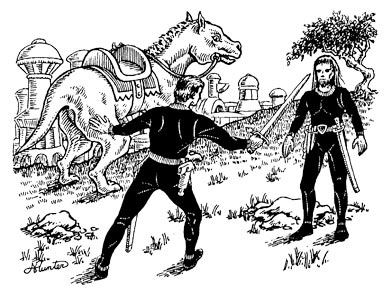
Illustration for 'Death's Head' by Alan Hunter
Alan was born in Coventry in 1923 and, inspired by some of the best pulp artists, particularly Virgil Finlay, got into science-fiction and fantasy illustration in the early 1950s. His work appeared in both professional and fan publications and he started the Fantasy Art Society. In his day job he worked as a technical illustrator for the Ministry of Supply, though he later had his own shop, a newsagent and stationers, at which point his illustration work all but disappeared due to work and family commitments.
In the late 1960s he left retailing and returned to drawing, this time for a large electronics firm, eventually working in computer graphics. He also made a welcome return to illustration for the SF/fantasy fan scene. He retired from work in 1989, though continued drawing. His wife, Joyce (Kirkham), sadly died in May 1994. They had a son, Christopher.
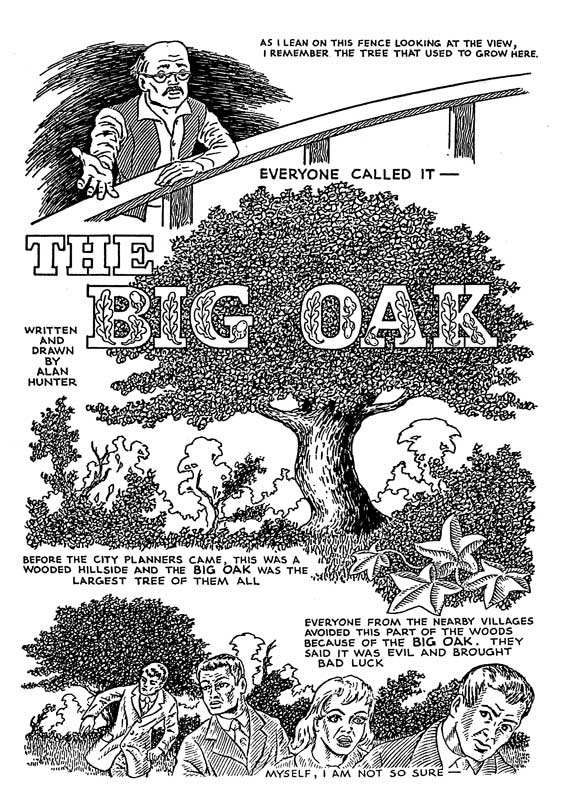
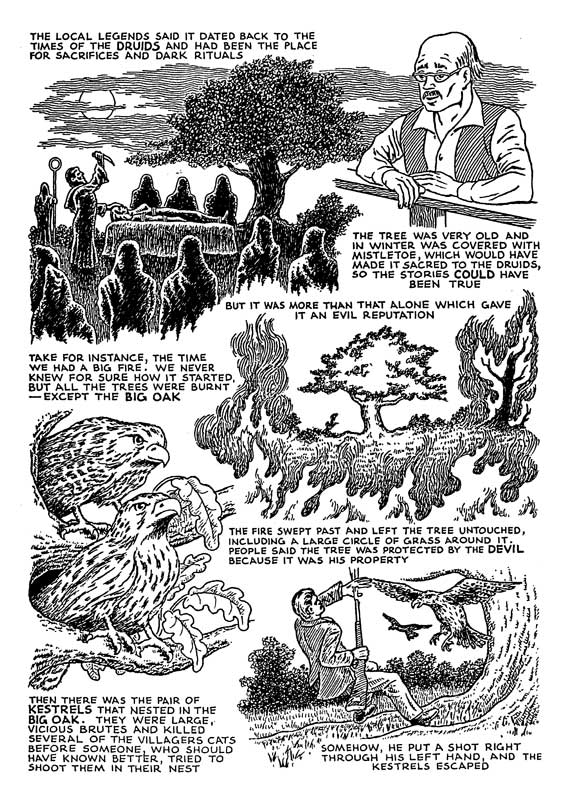
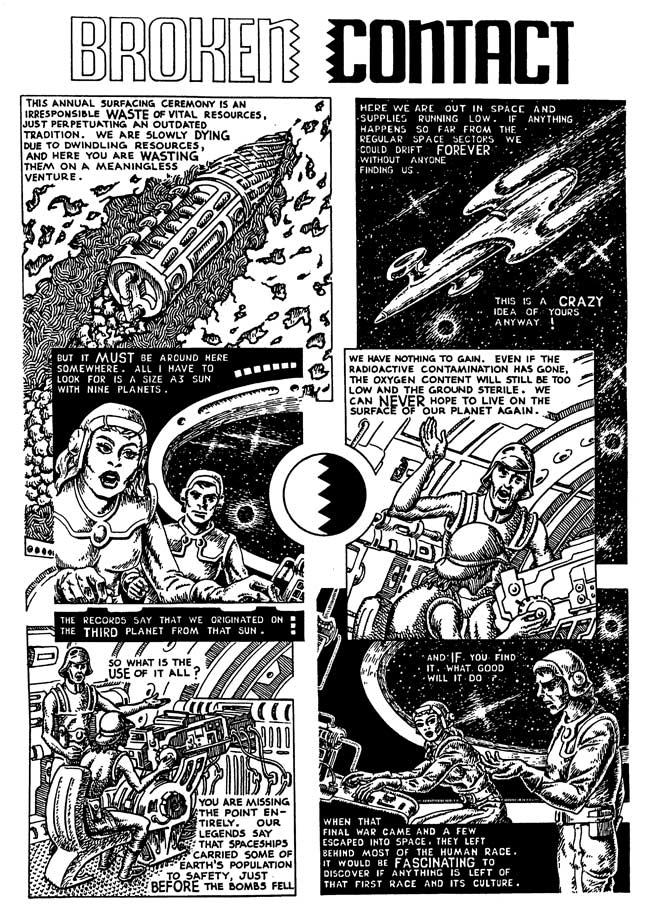
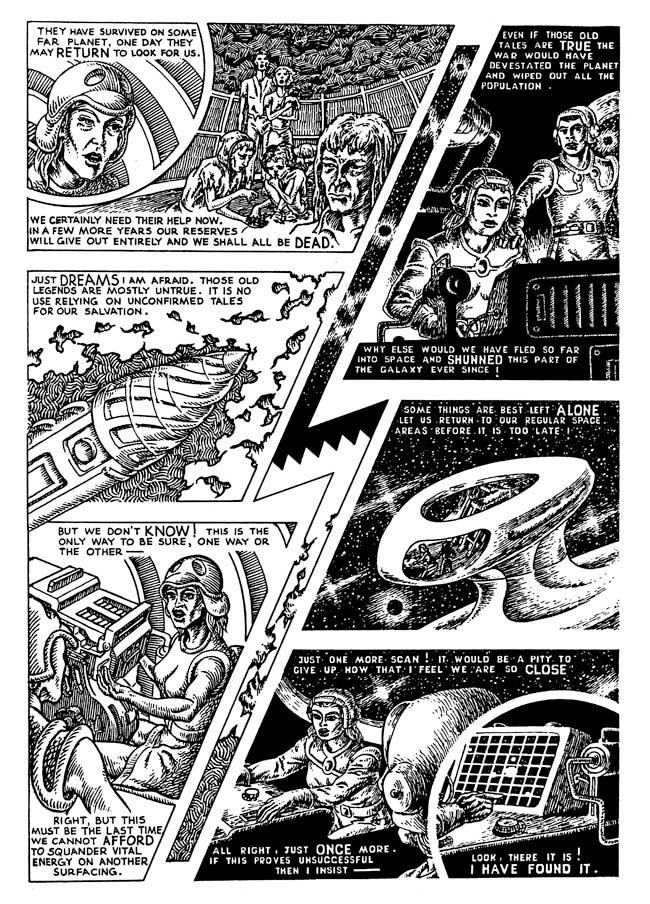
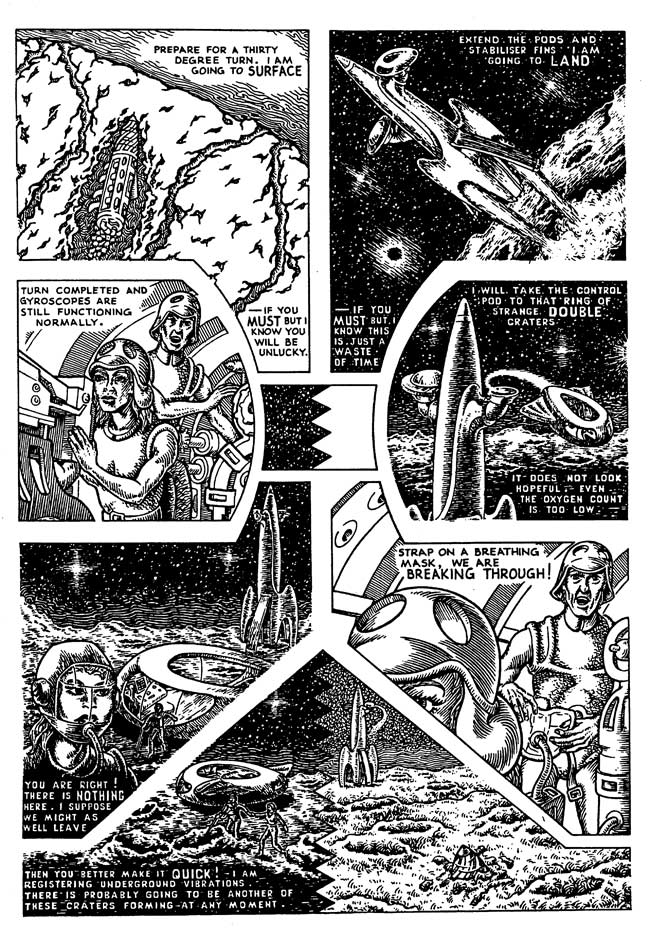
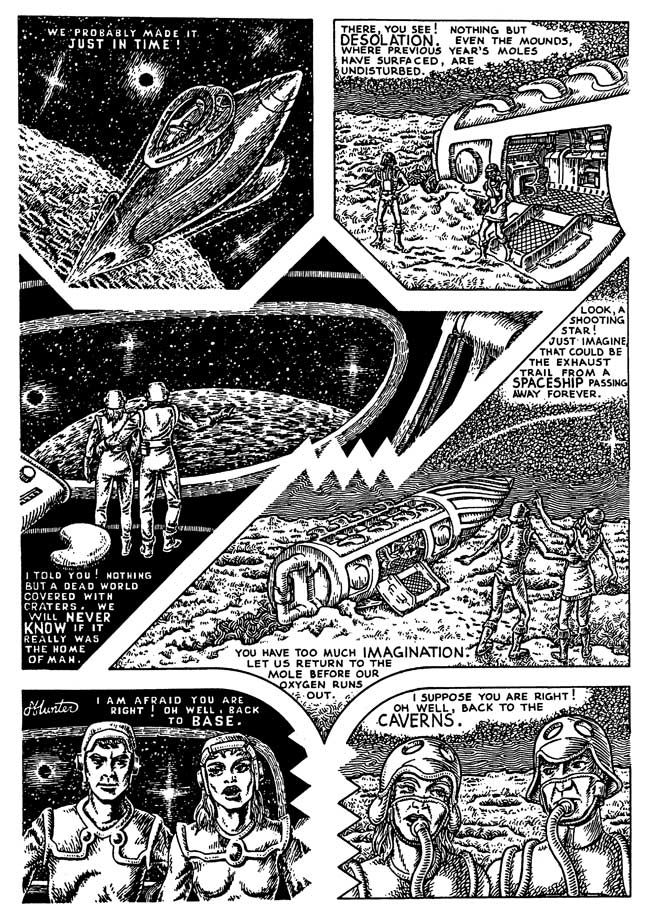
Alan was a superb illustrator. You just have to see his work to know the care and dedication he put into every piece, no matter how small. He was also a lovely chap, and very supportive of my own, then quite amateur, scribblings. I have put a few samples below, including the strip he contributed to Cosmorama 3 (Broken Contact, 1980) and a strip that would have appeared in the planned special (The Big Oak).
My condolences to Alan's family, friends and fans, the latter of which I most ardently include myself. You can read a little more on the British Fantasy Society website.
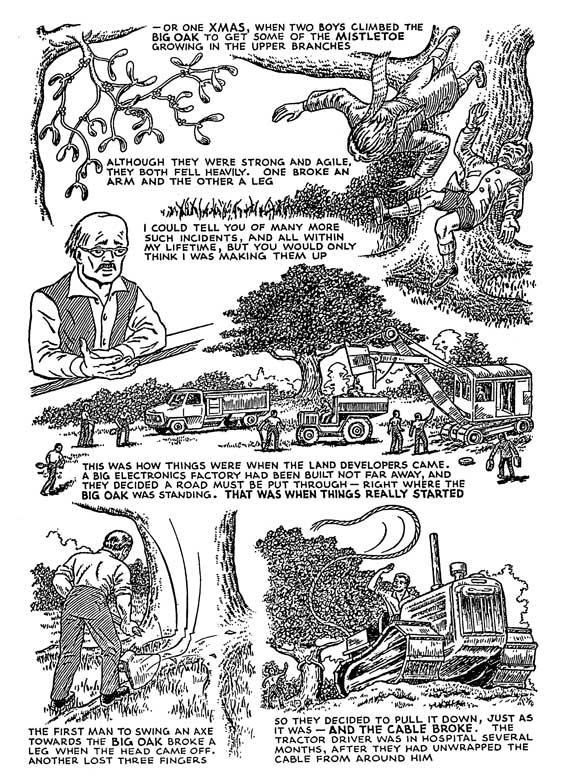
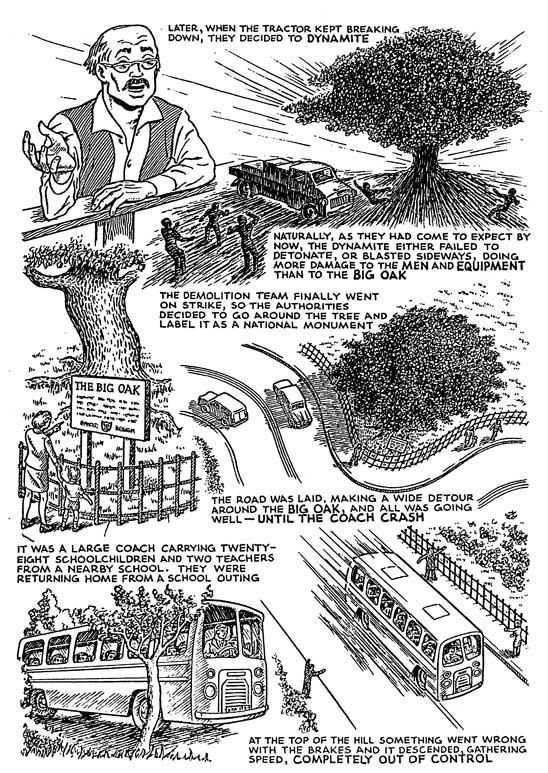
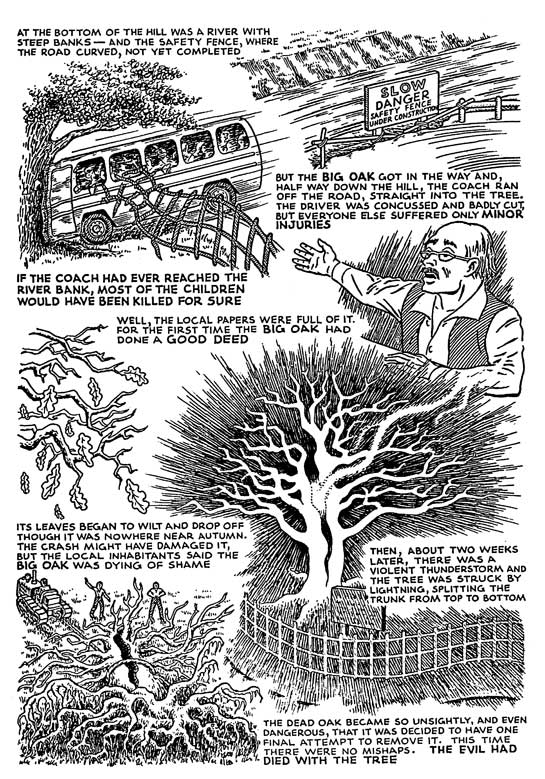
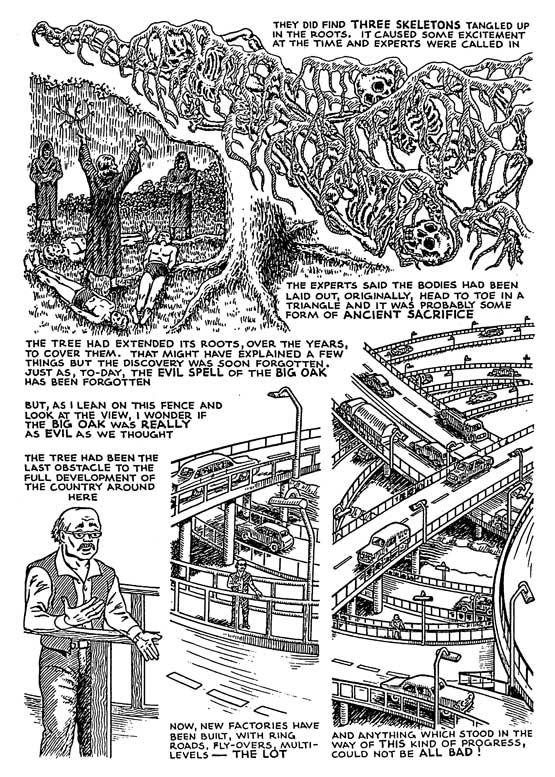
Broken Contact by Alan Hunter

His collection of short stories, Of Time and Stars, was a perennial favourite from my teenage years onwards. Many times I put it in the box for the charity shop, but always fished it out again at the last minute.

Paul, Joe and I worked together on a number of projects, mainly for Blue Comet Press on 'The Devil's Workshop' and 'Zorann Star Warrior', and in the past few months we were to collaborate again on 'Snowstorm' for Bulletproof Comics. I hadn't actually been in direct contact with Joe for a little while, but when I saw his profile on the Bulletproof website, he'd included some lovely comments about my Rainbow Orchid work. Looking at the letters he wrote to me he was always friendly and encouraging, without being at all condescending, and I looked up to him as he fostered a professional attitude to whatever work he was doing at the time.
This is from Paul:
"Joe contributed the Sindrome strip to the fanzine Amalgam before doing illustrations for Fantazia magazine. He did work for the small American publisher Blue Comet Press and assisted James Hodgkins on a number of projects for major publishers. The last 12 months had found him forging ahead, taking on clients of his own. He was very talented and not enough people knew that. More importantly, he was a loyal friend who loved nothing better than a good chin-wag."

For those whose time had run its natural course in 2003, a toast to my great uncle Norman and my great auntie Millie.

 previous