


This blog began in 1997 as a single news page called Nucelus. In 2005, during a long wait to move into a new house, I decided to learn some php and MySQL and write my own blogging system, which became inkyBlog and which now powers this, my own Webbledegook blog.
Thank you to my brother, Murray Ewing, for help with some of the more challenging aspects!
Emma says she took quite a while to do them as a lot of old, new and rare pieces went into their making, and I think you'll agree she's done a fantastic job.
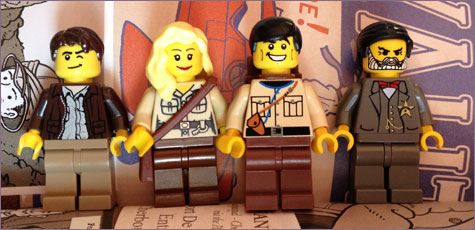
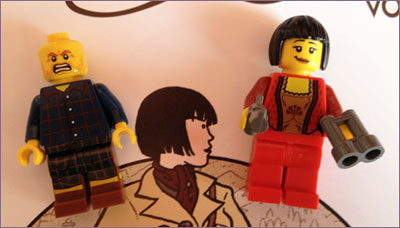
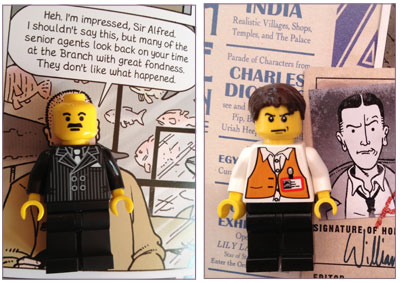
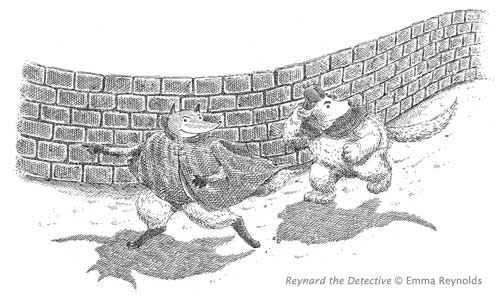
Do go and have a look at Emma's website, she has a beautiful illustration style and I especially love the look of her children's book, Reynard the Detective. And if you need a late Christmas gift (or even a post-Christmas gift) check out her Etsy shop as well.
Emma's Lego Julius Chancer and chums are going into the readers' art gallery, so do go and have a look at the full set and see some other wonderful Rainbow Orchid art there as well. Thank you so much for these, Emma!
 2
2
As well as accompanying me to one of my workshops (at the Forest Row Festival) we also went through the process of making a single page comic featuring Tom's own characters, The Larrys. Here's a little interview I conducted with Tom, as well as a few pieces of his fantastic artwork, more of which you can see over at his website.
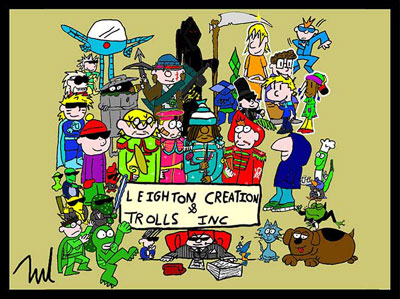
Tom, can you introduce yourself - age, interests, and what you'd like to do when you leave school?
I'm Tom V. Leighton, I'm 17. I love to draw and create my own comics, I like watching films and spending time with my friends. I am in my last year of Imberhorne Sixth Form and I am studying Art and Design as well as ICT. When I leave school I would like to go to University in America (Brigham Young University) where I will study animation and hopefully get a career at one of the large animation studios.
You recently visited me one day a week for a few weeks as part of a school project, can you give some background to this - what you had to do and what you wanted to get out of it?
I had to produce a case study of the business over a few weeks, I had to learn about the trade and gain ideas for a final piece. To begin with I learned about some basic business and the process of how you created a comic strip, which I found very interesting! We had some discussion and over a few weeks we decided to produce a full six panel comic strip starring some of my own characters, The Larrys. We also attended the Forest Row drawing workshop where I helped as an assistant. This was a new experience and I felt that I would observe to see the basis of what happens at these workshops. I learned a lot from these visits and I am very grateful for the opportunity I had in doing so!
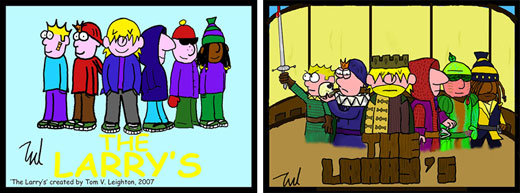
It was good fun, and I learned some stuff too! Can you introduce us to your comic characters, The Larrys - what's it all about?
Sure, The Larrys is about a group of young boys (around 7 yrs) who get up to all sorts of adventures. There are 5 of them to begin with until they take on a new member later on! They have certain adult characteristics to them and they occasionally refer to themselves as characters in a comic strip in some way or another. The adventures are based on what I would have liked to have done as a kid. There are quite a few adventures, I haven't developed all of the stories yet but all in good time! I came up with the comic idea from a dream I had; I dreamed that my Mum bought me a t-Shirt that had The Larrys on it.
Curious! We made a little 'Larrys' comic together (well, 90% you, 10% me*) - how did you find the experience? Was it very different from the way you usually work?
I found it very fun, I learned about the processes in scanning and colouring the strip and I thought it was great that we combined our two illustration styles. The process was definitely more technical than the way I would have done it without any guidance; I would have just drawn out the boxes and characters, followed by outlining it with black ink and then colouring it using comic pens. I will definitely consider the process for the future.
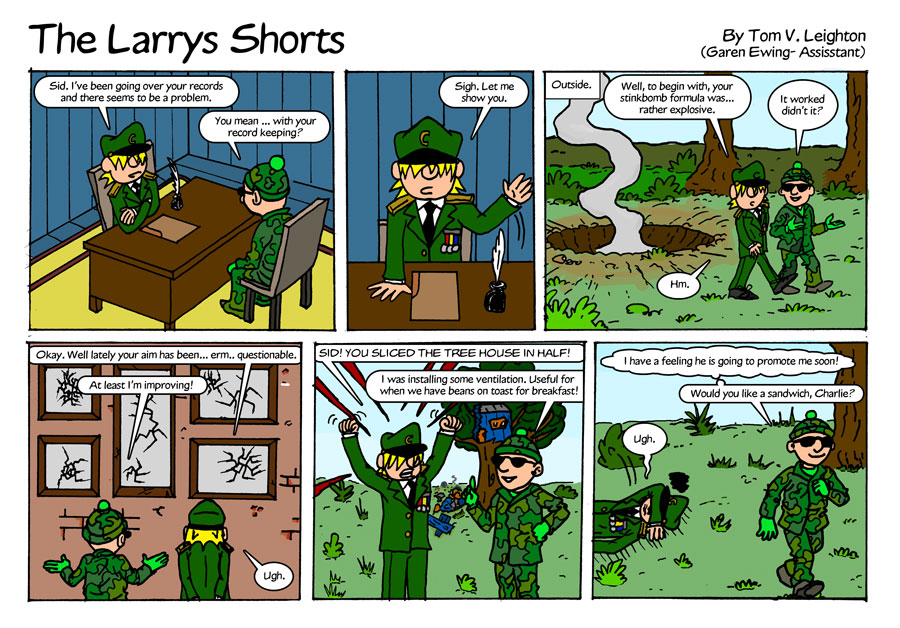
Click image to enlarge and read. *The strip was written by Tom, I pencilled the character of Sid and the backgrounds in panels 1 and 3, while Tom pencilled all the rest and inked and coloured the entire thing.
Sometimes it's interesting to know how other people do things, perhaps pick up a tip or two, but we all find our own way in the end. Can you tell me when and how you got interested in comics?
When I was in year 3 [age 7-8], I had a friend who 'taught' me to draw cartoons. From there I guess I became interested in different cartoons and came across different comic books. I came across a Wallace and Gromit comic book and a Garfield annual. I then became interested in The Beano when I got an annual for Christmas. I then went to Florida in 2004 and got a Fantastic Four comic book. I guess I came across other comics and started to develop my own characters and stories.
And what comics do you read now? What are your all-time favourites?
I mainly read The Rainbow Orchid, Garfield and Marvel. I did read some Adventures of Tintin and after working with you I have gained an interest in Tintin. My all time favourites are: Marvel, Garfield, Calvin and Hobbes, The Rainbow Orchid and there are probably other comics which I can't think of right now.
So, if you had to pick one comic to take to a desert island, what would it be?
That's a tough one, hmm ... If I had to pick one comic to take to a desert Island then I would probably have to take a big book of Marvel as it would be made up of lots of different stories.
Good thinking! Is there any interest in comics amongst your friends and fellow students?
A small amount, I don't really discuss comics and such, if I do then it is usually about my own works. I don't mind this as I enjoy talking about my own ideas and it implies that people are interested in my interests and hobbies.
As a young chap looking to embark on a career in comics, how do you see the current comics scene, especially in the UK? Do you feel optimistic both as a creator and a reader?
I don't really know. To begin with I genuinely thought that I would get a lot of money straight away from my comic ideas, now I see that's a bit dumb! Ha! There are many different comic ideas and there seems to be a lot of repetition over the years. I guess it is down to personal tastes and popularity. One comic may gain a lot of interest and some may not get much interest. It would probably be different in the USA. As I plan to live there when I'm older it may help as there is a different comic culture over there. If that makes sense.
Yes, it's good to have a clear plan like that. Having something to aim for is really important! At this moment in time, what is your ambition in art, comics, or any related fields? What is your ultimate aim?
At this moment I aim to get good grades in my A levels and to get into university in the U.S. and see where it takes me. My ultimate aim is to work at Pixar in many different fields of art, animation and illustration or even start up my own successful comics company. but we shall see...
Well, it seems you're certainly setting off on the right foot, so I wish you all the best with it! Thanks very much for your time and for answering my questions, Tom.
You can visit Tom's website here.
Firstly I should say that I haven't read any Tintin in a long time. That might surprise you, but there's a reason for it. When I started The Rainbow Orchid I wanted it to be a British comic but in the mould of European classics such as Tintin, Blake and Mortimer, Freddy Lombard, Yoko Tsuno and their ilk. But being so heavily influenced from the start I wanted to find my own feet with the style and story, so I pretty much cut myself off from reading Tintin (the best-known of the influences) over the next few years. I perhaps sneaked in one or two reads in something like eight years.
In that time I was given a hugely generous 40th birthday present from Egmont - the UK publisher of Tintin (and The Rainbow Orchid) - in the form of a complete set of Tintin in hardback. In the US the Tintin books have been published since the 1970s by Little, Brown, and recently they released a series of young reader editions, sporting newly designed covers and - the best bit - fascinating bonus material at the back of each book.
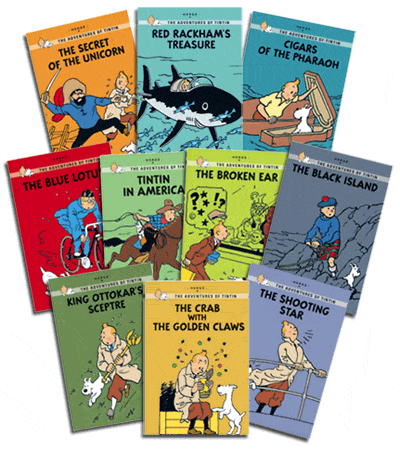
The new covers are the first thing you'll notice about the books, each one enlarging an extract from one of the story's panels on a flat colour background. There have been mumblings from some Tintin fans that the original albums shouldn't be messed with, but I have to say I think, for an offshoot edition, they're good; deliciously designed and rather attractive. The next thing you'll notice is the size - these are digest books measuring roughly six by nine inches but they're mostly perfectly readable (a few of the illustrated documents and longer balloons can be a bit of a struggle for older eyes) and they double up as an ideal and portable travelling edition.
Before you reach the start of the story you'll find seven pages, each devoted to a key character from the album with a little introduction to them and the part they play in the adventure ahead. So, in Cigars of the Pharaoh we get Tintin and Snowy, Sophocles Sarcophagus ("Doctor Sarcophagus only has one thing on his mind throughout this adventure: Ancient Egyptian pharaohs!"), Rastapopoulos, Thomson and Thompson ("The world's silliest police detectives make their first appearance in this Tintin story. Right from the start their investigations are in a hopeless muddle!"), Sheik Patrash Pasha, The Fakir, and The Maharaja of Gaipajama ("The dignified Maharaja of Gaipajama welcomes Tintin into his palace, and the heroic reporter returns his kindness").
The bulk of the book is, of course, made up of the most important bit, the Tintin adventure itself. I don't think I need to go into any more detail than to say that Hergé was a master of graphic storytelling, tight and exciting plots, wonderful characters, and sublime clear-line drawing ... do I? There's a very good reason the Tintin books are still selling in their hundreds of thousands to this day. There are currently ten titles in the Little, Brown young reader series; in order of publication: The Secret of the Unicorn, Red Rackham's Treasure, Cigars of the Pharaoh, The Blue Lotus, Tintin in America, The Broken Ear, The Black Island, King Ottokar's Sceptre (all 2011), The Crab with the Golden Claws, and The Shooting Star (2012). In the UK Egmont have so far published The Secret of the Unicorn and Red Rackham's Treasure in this format, with further titles to follow in 2013.
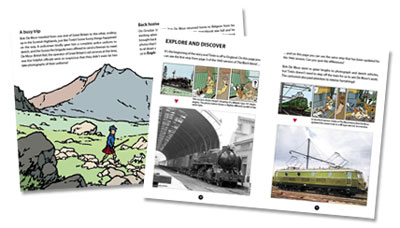
The most interesting unique feature of these young reader editions is the bonus material at the back of each book. Entitled 'The Real-Life Inspiration Behind Tintin's Adventures', this section provides twenty-two pages of behind-the-scenes notes, research, facts and figures relating to the story, and sketches and photos to help provide context. All this has been put together by Stuart Tett, working directly out of the Moulinsart vault with access to the entire Hergé archives, and he's done a terrific job. There's no doubt these are written with a junior audience in mind, but - even with my own well-stocked library of books about the making of Tintin - I found them fascinating and informative.
Let's take a look in more detail at one particular volume, one of my favourites, The Black Island ... First of all you get a Hergé timeline, from birth to death, placing the volume in the chronology. The main text kicks off with Hergé's connection and interest in England and then moves on to a bit about Tintin's role in the story as he takes on the guise of detective. Next we learn about the book's publication history and the vital part played by Bob De Moor in the final updated version, including some of the reference photos he took on location and a postcard he sent to the Hergé Studio from Dover. We then come to a section common to all the books, 'Explore and Discover', where particular scenes from the story are looked at in detail with the research that informed them and connected trivia: the model of trains used in different editions, Dr Müller's country house, Craig Dhui Castle, a bit of cryptozoology, the real-life Dr Müller, and aerobatics. We end off with six post-it notes of trivia - all interesting stuff. All of this is profusely illustrated with gorgeous Hergé art and related photographs.
These Little, Brown and Egmont young reader editions will be a nice addition to any Tintin collection, no matter the age of the reader, but for children in particular they will really help to give some idea of the work put into these comics, and a new dimension is added with the very well constructed and written supporting material from Stuart Tett. I highly recommend them!
If you'd like to know a little more about the work behind these new editions, there's an interesting interview with Stuart over at The Compulsive Reader. And, if you're on Facebook, do check out the Tintin Facebook page.
As in 2009 and 2010, though this time with our 20-month-old daughter in tow, Ellie and I drove up to Belton in Lincolnshire to stay with my wife's father and partner (always lovely), getting up early on the Saturday for the further hour-and-a-half's drive into Leeds. I had no idea how sales might go over the weekend so I decided to be optimistic and brought quite a few boxes of The Complete Rainbow Orchid - very heavy - as well as the newly printed Rainbow Orchid Supplement and a sensible stock (I thought) of individual volumes. This is where having a 20-month-old child came in very useful, as she could walk and I could commandeer her buggy to convey boxes from the car park to the venue.
I was in the larger of the two halls, New Dock, and as usual had made my first sale of the day before the doors officially opened. That set the tone for the rest of Saturday as things hardly let-up and I was selling, signing and sketching pretty much non-stop. Apart from a couple of furtive nibbles, I didn't get to eat my lunch until leaving the hall at about six in the evening.
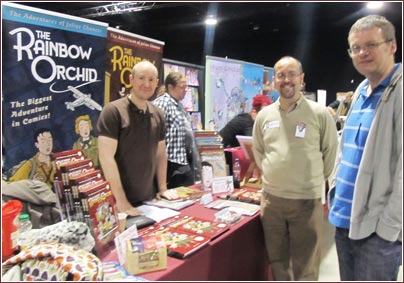
The Rainbow Orchid table enjoys a visit from Accent UK: Colin Mathieson and Dave West
With my wife and daughter off and about in Leeds I was on the table by myself, and while being so busy is great, I am aware of people coming along, waiting for a bit, and then wandering off as my head is often down while sketching and chatting to someone else. With no one to help out and engage them I do wonder if I miss out on new readers. Can't complain though! The whole weekend was terrific for sales and I sold 128 books in all, including 71 Completes and selling out of volume 3s.
I won't list all the lovely comics colleagues who stopped by to chat - too many - but I must give mention to my table-neighbours, the fabulous Laura Watton on one side and the marvellous Gary Erskine and Mhairi on the other. Laura gave me a copy of her wonderfully titled and highly entertaining comic Reluctant Soldier Princess Nami, and Gary and Mhairi were very generous with their space as they allowed our buggy to be parked next to their table when Ellie came back to the hall from her town travels. Having nice neighbours does make the whole weekend that little bit more pleasant and easier - so thank you, both!
I'd also like to give a special mention to artist-extraordinaire Graeme Neil Reid who astounded me by spotting and naming a very obscure cameo in The Rainbow Orchid (it's on page 113 of The Complete, or page 37 of vol. 3, if you're up for a challenge ... or failing that, the solution is revealed in The Rainbow Orchid Supplement). I'll just mention that we're both David Lean fans.
One thing that made the show a little different was that my table was one of five playing host to the Phoenix Feathers collection game. On my table were several phoenix feathers to be collected by children and taken back to The Phoenix stall in the Armouries in exchange for goodies and prizes. It was great being part of it and it brought a lovely added focus to my display. The Phoenix was a strong presence at the show with much activity from several of the regular artists, including Neill Cameron, Gary Northfield and Dave Shelton.
There were no negative aspects to the weekend. The only slight pain was that the official hotel (the Marriott) was quite a bit further from the venue than I'd imagined, and with our little daughter with us, it was a bit of a trek. Most people I spoke to were staying at the Holiday Inn, right next to New Dock Hall, and it might make sense, if possible, for that to become the official/recommended hotel in future years.
This year's show was host to the inaugural British Comic Awards for which there was a very fine selection of nominees. The winner of the Best Book category was Nelson, a project in which I had a very small part but is really the vision and product of editors Rob Davis and Woodrow Phoenix, and made possible by publisher Blank Slate Books. Next year a very limited edition will be produced and today I was up at the Royal Festival Hall to sign 130 insert sheets for it. As well as myself, a handful of other contributors had not yet signed their names and I was joined at the signing table by Posy Simmonds, a British comics legend and someone who's work I read, own, and admire very much indeed - it was a real thrill to meet and chat with her.
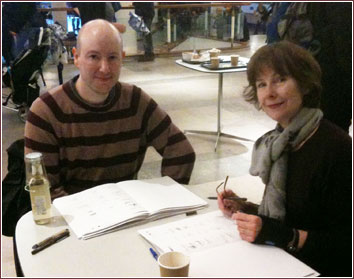
Signing Nelson inserts with Posy Simmonds at the Royal Festival Hall, London
So, back a week: another Thought Bubble was over and we packed up on the Sunday (thanks to Colin Mathieson for his help with box carrying), and made our return trip to Belton for a lazy Sunday night, a slightly less-lazy but still pretty lazy Monday, and then a night drive back down to Sussex.
A huge thanks to everyone who came to the Rainbow Orchid table to buy books, say hello, or even just to browse, and an equally huge thanks to the Thought Bubble organisers and volunteers for another terrific show, the comics event highlight of the year.
A comics website recently quoted the fact that I'll be charging 10.00 for sketches at Thought Bubble - this is not the case! I have never charged for sketches and I'll be only too happy to do one for you, especially if you have bought my book.
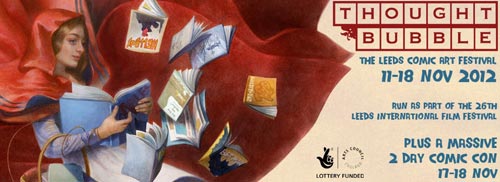
I'd like to address another thing that happens quite a bit at comic shows, which is people asking for free review copies. Please don't take offence when I say no to this request - I no longer give away review copies from my own stock. A large percentage of those that I have given to in the past did not, in fact, review the book. Also, I pay for my own stock, I don't get these books for free, so it can end up costing me quite a bit! If you would genuinely like a review copy, please get in touch with my publisher, Egmont (or get in touch and I'll be happy to do it for you).
Still on the subject of cost, I was asked about the price of the books I sell from my website - with the suggestion that I was charging over the odds. Well, let's see - The Complete Rainbow Orchid retails at 14.99; my packing materials - a sturdy book box and an adhesive address label - cost me 1.25; at 650g the book is quite heavy, and packed up it costs 3.50 in the UK, 6.62 within Europe, and 12.10 elsewhere in the world (eg. Australia or the US).
So for the UK you're looking at 19.74 (I charge £18.50); Europe 22.86 (I charge 22.00); and international 28.34 (I charge 28.00). And don't forget - you get a sketch as well, not to mention the time I spend parcelling-up and sorting out postage. Of course I don't pay 14.99 for the books myself, I get a slight discount, but the sketch time easily swallows that up. I hope that makes it more transparent and that you can see I'm offering the best deal I can without making a loss.
One last thing, my complimentary copies of La Orquidea Arcoiris, the Spanish edition of The Rainbow Orchid, arrived today and they look wonderful. Please visit NetCom2 Editorial to find out more.
Hope to see you at Thought Bubble - I'll be on table 176, on the end of the aisle just round the corner from artist Gary Erskine.
Whatever, they are seen as 'our glorious dead', heroes revered and venerated at village memorials across the land. Indeed, I have identified thirteen members (so far) of my own family to have died in the conflict of 1914-18, and every one is a tragic tale of a life cut short.
But how about when it's not so clear-cut? This year I will tell the story of one of my distant cousins who died on the first dreadful day of the battle of the Somme, but who - when you know the full tale - you would find hard to fully revere.
His name was Thomas Sherriff, and he was born some time around 1885 to a family of Romany Gypsies, his parents being Hope (aka 'Gypsy Jack') and Trinity (aka Hetty, Genti, Trenetty or even Franette) Sherriff. He'd already served in the Sherwood Foresters alongside his father around the time of the Boer War. I don't yet know whether he saw service in that conflict, but I do know he was imprisoned for seven days for violently attacking a family rival in the marketplace at Wirksworth, in February 1900.
A far more serious offence occurred in January 1903 when Tom was arrested for his involvement in the killing of a policeman. PC William Price had gone to the Sherriff Gypsy camp to investigate the theft of three ferrets from a nearby farm. Things turned nasty and a fight broke out between PC Price and three of the Sherriff brothers, Tom, John and Joseph. Their father, Hope, and a fellow traveller, Arkless Holland (married to Tom's sister, Raini) were also implicated. During the fight, the constable was struck on the head with his own truncheon and the three brothers bolted. Price later died from his wounds and a murder hunt ensued.
After a few days on the run, and two more policemen injured while trying to arrest them, the Sherriffs were caught. Hope and Arkless, held earlier, were acquitted, but Tom, John and Joseph were found guilty of manslaughter and were given fifteen years penal servitude. The brothers never revealed who struck the actual devastating blow to PC Price, but the family story points most strongly at Tom. They were lucky - had the verdict been murder then they would have all hanged.
Joseph died in prison in about 1907. Tom and John can both be seen on the 1911 census as inmates of Portland Prison in Dorset. But, with the First World War looming, it seems they were released early, or perhaps volunteered, into the hands of the army, John into the Notts & Derby Regiment and Tom, at first into the Notts and Derby Regiment, and then the Lancashire Fusiliers. It was with this regiment he found himself on the front line of the Somme on 1st July 1916. At 7.20 am a huge mine was exploded under the Hawthorn Ridge Redoubt and the Lancashires charged, only to come under severe German machine gunning and artillery. The regiment lost seven officers and 156 other ranks in the attack - including Tom Sherriff, a small portion of the 20,000 dead the British suffered on that first day alone.
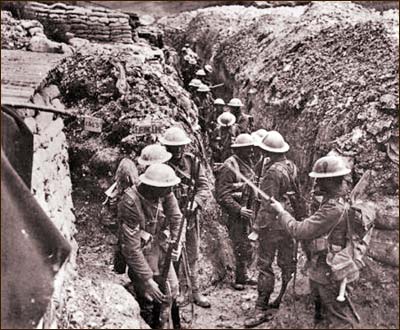
Lancashire Fusiliers at Beaumont Hamel, July 1916.
For the past two years I have been invited by the Romany and Traveller Family History Society to join a delegation at the Cenotaph memorial in London, helping to represent Romanies who served. Sadly I have not been able to make it, and I do always think of the conflicting feelings that surround the sad story of Thomas Sherriff. Tom is remembered on the Thiepval Memorial in Picardy, and also on the village memorial at Newbold, Chesterfield. (Out of interest, Tom wasn't the only less-than-pristine family member to serve... another distant cousin, James Veevers, has a war record that brims with notes about drinking, housebreaking and disorderly conduct, all of which eventually landed him in prison for a while.)
Still, as well as Tom's fellow convict, John (also known as Uriah, wounded in 1917), other Romanies of my family served in the First War: Henry Holland, also with the Notts & Derby Regiment, was wounded on eight occasions in France, the final time, in Sep 1916, seeing him invalided to England before he died at home, in Aug 1918, from complications connected to his wounds; Charles Duffield (aka Hodgkins) was with the North Staffordshires and died at Ypres in July 1916; Perrin Dennett served with the Notts and Derby Regiment in 1918, though stayed in England.
Although my direct Romany-related line had ended their travelling ways in the 1870s or 80s, several descendants also fought in the war - my great-grandfather, Charles Hodgkins fought with the North Staffordshires in Gallipoli (see his story here); his brother Edward was also with the regiment (though a different battalion); their cousin Ernest Sherriff served in the Royal Warwickshire Regiment and then the Royal Garrison Artillery; and his brother, Horace, joined the Durham Light Infantry (though did not fight abroad).
This has been my seventh Remembrance Sunday post, though the first for two years. You can see the previous entries here: 2009, 2008, 2007, 2006, 2005 and 2004. My family war archive can be found here, and my online family war memorial here.
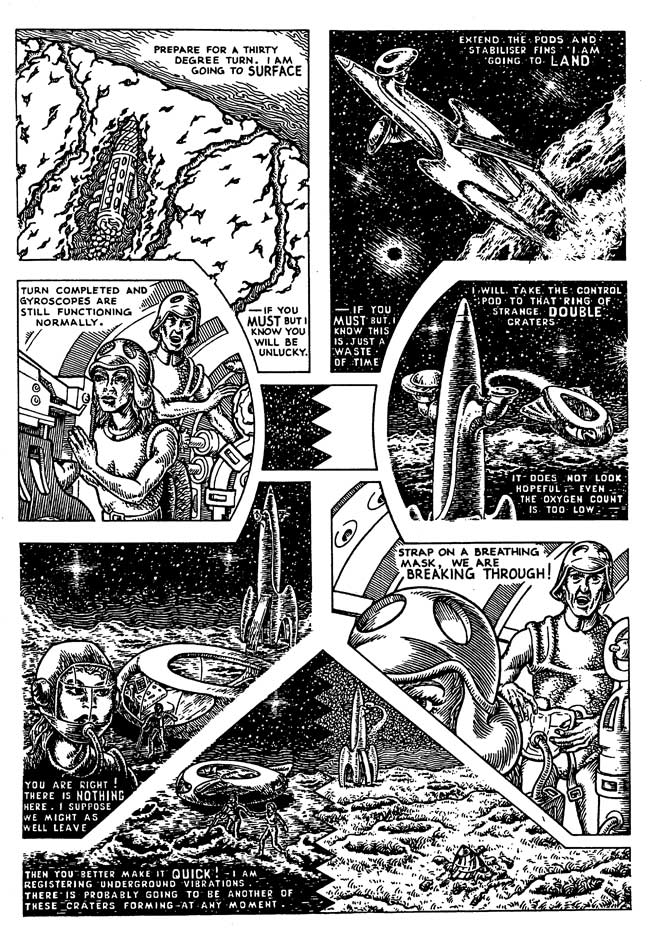
He was not known as a comic artist, but was a well-known and well-loved science-fiction and fantasy illustrator. Even so, I planned to publish a one-off special of his comic strips, for which he provided me with good copies - unfortunately this never came to pass, mostly due to funding issues on my part. My last contact with him was in June 1997 when I returned his prints to him, but he came into my thoughts again in June of this year after I read Jeremy Briggs' article on Near Myths, a comic that Alan had contributed to (Private Eye in issue 5), and I discovered, thanks to Steve Holland, he was still living at the same address as he was in the 90s. Sadly I never got round to writing to him again, as I intended.
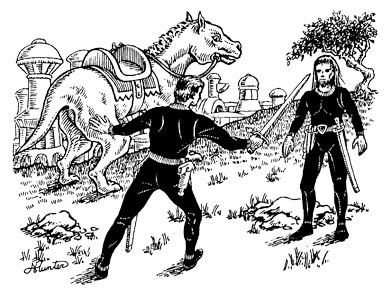
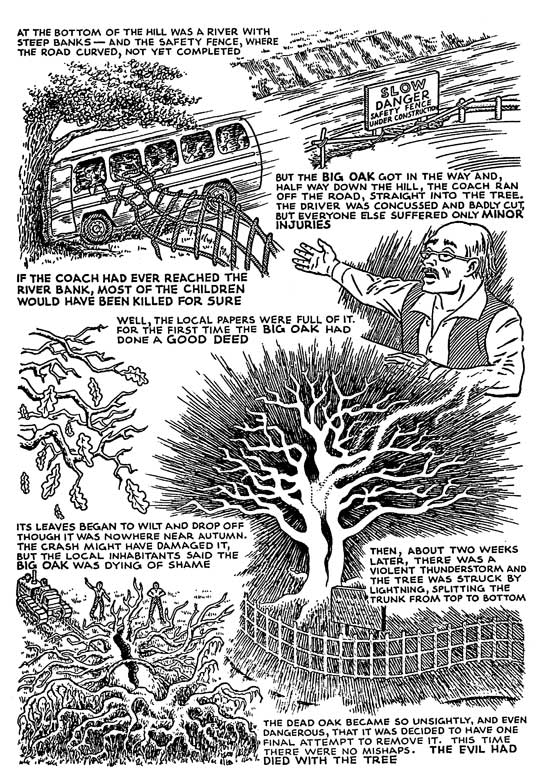
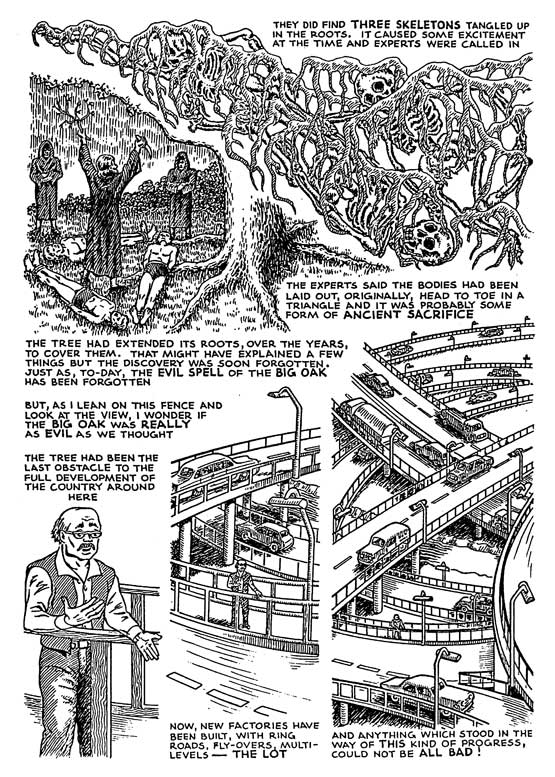
Illustration for 'Death's Head' by Alan Hunter
Alan was born in Coventry in 1923 and, inspired by some of the best pulp artists, particularly Virgil Finlay, got into science-fiction and fantasy illustration in the early 1950s. His work appeared in both professional and fan publications and he started the Fantasy Art Society. In his day job he worked as a technical illustrator for the Ministry of Supply, though he later had his own shop, a newsagent and stationers, at which point his illustration work all but disappeared due to work and family commitments.
In the late 1960s he left retailing and returned to drawing, this time for a large electronics firm, eventually working in computer graphics. He also made a welcome return to illustration for the SF/fantasy fan scene. He retired from work in 1989, though continued drawing. His wife, Joyce (Kirkham), sadly died in May 1994. They had a son, Christopher.
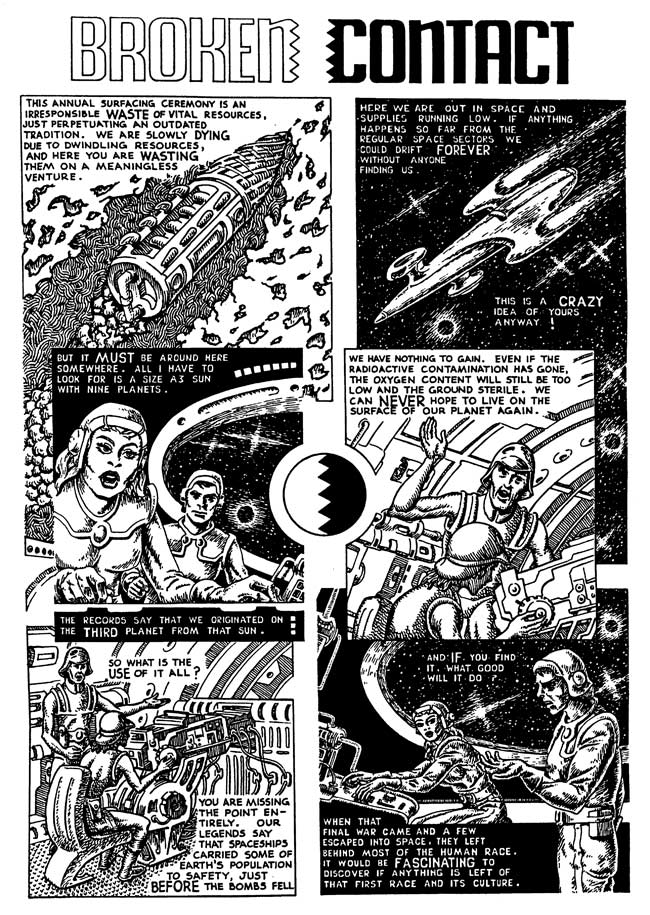
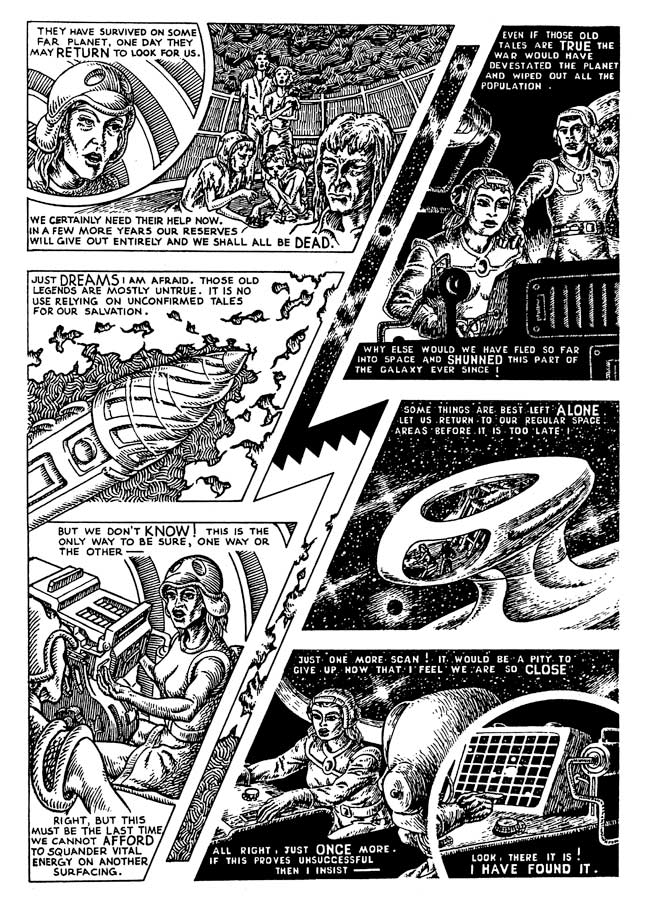
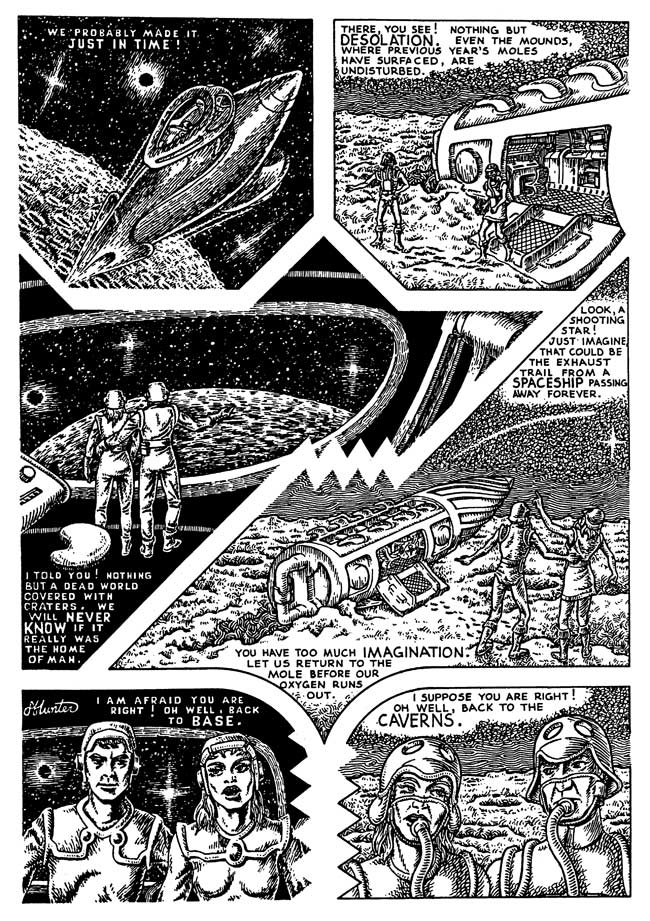
Alan was a superb illustrator. You just have to see his work to know the care and dedication he put into every piece, no matter how small. He was also a lovely chap, and very supportive of my own, then quite amateur, scribblings. I have put a few samples below, including the strip he contributed to Cosmorama 3 (Broken Contact, 1980) and a strip that would have appeared in the planned special (The Big Oak).
My condolences to Alan's family, friends and fans, the latter of which I most ardently include myself. You can read a little more on the British Fantasy Society website.
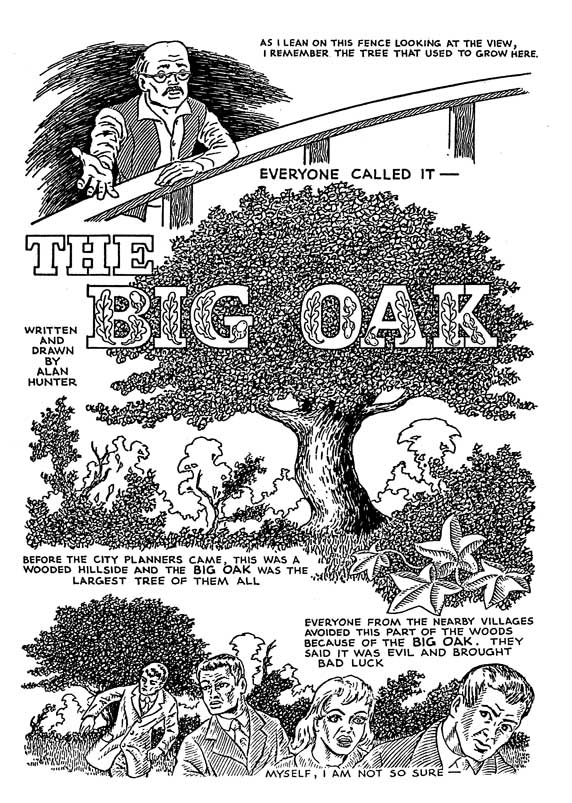
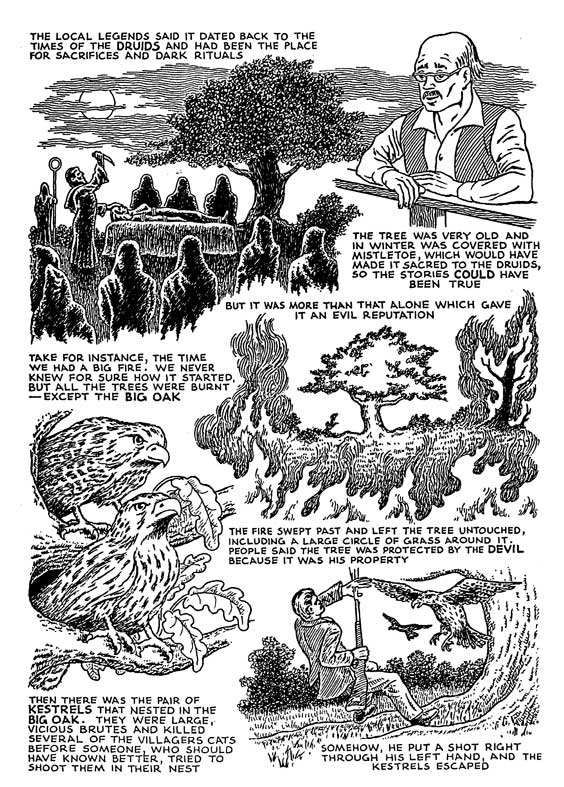
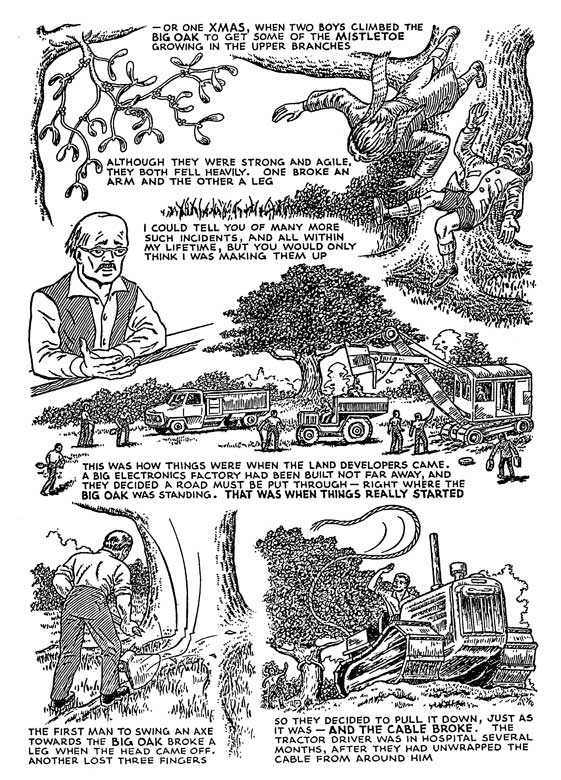
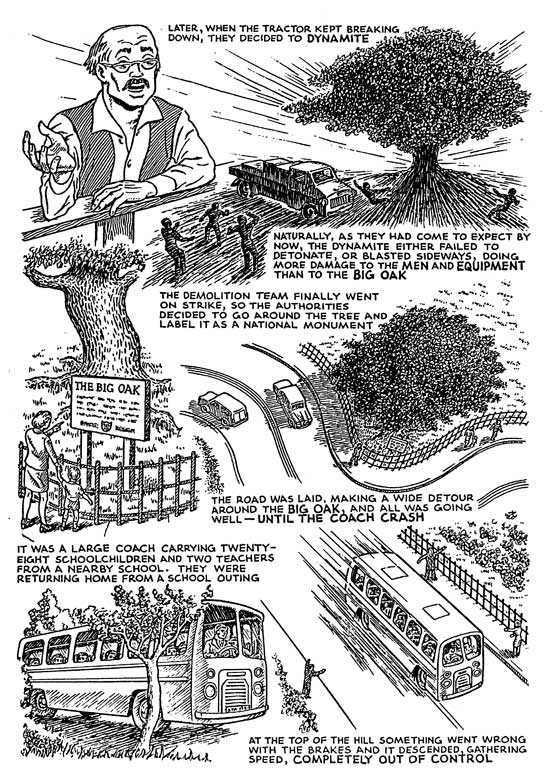
Broken Contact by Alan Hunter
November will see the release of The Rainbow Orchid in Spanish (La Orquidea Arcoiris) from Netcom2 Editorial. A preview appeared in NetComic no.16, which you can see here.

The English (UK) edition of The Complete Rainbow Orchid has been out for nearly two months now and is doing well, with a couple of nice Amazon reviews online (thank you, nice Amazon reviewers!). I was particularly pleased to read this extract:
"The addition of a cool, strong and resourceful female antagonist gives this book a modern edge that can be lacking in some of the European BDs that this tale echoes."
The initial print-runs of both volume one and two have sold out, and both have gone to a second-printing, which is great news.
I had a marvellous time at the last few events I've done - the Forest Row Festival (two workshops), Just Imagine (comic workshop at Elm Hall School) and a terrific two-hour workshop at the Cheltenham Literary Festival (which sold out).
The next event I'll be at is Thought Bubble in Leeds on 17 and 18 November. I'll have The Complete Rainbow Orchid with me, and hopefully The Rainbow Orchid Supplement too (going off to print imminently!). If you can't make it, I'm selling signed and sketched-in editions of The Complete... from my online shop.
Let me leave you with this great article on selling kids' comics by Laura Sneddon. Selling comics to the general public in the UK is a real challenge, but it's more about getting them seen than having to convince people to give them a go. This has been my experience everywhere - if people can see and look at The Rainbow Orchid it nearly always results in sales. Visibility and access to comics themselves are the challenge!
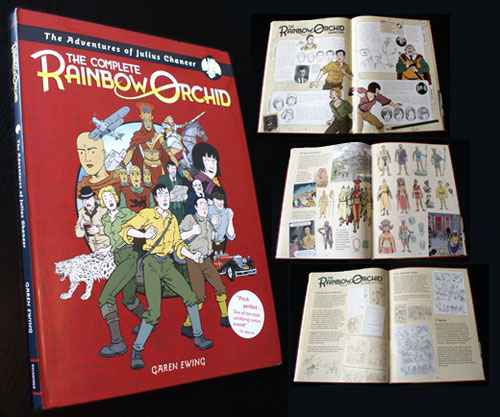
I'll be at Caption on Sunday this week, on a panel at 3.30pm ('America is not the only fruit'), and I'll bring a copy along, if you'd like to see it.
 previous