This blog began in 1997 as a single news page called Nucelus. In 2005, during a long wait to move into a new house, I decided to learn some php and MySQL and write my own blogging system, which became inkyBlog and which now powers this, my own Webbledegook blog.
Thank you to my brother, Murray Ewing, for help with some of the more challenging aspects!
The collector's pack is limited to 1000 numbered sets, with each hardback volume containing a signed bookplate. There is also a 16-page Dossier - a shortened version of the Supplement I published last year.


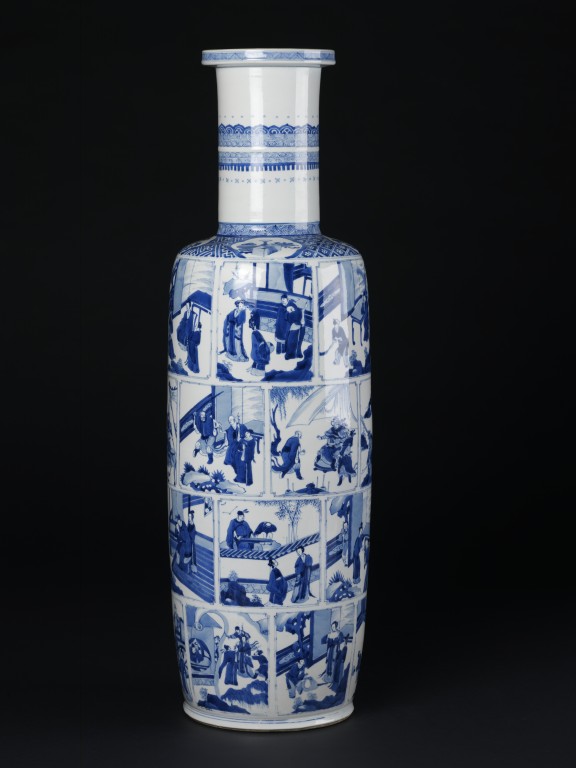
It was made in Jingdezhen sometime between 1690 and 1700 (Quing Dynasty) and depicts the tale of Xi Xang Ji (The Western Chamber) in a remarkably bande dessinée-like four tiers of panels. There are similar vases of the same period but many of them have panels designed as nested petal shapes and don't tell any story, just showing scenes of ladies on terraces and flowers. This one in particular, complete with panel gutters, looks as though it could have been transferred directly from the pages of a Tintin album (see it in more detail here).
Far Eastern objet d'art have long been adorned with traditional folk tales. I remember studying my grandparents' Willow pattern tea set through the glass of their 'best china' cabinet, with my mum explaining to me the tale it told of two lovers transformed into birds. Of course now, thanks to Wikipedia, I discover that particular story and design was an eighteenth century English invention, an imitation made to cash-in on the popularity of the real thing.
The Western Chamber - the real thing - also tells the story of two lovers, with the young man having to overcome the adversity of tradition, bandits, a civil service exam, and - worst of all - the girl's disapproving mother. The Jingdezhen vase is housed at the Victoria and Albert Museum, though is currently in storage.
While I'm mentioning this, I'll mention a couple of other things too. The first is a very nice in-depth review of The Rainbow Orchid on the SFSite. The second is some brilliant readers' art by William Lloyd Jones, age 5 - my youngest contributor yet!
The image comes from the Ashmolean Museum's copy of the print (the British Museum has one too), though an original came up for sale on ebay a few months ago and I was sorely tempted. After a day of being on the edge of bidding, I came to my senses and realised that I couldn't afford it, and anyway, I don't know the first thing about looking after antique Japanese prints. It would be a crying shame if it faded and died under my care. It sold, and I hope it went to a good home.
So, the Christmas present was my (very nice) consolation prize. I first came across the print in 1985 after I started karate and became slightly obsessed with samurai. One of the first books I bought on the subject was Stephen Turnball's The Book of the Samurai: The Warrior Class of Japan (1982), in which just two sections of the triptych were reproduced in black and white, though even without colour I was captivated by the beautiful depiction of the dead's cold visitation on the defiant Taira Kiyomori.

The book (I still have it, somewhat battered now after years of perusal) is full of such magnificent musha-e prints, and I immediately fell in love with the form. I don't know if the ligne claire of Tintin prepared the ground for my attraction to the pure line and flat colours of ukiyo-e, or if my love of both the prints and Tintin are a result of some other predisposition to such things - but I've been enamoured ever since. Turnball's book also introduced me to my favourite director, Kurosawa, as he used several stills from his films as illustrations leading me to seek out, at first, The Seven Samurai, and then more of this master's work, as well as that of his contemporaries (Ozu, Mizoguchi, Naruse and others).
Taira no Kiyomori (1118-1181) was head of the Taira clan, leading its domination over Kyoto through powerful government positions, defeating his rivals, the Minamoto, and seeing his grandson take the emperor's seat - only for it all to come crashing down at the feet of his revitalised enemies not long after his death. This is told in the Japanese epic Heike Monogatari, and from this comes the scene in the print - Taira (played by the kabuki actor Nakamura Utaemon IV) at his Fukuhara palace, haunted by the vision of all those he has slaughtered in his climb to the heights of power. Mizoguchi actually made a film about the young Kiyomori in 1955, Shin Heike Monogatari (New Tales of the Taira Clan), one of only two colour films he made, and one of the last before his death in 1956.
The artist is one of the big four or five most famous ukiyo-e creators, Utagawa Hiroshige (1797-1858), most well-known for his Fifty-three Stations of the Tokaido. Other artists have also depicted the scene - Fukao Hokui (a pupil of Hokusai) in about 1835, and Tsukioka Yoshitoshi (a pupil of Kuniyoshi) in about 1882. I like the others, but for me Hiroshige's is the best - the central figure of Kiyomori, grasping his tachi as if he fully intends to defeat all his vanquished enemies once again - though with perhaps a hint of uncertainty in his eyes; the concubine - we're not sure if she too sees the Chancellor's nightmare vision; and the silent, accusing ghosts in frozen white - which at first you may not notice, and then, like the Lord Taira, you start to see everywhere you look.

Brigitta Pekelharing made twelve in all - below you can see photos of the Julius and Lily models. They're going straight into the Readers' Art page (where you can take a closer look and see Nathaniel and Evelyn too). They're beautifully drawn and terrific fun - thanks so much, Brigitta, I love them!

The Phoenix is a weekly children's comic featuring some of the very best in UK comics talent, providing a variety of funny, dramatic and adventurous stories in a beautiful, ad-free, wonderfully designed package. It is truly one of the best British comics around (for all ages), and one of the very few true UK comic weeklies in existence. If you want to support the future of British comics then this is a good way to do it. So, if you've got an iPad (I believe other platforms are on their way) then you really must take advantage of this stupendously amazing offer.
Here's a link to the App, here's The Phoenix's web page about it, and here's an early review from George Shiers' Wacky Comics blog. Go!

These are extracted from a file I've kept on my desktop over the past three years or so that I add to whenever a thought occurs. Some are learned from my own experience, and some are from observing fellow creators. All of them should be taken with a pinch of salt, and none are any kind of gospel, or even necessarily true. They're just notes, but perhaps one or two may resonate with you as well ...
The best defence against failure, and the best ally of inspiration, is to make sure you're working on a project that you really love.
You can learn from anyone, no matter what their level of expertise, no matter what their age is. Stay humble and be generous.
When 'character development' is mentioned many people think of the creation and filling out of a character before they are used in a story, but you should rather think of it in terms of the way the character develops because of the story. The story should develop the character.
In a story, for a character to change their mind (or have it changed) something dramatic should happen.
I don't like stories that are aimed at kids or aimed at adults. I don't like films that claim to be for both but are just slapstick for the kids and double-entendres for the adults. I like the story to be true only to itself, and not written for some imaginary demographic.
When you end a scene you need to end it with a full stop, or maybe an ellipsis, and when you start a scene you need to start it with a capital letter. Not literally (grammar goes without saying), but visually.
Writing for kids is difficult, which is why I don't bother. I write for me and hope that others, including kids, will like it too.
People sometimes seem to think that a strong female character is simply a girl who acts like a boy - in which case I think they're wrong.
I'm an expert in how to make comics the Garen Way. As for how to make comics any other way, I'm rubbish.
As soon as you get a book deal don't sit back and hope the publisher will take care of all the marketing from now on. What you actually need to do is double and triple your marketing efforts.
Self-depreciation and false modesty are all very well but don't forget you're a one-person marketing force on your own behalf, so it's best not to constantly put out 'press releases' saying how awful you are.
"That's brilliant, I hate you!", "It's really good, but I must say it's not how I'd have done it", and "you're sickeningly talented" are not really compliments.
Stop thinking you're important and get on with your work.
Stop thinking everyone else is better than you and get on with your work.
Stop thinking the world is out to get you and nothing's fair - and get on with your work!
I don't mind not being original, in fact I think that may even be beyond me. But I do want to be authentic and true to myself. That is very important.
How many comic creators does it take to change a light bulb? One, plus twenty-two to sit around saying how the light bulb industry is dying and if only they made light bulbs like they used to in the 70s then everything would be all right.
There's nothing wrong with occasional wordy scenes - as long as the words are useful, important and serve the story. If a comic is light on dialogue it might mean you're just reading lots of running and fighting. Either way, just make it good.
Success can often have more to do with not giving up rather than being brilliant or lucky. It's about not letting obstacles defeat you. It's about overcoming them and carrying on.
People who draw only sexy girls draw brilliant sexy girls, but not very good telephones. Sometimes you need to draw telephones.
The UK comics scene is small. When someone has a success with their comic, it is a success for all comics.
If fight scenes or extreme situations are too commonplace then they can lose their potency, their danger. If, like in life, fights are rare, then when they do happen they have greater impact, especially if the result on the characters is serious. Too much death and it takes on very little meaning.
When I make comics I am not a writer when I write the script and I am not an artist when I draw the pictures - I am a comic creator with both tasks. Making comics is a single discipline with a single end product - the comic.
Don't sit there sobbing over everything that's wrong with a drawing you've just done. Go and do a new drawing and make it better.
Don't concentrate on what you haven't got. Focus on what you have got and develop it.
Don't respond to bad reviews of your work. Don't, don't, don't, don't don't.
Things in publishing aren't always great. When this happens, don't withdraw - you've got to keep engaged. Keeping engaged means opportunities will still come your way and things will improve.
It's very easy to spend all your time writing emails, doing interviews, attending events, dealing with admin - and not writing and drawing. Don't do that. Writing and drawing must come first.
People are fond of saying how comics are great for slow readers to hook them into reading. Then they complain when comics are seen as dumbed-down kids' stuff, useful only as a stepping stone to 'proper books'.
The greatest enemy of the comic artist is to think you're worthless. Don't think that, it's not true.
Wherever there are awards, there are arguments.
If someone says "I could do better than that", what they usually mean, probably without realising, is they think they could improve on what they have just seen or read - not doing better from a fresh, uninfluenced, start - a blank sheet of paper - as the original author did.
You don't find the time to draw comics, you make the time to draw comics.
Everyone thinks there's a clique and that they're not in it.
If a gun is used, it must have serious consequences. A gun must not be used to solve plot situations. Guns don't solve problems, they make them more complicated.
A drawing will lay bare your soul. No wonder artists are so sensitive to criticism!
When I type a comic script I'm writing with words. When I draw a comic strip I'm writing with pictures.
Successful artists suffer from a lack of confidence in their own ability just like every other artist does, the difference is that they don't let it rule their lives.
Don't write for children, write a story with children in mind. The emphasis is on 'write a story', not 'children'.
Talking heads are fine if: a) the talking is interesting, and b) the heads are interesting. Oh, and it doesn't go on too long.
Isn't it time we moved beyond the idea of girls' or boys' comics?
For a villain to be a threat they must be shown to do something with real and serious consequences.
You are not in competition with other cartoonists.
No book reviewer has ever found a fault with my work that I wasn't already painfully aware of. Where my own work is concerned, I am the Critic King!
The Three Excitements: Action, Tension, and Comedy. Try to use at least one in every scene.
There seems to be this idea that there's a tiny room called 'Comics' and only a few privileged souls can fit in it. Actually 'Comics' is a universe, and it's bigger than all the comic creators in existence, many many times over.
See part two - more thoughts - here.

I actually finished drawing The Rainbow Orchid in October 2011 (with the cover completed the following month), and volume three was finally published in April. It was a fairly low-key launch, with the nearest event being the following month at a quiet Bristol Comics Expo, but the reaction and reviews were still very nice - the best being May's Graphic Novel of the Month in The Observer:
"... I couldn't like it more if I tried ... It is all so beautifully done: the historical references are spot on ... the dialogue is pitch perfect ... the result is one of the most satisfying comics around, whether you are a small boy, or a grown woman."
Receiving an endorsement from comedian Rhys Darby was the icing on the cake:
"... I really love your Rainbow Orchid books. They fuel my hunger for classic adventure!"
One of the nicest things has been the lovely emails I've received from readers, not to mention the in-person comments from people at various comics shows - where they can actually see me blush!
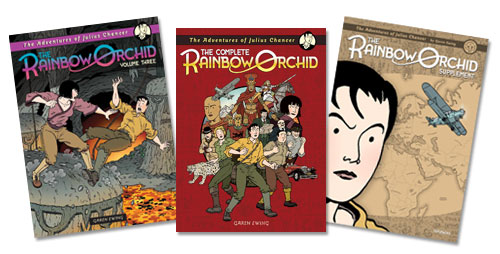
In September The Complete Rainbow Orchid came out - for me, the book that really matters, and the way I would like most people to read it. I still haven't read it all through myself yet, I'm waiting a while so I can at least have a partially fresh look at it. But Egmont did a wonderful job on the book, and I'm especially chuffed with all the extras. It even made a few best-of lists for 2012:
The Observer best Graphic Novels of 2012 - "... timeless adventure stories that fans of Tintin will adore."
Forbidden Planet Best of the Year: Zainab - "... Ewing's adventure of a search for a rare, possibly non-existent flower left me more excited than that sentence possibly can recount. I have no further words for it: it's just a fantastic comic."
Forbidden Planet Best of the Year: Rob Jackson - "... this is my best of the year, it's such a beautiful book. It was great to read the whole story all the way through in one go."
Jason Cobley - "... the pages just zing, enthralling kids and grown ups alike. Proper all-ages storytelling. ... if you're looking for something to get youngsters away from TV and reading something that also gives them visual appeal, here it is."
And a couple more from Laura Gomez and Jonathan King. There was also this very nice review from coNZervative in New Zealand. I wouldn't be aware of most of these nice mentions if it wasn't for Linda Wada, who maintains a Rainbow Orchid fan-page. Big thanks, all!
Another nice thing that happened this year was The Rainbow Orchid getting distribution in the United States, resulting in a number of positive reviews and mentions, including this one from Comics Worth Reading ("... "a great example of what "all ages" really should mean"). There was a good interview with me on US comics website The Beat back in January.
In November I published The Rainbow Orchid Supplement (Down the Tubes review and Forbidden Planet review), and the Spanish edition of RO came out, La Orquidea Arcoiris from NetCom2 Editorial. A few months earlier Silvester Strips brought all three volumes of De Regenboog Orchidee into a lovely boxed set, or cassette.
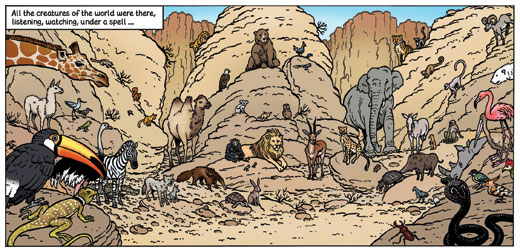
January 2012 saw the launch of The Phoenix, a brilliant weekly comic for kids that has been quite rightly receiving praise and plaudits from all quarters. Due to other work commitments I haven't been able to be a big part of it (yet!), but I was delighted to appear in the first issue with The Legend of the Golden Feather and in the middle of the year with The Bald Boy and the Dervish, both written by Mezolith author and storyteller, Ben Haggarty. It's chock full of the very best of British comic creators, so give yourself a present for 2013 and subscribe!
On a personal level the year has been a nice one, though with one low point when I lost my dear cat, Tansy, on her 14th birthday in August (you can see a photo of her in the back of The Complete Rainbow Orchid as I tried to get her to pose for the cover of volume two!). A good innings, but she's terribly missed. On the up-side, my daughter saw her first birthday and is turning into such a lovely little person - I feel very lucky.
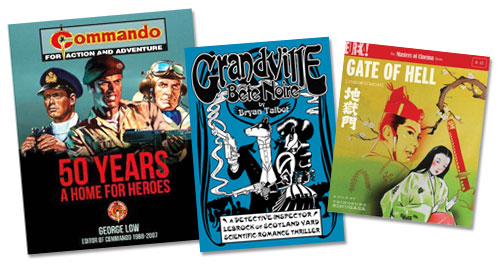
I had a good Christmas - my comics presents were Bryan Talbot's third Grandville book (completely terrific) and the Commando: 50 Years book (have yet to explore, but looks wonderful). I got a beautiful Japanese print (which I may blog about soon) and I'm looking forward to watching Jigokumon, which i got on DVD.
So what can I say about 2013? Firstly, the French language editions of RO, L'Orchidee Arc-en-ciel will be published in February by BD Must, and I'm really looking forward to seeing those. I can also say there will be new Julius Chancer, though with no contracts signed, as yet, I'm reluctant to say any more. But even if every publisher suddenly abandoned me you'd still get new Julius Chancer - on this website. Still, the greater likelihood is that it will be in print, and I'm looking forward to getting stuck into that.
Here's hoping we all have a fabulous 2013 - happy new year!
Very little is given away about Evelyn throughout The Rainbow Orchid. The only hard fact seems to be that she works for Urkaz Grope. We can see she's resourceful, often using deceit as a weapon, though she also keeps a handgun and a pocket knife handy. That's if she even needs them - her unarmed combat skills have evidently benefitted from training, possibly karate from the style of some of her techniques.
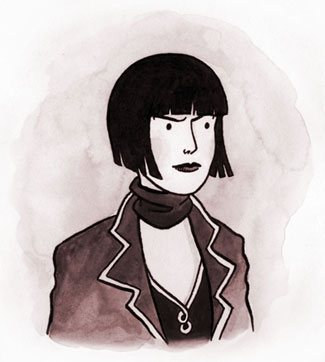
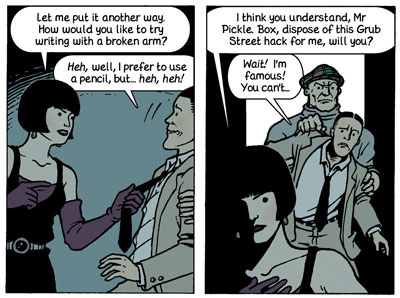
She's a careful planner and a strong leader, as well as incredibly loyal to Grope, even going so far as to kill those who would get in her way - she doesn't seem to be too troubled by empathy. Her self-confidence knows no bounds; she's genuinely shocked when the tables get turned on her (a rare event). She's smart, classy, and probably a little vain.
Evelyn may have a blank on her character's history in the story, but I can at least offer something regarding her creation. Like Lily Lawrence her origins lie in the abandoned short comic I wrote in 1996 called Stage Fight - a story that would eventually be produced as Sword of Fate, Lily's origin tale, in The Girly Comic. Stage Fight featured a character called Evelyn Saxon, a Victorian vamp with a wine bottle in one hand and a couldn't-care-less attitude in the other (I renamed her Eleanor Saxon for Sword of Fate). You might see a future echo of her in the character of Josephine Bolan from my episode in Blank Slate's Nelson, and if you happen to know some of my much older work then you might see a more distant version of her as The Sorceress from my fantasy story Realm of the Sorceress.
Physically she is a 1920s modern woman with a straightforward yet stylish hairstyle that matches her character, inspired by some of the more self-determined figures of the silent screen: Louise Brooks, Clara Bow, Pola Negri, and a little Theda Bara for good measure. Another more recent similarity has been noted - with that of Irina Spalko, played by Cate Blanchett in Indiana Jones and the Kingdom of the Crystal Skull (though Evelyn predates her).

I mentioned earlier that Evelyn Crow carries a handgun and I'd like to say something about my philosophy of gun use in The Rainbow Orchid (and in my stories generally). When Evelyn fires the gun it has consequences - people get hurt, and I don't just mean cartoon-hurt (even though this is a cartoon strip). I hope you feel that Tayaut is in real danger from his bullet wound, and you can also see the effect it has on his friends and loved-ones, not to mention the death that also occurs. And, of course, Evelyn becomes a victim herself later on, again with consequences that affect characters and story.
For me, when a gun is introduced into the plot, it is not as a solution - it does not enable the hero to solve the problem of his antagonists; it is a complication. I hate films where a gun is just a toy-device that blasts people away with no effect on lives or story. I'm not against action films with guns, even fairly violent films to some degree - as long as there are consequences. It's a matter of the weapon having weight, a weight that reflects what can happen in the real world - I think that's important.
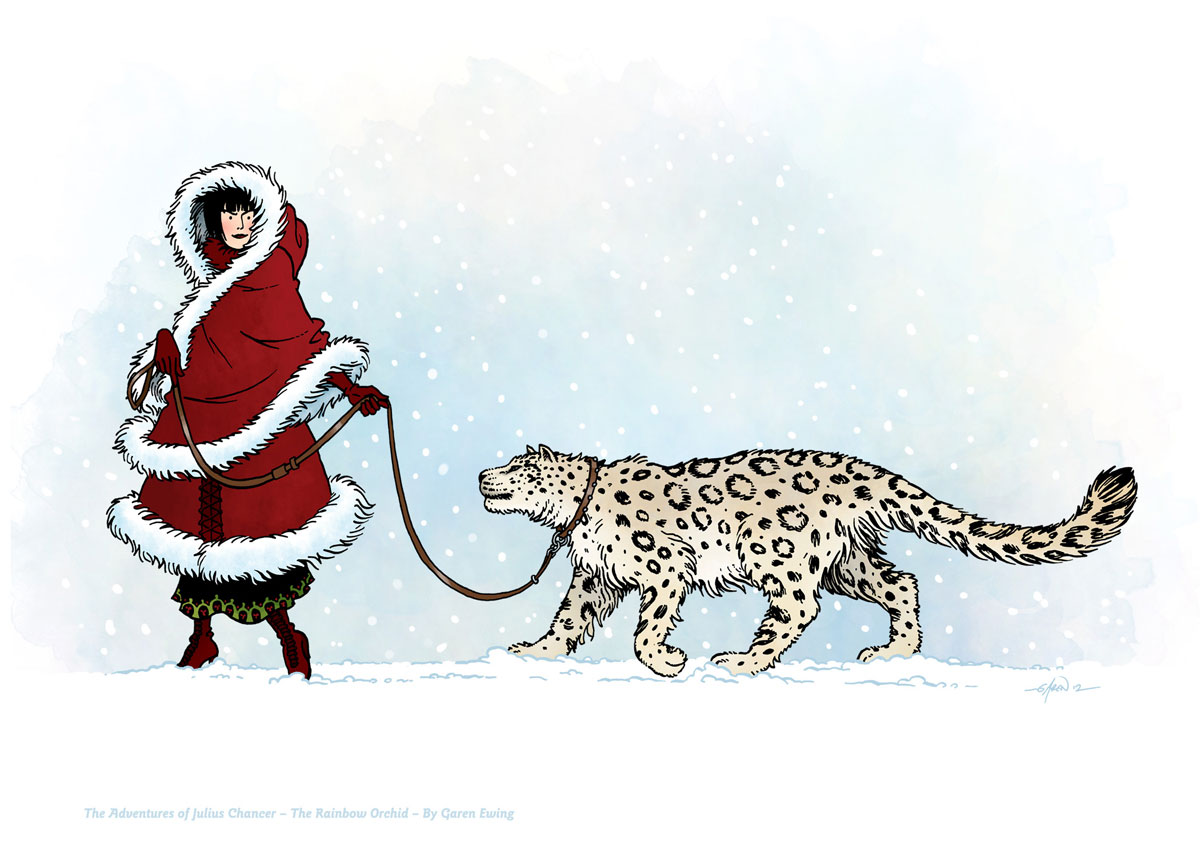
My Christmas card to you this year consists of two reader favourites from The Rainbow Orchid, the exoptable yet deadly 'dark angel', Evelyn Crow, and barfani chita - the snow leopard (click picture to see a bigger version). You can expect a blog post about Evelyn in the next couple of days!
 previous