


This blog began in 1997 as a single news page called Nucelus. In 2005, during a long wait to move into a new house, I decided to learn some php and MySQL and write my own blogging system, which became inkyBlog and which now powers this, my own Webbledegook blog.
Thank you to my brother, Murray Ewing, for help with some of the more challenging aspects!
You can do a Rainbow Orchid maze to find the Trembling Sword of Tybalt Stone (pdf) or to recover the statue of Idrimi, King of Atalah (pdf). Or you could try your hand at the snow leopard dot-to-dot (pdf). When you've done those, you can test yourself with the Rainbow Orchid word-search (pdf).

I also have three spot-the-difference scenes you can try your hand at (no.1, no.2, and no.3, all pdfs) and, finally, a make-your-own comic page, originally made as a feature for TBK Magazine (pdf).

(By the way, if you get really stuck, here are the spot-the-difference answers!)


Most of these are perennials - albums that are intertwined with my history, burned into my neural pathways in some way, or chained to particular times or emotions. It's a tough decision, and many favourites have been left behind. I worry there's not enough diversity here - because actually my music collection is very diverse. But from this I was formed, and that's the way it is.

Matthew was just nineteen years old at the time and working as a collier, probably at the nearby Clough Head pit. Although his father came from Marsden, he'd been born in Manchester, with his five younger siblings (three sisters and two brothers) born at various places - in the city, in Colne or in Marsden itself - reflecting his father's search for work which alternated between the core local industries of cotton weaving and coal mining, not always with success.
The door was answered by the shoemaker's wife, 77-year old Mary - she didn't know who this young man was, shouting and being generally abusive in his intoxicated state, but she managed to get him out and shut the door. Her husband was still away in Burnley on business, but was expected back soon. Perhaps she was alone, but it's possible a young relative, 15-year old John Thomas Wells, was also present.
Henry and Mary don't appear to have had any children, but they seem to have been responsible for bringing up young John - the illegitimate son of Isabella Wells who may have been Mary's niece - and trained him as a cordwainer (he later moved to Accrington and became well-known for his political debating skills).
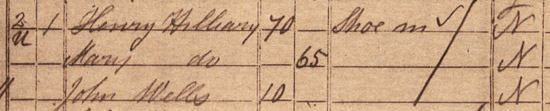
The Hillarys on the 1841 census, Catlow Row, Marsden
Forty-five minutes later, Henry Hillary returned home from Burnley, but as he entered through his front door, Matthew Higson suddenly appeared and pushed in after him. The two men argued, with Matthew again becoming abusive and refusing to leave. At some point it became too much for the 79-year old Henry Hillary and he rose and slapped the young intruder across the face. Matthew responded by jumping up and kicking the old man in the stomach, forcing him back down in to his chair where, in excruciating pain, he exclaimed he'd been "killed" and that this was his "death blow".
Henry was put to bed but spent the night vomiting blood and "other matter". Despite the efforts of a local surgeon from Colne, Dr. Henry Buck, Hillary was in pain all the next day and then finally, in the very early hours of Monday morning, his words were borne out and he died.

The initial report in the Manchester Courier, 23 October 1847
The inquest was held a week later, in Marsden at the Merry Colliers (known as the Marsden Cross in more modern times), just down the road from Catlow Row where the incident took place. The district coroner, John Hargreaves, travelled from Blackburn, and Dr Henry Buck travelled down from Colne. Also present as witnesses were the widow, Mary Hillary, the deceased's apprentice, John Thomas Wells, a local stone mason, Robert Binns, as well as a David Spencer and one Margaret Smith.
Dr Buck, who had qualified as a surgeon three years previously and was a third generation medical man in the locality, had performed a post mortem on Hillary and gave the surprising evidence that the old shoemaker had suffered a ruptured intestine two or three months before the attack. It was his opinion that the kick had "nothing whatsoever to do with the deceased's death" and that the old rupture was to blame. The pain following the kick, the doctor said, was "entirely accidental".
In accordance with this evidence the verdict returned by the jury was one of "accidental death by a rupture", and Matthew Higson escaped a possible manslaughter conviction which could have carried a sentence anywhere from twelve months with hard labour to transportation for life.

Catlow Row, Marsden, in 1848
Mary Hillary, Henry's widow, died just over a year later, aged 78. Matthew Higson, my ggg-grandfather, having only just survived a serious accident at the local Clough Head pit, married within a month of the old widow's death, and went on to have seven children (six girls and one boy). While the events of October 1847 were not Matthew's last brush with drink and the law (though none were again connected with such violence), he does seem to have had a lucky escape from a very tragic incident
Reading this story, which was reported in the Blackburn Standard and the Preston Chronicle (no inquest reports have survived, just the coroner's expenses record), it seems amazing that Matthew Higson's kick to the stomach had no part to play in the death of Henry Hillary, especially given the awful reaction the elderly victim had through the following night, and I found it hard to believe my ancestor's terrible conduct didn't have some part to play in this tragic tale.
It would be the obvious reaction to think that Matthew killed Henry Hillary that night and that a harsh custodial sentence should be the result, and no doubt those must have been the thoughts of many going into the inquest that day. That was my reaction when I first came across the story. But as I read the article more closely and researched the findings given by Dr Buck, I gradually changed my view. It was Buck who examined the deceased and noted the "mortification" of the intestine - in other words, it was in an advanced state of decay, the result of weeks-old impeded circulation at the site due to a previous injury.
While it does seem impossible to imagine the young collier's kick had no effect at all, without that old rupture the kick might have merely thrown Hillary back into his chair with no serious damage done. There can be no excuse for Matthew Higson's aggressive behaviour that Saturday night, and I have no doubt my ggg-grandfather did give Hillary his 'death blow'. Was Matthew horrified at what he'd done, or ambivalent? Had he caused the death of a friend or a stranger? Did he go for the doctor himself or did he run away? We'll never know what the argument was about or what their relationship was. But perhaps the bare facts of the case did prevent the wrong conclusion being jumped to, and some thin strand of justice - if it can be called that - was pulled from this terrible event.
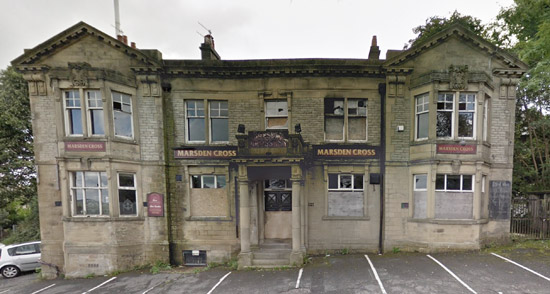
The remains of the Marsden Cross in 2015, at one time known as the Merry Colliers

I hadn't realised that my Belgian-based publisher, BD Must, had run a crowd-funder earlier this year to produce the binder, and as it funded at 225% production went ahead and it's available. Plus I now have a few books to add drawings to for the top-tier funders.

The centre-spread art for the binder is from an early draft of the cover for volume 3, produced for Egmont long before I finished the album, but required for various advance publicity things, so it doesn't quite reflect what eventually appeared in the actual story. It's nice though!

In the following article I'm going to record (perhaps solely for my own benefit) how I broke down a twenty-year brick wall, as well as highlighting the clues that revealed the facts and a couple of wrong turns I took, while hopefully offering some routes that may be helpful to others in a similar situation. Warning: this is still a work in progress, may contain errors, and does not necessarily constitute an end result!
When I started researching the Camerons back in 2000 I made fairly quick progress through the usual route of birth, marriage and death certificates (along with a few letters from a great uncle and a photocopy of a family Bible). My great-grandfather was Peter McDougall Cameron (1881-1923), his father was Peter Cameron (1856-1913), and his father was Donald Cameron (1810-1887), with the family hailing from Perthshire, particularly Clunie, where Donald was the Church officer. At Donald I hit a brick wall - and he currently remains one (though I have a small book's worth of research and theories that I'm hoping will click one day and unlock the answer; update: see here for more on this).

Clunie Church (photo by Garen Ewing, 2002)
But I was even more intrigued by Donald's wife, Catherine Campbell. The census returns gave her a birth date of around 1815 and her birthplace as France (though a British citizen). Her death certificate, from 1889, claimed her parents were Donald Campbell, a sergeant in the 42nd Regiment, and Barbara Stevenson. Anyone with a taste for military history will recognise the potential importance of the date 1815 - the year of Waterloo. Indeed, a family story claims Catherine was 'born at the battle of Waterloo', and the 42nd Foot were in the thick of it. In fact, the battle did not take place in France but in nineteenth century Netherlands (now Belgium), though afterwards the regiment moved to the vicinity of Paris as part of the occupying army, before returning to England in December, which may give some logic to the record of Catherine's French birth.
With these facts at hand I spent the next nearly twenty years trying to find and identify Catherine's parents, but to no avail. Perhaps the names on the death certificate were wrong, in which case my chances of finding Catherine's forebears were going to be next to impossible. Donald Cameron and Catherine Campbell were a brick wall so high that I started to accept I'd probably never be able to climb it.
On New Year's Eve 2018 I was in the house alone and found myself, yet again, making a fresh search for Catherine's parents - only this time something came up. I don't know if it was a new record, or just that my desperation was leading to more and more creative searches, but up popped an 1810 baptism at Musselburgh for one Alexander Campbell, son to a Donald Campbell, sergeant in the 42nd Regiment, and his wife Barbara Stevens. Seeing those names confirmed as real, after all this time, had a surprisingly emotional impact.

Baptism of Alexander Campbell at Musselburgh, 1810
At last I had a contemporary account of my 4xg-grandparents, so I went into overdrive searching for any other trace of their existence. The standard searches continued to remain silent, but when I tried something a bit different I came up with another result. The above baptism of Alexander Campbell took place in Musselburgh in 1810, which coincides, unsurprisingly, with the location of the 42nd Regiment on that date. I decided to search the census returns for anyone named Campbell who was born in a known 42nd Regiment location, either at home or on campaign, within the early 1800s.
To my surprise I had some success and came up with a William Campbell, born in Gibraltar around 1808 - the location for the 42nd just before they embarked for the continent and the Peninsular War. A little research on this William, who also stood out to me because he was living in Perth, not too far from my own Catherine Campbell, seemed to confirm him as a 4xg-uncle - a brother for Catherine. He died in 1879 and his death certificate recorded his parents as William Campbell, soldier, and Barbara Stevens. I reasoned that 'William' was probably a mistake that should have read Donald (though I did make a note that I should allow for the possibility of a previous Campbell husband, even if that seemed unlikely). He had married Martha Hamilton in Perth in 1834, and one of his children helped to confirm the family connection.

Death of William Campbell at Perth, 1879
In 1844 he had a son baptised as William Keir Campbell - significant because Catherine also had a child, a daughter, baptised in 1844 called Charlotte Keir Cameron. Neither of the children survived into adulthood, William dying in 1848, and Charlotte sometime before 1851. I'd often wondered about the name Keir, reckoning it must have had some importance to Catherine, so I decided to divert my attention onto that question for a bit - who were the Keirs?
I started my research looking at contemporary Keirs in the Clunie and Caputh locales of Perthshire and a promising family soon emerged. A William Keir, born in Caputh in 1760, married Helen Sangster in Clunie in 1798. One of their children was Charlotte Keir, born in Clunie in 1804. A niece, born in 1843, was called Charlotte Keir Lamont. William Keir lived a long life, and though he died in Rattray, where he worked as an inn keeper, his 1856 death certificate notes that he was buried in Clunie, certified by the Church officer there - Donald Cameron, my 3xg-grandfather. That seemed to seal it, though I could find no obvious family connection, and no evidence linking Catherine's brother William. They may just have been family friends, but certainly the connection was likely to have been with the Campbell parents.
It felt as though a long-empty canvas was now being slowly filled in, and I continued my searches with the few available records of the 42nd Foot in the early 1800s that were available online (particularly the regimental Description and Succession Books). From these there appeared to be only one Donald Campbell who was a sergeant in the right time-frame. He was born in Halkirk, Caithness, around 1781 or 82, and in December 1799 he'd enlisted with the Caithness Highlanders before serving in Ireland following the 'Rebellion'. After the militia were disbanded in 1802, he joined the 42nd Highlanders. There was a slight spanner in the works in that he did not appear on any of the rolls for Waterloo - even if he was killed there, or at the immediately previous actions of Ligny or Quatre Bras, he should have been on the roll, but perhaps he was wounded or sick, or maybe he was one of the men kept back on guard duty in Brussels.

Camp of the 42nd Regiment
As for his marriage to Barbara Stevens, that remained elusive, but an interesting newspaper article from the John O'Groat Journal of March 1883 provided a potential theory. It told how many of the Caithness Highlanders returned from Ireland and " brought home to Caithness Irish wives, and it is universally admitted that they were 'pretty women' and that many of the Caithness girls were not a little mortified to find that their old admirers had returned, already provided with spouses". Could Barbara be Irish?
At this stage I had confirmation that Donald Campbell and Barbara Stevens/on existed, I was pretty sure that Donald was from Halkirk in Caithness, and I knew they apparently had three children, born in 1808 (in Gibraltar), 1810 (in Scotland) and 1815 (in France), and also that a Keir family had some importance to the Campbell children - but that seemed to be the limit of what I could discover for now.
With that I turned my attention back to later branches of the Cameron family. I had been slowly going through the families of Donald and Catherine's children, many now in Glasgow and Dundee, filling out their stories and keeping an eye out for any clues that might reflect on the families' past. Especially interesting were the children of daughter Barbara Cameron and her husband James Wilson. They had both died before the turn of the 20th century, leaving a young family largely in the charge of eldest daughter, Agnes.
I eventually got round to looking more deeply into Agnes's story - in 1906, at the age of 37, she married a 58-year old widower and ex-sailor called Archibald Wallace. They settled down and ran a local shop in Birnam near Little Dunkeld where they had two daughters (a previous son had died as a baby, and only one of the daughters made it into adulthood). Archibald died in 1925 and Agnes in 1950, both in Dundee.

The children of Donald Cameron and Catherine Campbell
To complete the story I was also looking a little into the families of the wives and husbands of the Cameron children and grandchildren, and I was particularly intrigued by Agnes's husband, Archibald Wallace, and his life as a merchant sailor. He'd been born in Argyll, the son of a candlemaker, and in 1879 he'd married his first wife, a young widow called Sarah Sim. A couple of things stood out on Archibald and Sarah's marriage certificate when I found it - Sarah's parents were recorded as George Sim, soldier, and Charlotte Keir, and one of the witnesses was James Wilson, house painter, and the father of Agnes Wilson who would become Archibald's second wife twenty-seven years later.
Besides the hint of a family relationship with Archibald or Sarah much earlier than was previously known, the name Charlotte Keir was surely no coincidence, and I immediately furthered my research into Sarah Sim and her family. George Sim had been a corporal in the 92nd Foot, but I could find very little about him, other than he married Charlotte at Perth in 1844 and seems to have died around 1850. Looking more closely at Charlotte was like a lock clicking open. She died in Perth in 1860 and her parents were recorded as William Keir, late of the 42nd Highlanders, and Barbara Stevens.

Death of Charlotte Keir at Perth, 1860
So Barbara had married again, staying within the regiment of her previous husband, Donald Campbell, and had become a Keir - a more concrete explanation for the middle name of her two grandchildren, William Keir Campbell and Charlotte Keir Cameron. Besides dismissing my previous Clunie-Keir discoveries (though I still wonder if they're part of the same wider Keir family) it also meant that Archibald's two wives were cousins (half first-cousins once-removed, to be precise, or to put it another way, their mothers were half-aunt and niece).
From there the research avenues opened up and the picture started to come into sharper focus. William had been with the 42nd Regiment since 1805, had served in the Peninsular war at Busaco, Fuentes d'Onoro and Ciudad Rodrigo, and was discharged while on service in Ireland in 1822. But unlike Donald Campbell, I found his marriage to Barbara in 1816, in Thurso, Caithness. The couple had four (known) children, half-siblings to Catherine and William Campbell: James and Charlotte in Ireland, and then Daniel and Frederick after William's retirement in Perth.
Looking for Thurso connections I found another surprise - Barbara Stevens had married a William Campbell, a soldier in the 42nd regiment, in Thurso in 1803. This changed things again - it seems the William Campbell born in Gibraltar in 1808 was not, in fact, a full brother to Catherine, but a half-sibling - the father's name on his death certificate had been right after all. So Barbara had three husbands within the 42nd Foot - William Campbell, Donald Campbell, and William Keir. This was not an unheard of situation in these years of the Napoleonic wars. Writing in 1841, ex-42nd Highlander James Anton had mentioned in his memoirs the plight of the wives on campaign who lost their husbands, "many a good woman, who in a few months, perhaps weeks, after her sudden bereavement, becomes the wife of a second husband."
Similarly Sheila Simonson mentions in her paper Following the Drum: British Women in the Peninsular War, "when a woman's [soldier] husband died ... the odds were good that she would remarry within the week." If a woman couldn't remarry, or if a job could not be found for her within the regiment, her rations would be immediately stopped and she and any children would be sent back to England without any further support, facing potential destitution and poverty. It's recorded that the highest known number of husbands a woman held in the Peninsular war was six.

Soldiers On A March (1811) - 'to pick up her tatters and follow the drum'
To my delight I found William Keir and Barbara on the 1841 census, at Redgorton in Perthshire. By now William was working as a hand loom weaver, and while it showed their son James was born in Ireland, Barbara herself seems to have been Scottish, though not a native of Perthshire.
I also discovered a statutory death record for William Keir in 1857, in Perth, and that reminded me to check the very useful Perth burgh burial registers that were available at the Perth and Kinross Council website. Sure enough, William's burial was recorded, buried at the Wellshill Cemetery in Perth, but I also discovered a burial for his wife, Barbara (recorded as 'Kerr') - she died in October 1847 with the cause given as 'apoplexy' - a term often used for any sudden death.
By now I'd done a lot of research into the Keirs, but I was starting to dry up again on Barbara Stevens and had made no progress on her possible origins. One evening I made a tentative search in the Perth newspapers around the time of her death - knowing that obituaries and death notices were not nearly as common as they would later become, especially for women, so not expecting anything in return. Nothing was coming up until I really honed down the date bracket and just tried the name 'Keir' on its own - and I got a hit.
The Perthshire Courier of 4 November 1847 had a report on the sudden death of 'Mrs Keir', the wife of an [army] pensioner (explicitly named as William Keir of the 42nd Regiment in the Dundee, Perth & Coupar Advertiser version of the article the following day). She was returning home with a neighbour after putting out some washing on the green when she collapsed and died. But it gave up more ...
"Few women have endured more of the fatigues and hardships of life than Mrs. Keir. She was at the battle of Corunna, marched with the army in the previous memorable retreat, carrying along with her an infant seven months old; afterwards went out with the army to Portugal, and through all the campaigns in that country, in Spain, and in France."
The seven-month old child would have been little William Campbell, and I can't help but wonder what happened to his father - was he a casualty of those terrible months at the end of 1808 and into 1809? Or did he make it, with his wife and child, onto the ships that eventually came and made possible their escape back to England?

The 42nd Foot at Corunna, by Harry Payne
And what of Donald Campbell? He certainly seems to have been Barbara's husband by 1810, and must have at least have been in the picture within the nine months before Catherine's birth in France in 1815. But did he die in France or did he return to England in time for Christmas of that year? Curiously, at the marriage of William Keir and Barbara Steven in 1816, one of the witnesses is recorded as being 'Donald Campbell' - not a unique name by any means, but it certainly adds to the mystery of it all.
While I continued to research the easier pickings of the Keir children and their families, as well as some intriguing Cameron connections that came to light after looking into some of Agnes Wilson's friends and siblings, I poked an occasional idle theory or two concerning Barbara Stevens. I'd already discovered so much more than I ever imagined I would, but she had to have come from somewhere ...
One theory I tested was that her mother may have been called Charlotte. She named her second (known) daughter Charlotte Keir, not a hugely common name in 1820 (just over 80 Charlottes were registered in Scotland in 1820, compared to over 200 Barbaras, 385 Catherines, 2,300 Marys and 2,700 Margarets), and the name didn't seem to come form the Keir side of the family. I did find a Barbara Steven, born around the right time, in 1782, to a William Steven and Charlotte Hill, but it was in Edinburgh, and I had no reason to connect her with my own Barbara Stevens.
I was starting to think that she may have her origins in Caithness, and particularly in Thurso - after all, that's where she married her first husband, William Campbell. I turned to my DNA matches to see if any strong connections came up with Stevens and Caithness. A few came up, but with nothing very convincing - except for one who had a John Steven who died in Thurso in 1890. Their tree was not complete so I did a quick series of searches and discovered the possibility that this line lead back to an Alexander Steven who may have been the Thurso-born son of a William Steven and Charlotte Hill - the same names I'd discovered recently in Edinburgh.
I looked at this couple more closely and discovered that William had been a journeyman blacksmith and had married Charlotte Hill in Edinburgh in 1781, having Barbara the following year. But what I'd missed before was that they then moved to Thurso where they had three more children - Jean, Magnus and Alexander. As it turned out, this was not the Alexander of my DNA match - her Alexander was of a completely different line (the son of David Steven and Elizabeth Mowatt of Olrig). My hurried family tree was a mistake but had inadvertently lead me to the right family.

Baptism of Barbara Steven at Edinburgh, 1782
How did I know that I had finally found Barbara Stevens' parents? It was all in the witnesses, only revealed by looking at images of the original baptism documents (they're not included on the searchable indexes). While none were recorded for Barbara in Edinburgh, the Thurso records were slightly more detailed. Barbara's siblings had a couple of witnesses who appeared on more than one occasion, including James Keith and Magnus Steven. They helped to identify that William Steven had a second marriage in Thurso in 1790 to one Janet Sutherland (presumably Charlotte had died). This marriage had Magnus Steven as a witness and a new name, Richard Sutherland - likely the father of the bride.
Richard Sutherland continued appearing as a witness for a number of the new couple's children, all the way to 1803. In one record, in 1795, it was mentioned he was a 'Chelsea Pensioner', in other words an old soldier (and I would later discover his probable daughter, Janet, was actually born in London). More importantly he appeared on a document I'd already been holding for a number of months - the marriage of Barbara Stevens and William Campbell of the 42nd Regiment in Thurso, in 1803, where one of the witnesses was Richard Sutherland. I double-checked to make sure he wasn't some kind of church official, thus appearing across many records - he wasn't, but was connected closely to the Thurso Steven family. Also, while Sutherland is one of the most common Caithness surnames, Richard Sutherland was very rare, appearing only about 15 times across the whole of Scotland in the old parish records (compare that to over 500 John Sutherlands in Caithness alone).

Richard Sutherland, witness at the 1790 marriage of William Stephen and the 1803 marriage of Barbara Stephen
Looking at the witnesses also helps, I believe, take the Thurso Stevens back one further generation. Barbara's father, William, appears in a number of online trees, though often only recording his second marriage to Janet Sutherland, and then they differ on his parentage - with some opting for a family form Dunnet, and others from Olrig or Wick. But I think he was Thurso born and bred, specifically to Magnus Steven and Jane Manson, with William born in 1756.
While I can't find a marriage for Magnus and Jane (sometimes recorded as Anne), one witness to the baptism of their son Magnus, in 1765, was James Keith, the same name that appears on a couple of the early baptisms for William and Charlotte. Another is Francis Manson - a name that appears on four of the Steven/Sutherland baptisms (1793-1797) and one of the Steven/Manson baptisms (1761) - the dates suggesting the latter witness is the father of the former, the son of Francis Manson and Katherine Bain, born in Thurso in 1771.
The birthdate of 1756 for William might also tie in with the possible age of Charlotte Hill. While no baptism for her could be found, her marriage entry does record her father to be one George Hill of 'Mutton Hole', Edinburgh, and I did find a George Hill having several children in that precise locale, with his wife Janet Aitken, between 1750 and 1758 (update: I now also have a DNA link with another descendant of this Hill family).
At the end of all this I find I have a surprisingly full biography of the life of Barbara Steven/s/on, but also many questions. What happened to her first two husbands, the Campbells, William and Donald? I can only presume they perished on campaign - did William die at Corunna or during the retreat there? When did Barbara marry Donald, and did he die in Flanders or France, or did he make it back to Scotland? What of their son, Alexander, born in 1810 - I've not been able to confirm his existence into adulthood. Did she have any other children? And looking further back into her roots, would we eventually find Scandinavian blood? Her grandfather seems to have been called Magnus, and she had a half-brother called Darg, both names with an Icelandic or Norse origin, places with a strong connection to Thurso - though that may be many generations further back, and will have to be a search for another day. There's plenty to still find out.

Thurso, Caithness, in a map from 1822 (National Library of Scotland)
Hints and tips
Search again within record sets you've looked through before - there may have been new records added, or you may have new information or experience that makes your search more successful.
Sometimes more general searches could open a door, for instance search for just a surname in conjunction with a particular place and see who comes up.
Use wildcards (*) to search for variant spellings of a name. When searching for Stevens I used 'st*n*' to encompass all Steven, Stevens, Stevenson, Stiven and Stephens (etc.) - all were spellings used within the family I was searching for. Keir was also spelled as Kier, Keer, Kear and Kerr or Ker.
Look at the original documents (or facsimiles of them) as much as possible - often they will contain extra information that doesn't appear on the index (such as witnesses or exact locations) that can help differentiate between families with the same name, or they may reveal that, actually, the index transcription is wrong.
First and middle names can be clues to other parts of the family, but they could also just be a tribute to friends or neighbours. I knew to keep an eye out for the name Keir as it was used as a middle name, but I also knew another middle name - Leishman - was from a family friend, the local church minister.
Research the spouses of your family members as well as any previous wives or husbands if they were widowed, if they're fellow locals you might be surprised to see a familiar surname within their family.
I started The Rainbow Orchid in 1996/97 before it saw small-press publication in BAM! (Bulldog Adventure Magazine) in 2002. In 2005 I started colouring the strips and posting them online. One thing lead to another, which lead to getting an agent, which lead to several publishers showing interest, and eventually to publication through Tintin's UK publisher, Egmont.

Not content with one, I had two book launches in August 2009 - an 'industry' one at Foyles in London (I was super ill, but managed to survive the evening) and a local one at East Grinstead's Bookshop. The support and love shown for the book at these and subsequent events was wonderful, and has continued throughout the life of the book - an aspect I find pretty humbling and feel enormously lucky about.

At the end of 2009 I wrote up a little overview of how the book had been received, with some thoughts on the UK comic industry of the time (a lot has changed since then). I was privileged to have a number of lovely and enthusiastic people working with me on the book, and in 2010, around the time volume 2 was published, I interviewed several of them about their roles in publishing (agent, commissioning editor, editor, designer, and press officer).
In July 2010 I was able to announce the first foreign language edition of The Rainbow Orchid, in Dutch from Silvester Strips. This would be the first of a handful - with Spanish in 2012, French and German in 2013, and Danish in 2015. A contract was also agreed and signed for a Bengali edition, but sadly the book never materialised.

These European editions lead to me travelling to my first comic shows abroad - twice to Holland, twice to France, twice to Denmark, once to Austria, and four times to Germany. Of course I also attended a good number of UK comic shows and most of the big literary and book festivals - which were wonderful. (I won't mention specific shows, but all my reports are linked here.)
Not every event I did was a roaring success - I did a fair number of school events (not listed), some were fantastic and some I couldn't wait to get out of there! I turned up to one bookshop event to find none of my books on display, no promotion, and, perhaps not surprisingly, just one person turned up to my talk at the end of the afternoon. At another I found my audience was largely 5 and 6 year-olds - too young for my book really - and a table of cakes and fizzy drinks had been set up right next to them. That was memorable! At the other end of the spectrum I found an audience full of serious-looking twenty-somethings, obviously expecting the 'graphic novel' workshop they were attending to feature more darkness and grittiness, and less how to make a fun story out of the surprise novelty items I'd placed into a pillow case and reciting my 'Adventurer's Oath'. We got through it!

One of my favourite events was at my second Edinburgh Festival, jamming and drawing stories with Nick Sharratt and Vivian French inspired by audience suggestions. One of the most memorable was travelling on my own to Angouleme, getting to stay in the grounds of a misty 14th century castle and having a series of more and more delicious meals. I spent time with some incredible comic creators from the UK and Europe, I had dinner with Tom Gauld, Kerascoet and Boulet, discussed blues with Francois Walthery, had a one-to-one director's commentary on Franka from Henk Kuijpers, signed a stack of books for an hour with Posy Simmonds, walked around Angouleme with Eric Heuvel and Vano, and have generally met more lovely people than in any other walk of life.

Sketching in books at shows was something I had to get to grips with quite quickly - I was very rarely pleased with the drawings I produced, but I did slowly get a little better as I went along. At festivals such as Hay and Edinburgh I may have had shorter lines than the big-name authors next to me, but when they'd finished, I was still signing - a sketch in every book!
I had some unusual requests, especially in Europe. Could I draw Evelyn in the nude? (No!). Please draw Julius flying an aeroplane, Julius riding a snow leopard, please redraw this panel here, these two characters fighting, full-length, etc. etc. I usually declined and got them to compromise with something smaller - or my publisher would step in, saying "portraits only!".

In 2012 the complete edition of RO was published - by this time Egmont may have been running out of steam on it, budgets were dwindling, sales were slowing, and I think I was feeling a bit tired of it by now too. There were still some nice things to come - including blistering sales at that year's Thought Bubble and a British Comics Award the following year.

To this day I have still not read The Rainbow Orchid all the way through from beginning to end. While I'm proud of it overall, some of it makes me wince and it's still the bits I'm least happy with that stand out to me when I look at it.
Having said that, my six-year old son just picked it off my bookshelf and asked for it be his bed-time book. I tried to dissuade him, but he insisted, so I am currently reading it to him, a few pages at a time. One thing I will say - the dialogue reads rather well out loud, and it's one book where I can be sure of getting the voices more or less right!


The French edition (L'Expédition Perdue) is published by Nuts! Publishing and the Polish version (Zaginiona Ekspedycja) comes from All In Games. A Chinese version from Yihu BG is also available - or soon to be, I'm not sure - I've seen a cover but haven't yet seen any sign of a physical copy.
The game itself is largely visual and doesn't require much in the way of translation except for the rulebook, of course. Besides the above repackagings you can find a number of downloadable rules translations at Boardgame Geek, including Spanish, German, Italian, Japanese, Hungarian, and Russian.

There are degrees of fame, of course, and not all of it the good type. So I can say I'm related to a murderer or two as well as a couple of murder victims (separate cases), a dodgy priest who was uncovered by the Boston Globe, a well-respected Victorian army piper, and a number of local worthies and 'characters'. However, while it's quite often the smaller stories and individuals I find truly interesting, there are a handful of modern 'celebrities', more widely known, that I share some DNA with. They are by no means close relationships but I can say where they sit on my family tree, so I thought it might be fun to have a look at them.
The first is Chris Farley, probably most famous for his time on NBC's Saturday Night Live during the early 1990s where he performed alongside fellow cast members such as Chris Rock, Adam Sandler, Mike Meyers and Julia Sweeney. He also appeared in a handful of films, including Wayne's World and Coneheads. Farley had a number of similarities to one of his heroes, another SNL regular, John Belushi, and unfortunately that included an addictive personality - he died from a drug-induced overdose in 1997, aged just 33 years old (the same age and cause as Belushi, 15 years earlier).

Chris Farley as 'motivational speaker Matt Foley', with David Spade and Christina Applegate, SNL 1993
Chris Farley (and his brothers, two of whom are also involved in the entertainment industry) is descended from the Henderson family who emigrated from Scotland to the US in the 1850s, becoming early settlers in some of the outpost communities of Wisconsin and Minnesota. Our common ancestors are James Ewing and Helen Clark (my 5xg-grandparents, his 4xg-grandparents), making Chris Farley my fifth cousin once removed.
Next on my list is the Queen of Brit-Art, Tracey Emin. I'd suspected we were related when I watched her 2011 episode of Who Do You Think You Are? where it was revealed she was descended from Midland Gypsies with the name Hodgkins, though hers came chiefly from Warwickshire, and mine from neighbouring Staffordshire.
At first I discovered that distant branches of our families did marry (through a very convoluted link) but it wasn't until a few key DNA matches appeared that I was able to confirm her as a blood relative and place her, fairly confidently, on the family tree. Our common ancestors are unknown, but it is highly likely that her 5xg-grandfather, Edward Hodgkins, is the brother of my 5xg-grandfather, Thomas Hodgkins, making us 7th cousins.

Tracey Emin in her London studio
Finally, back to Scotland and late 1805 where a ship's carpenter, James Horsburgh, had a bit of a dalliance with the twenty-year old daughter of a local land labourer, producing a son out of wedlock. The son was named after the father but did not follow him to Dundee, where a new wife gave him several more children, this time 'legitimate'.
These Dundee Horsburghs prospered quite nicely throughout the remainder of the nineteenth century, and they were joined in the city some 50 or 60 years later by a separate Horsburgh branch - actually the descendants of the 'illegitimate' James Horsburgh, though whether the two branches were ever aware of their half-cousin status after so long can't be known (unlikely).
This later Dundee branch are my ancestors and were responsible for a number of carting and contracting businesses within the city. The earlier Dundee Horsburghs are the ancestors of one Glasgow-born James William Somerville, also known as Jimmy, and the face and voice of famous 80s synthpop bands Bronski Beat and the Communards. Our shared ancestor is James Horsburgh (my 5xg-grandfather, his 4xg-grandfather) and that makes Jimmy Somerville my half-5th cousin once removed. (Sidenote: my wife's uncle, Royston Edwards, designed much of the sleeve and logo artwork for the Communards).

The Communards on Top of the Pops in 1986
As you can see, these aren't close relations and I just happened to discover them while climbing down some of the outer branches of my tree. There are probably others not yet discovered, and you'll likely have some too at this range where we have thousands of relatives spreading out from our common ancestors. I have been involved in a bit of acting, I've been in a band, and I work as an illustrator, so next time someone asks if acting or music or art runs in the family, I can answer, "well, as it happens ...".
"Will there EVER be another Julius Chancer graphic novel? We have been waiting for more than five years. I hope that you realize that it won't be long before your readers turn their attention elsewhere. Tintin has stopped the production of new stories, but there are 24 of them. Blake and Mortimer, ever since the title was revived, have come up with a new story every six months to a year. The Rainbow Orchid is too good to let die. Surely, the fertile brain that concocted that story has not run dry."
My stock answer to questions about an Orchid follow-up has been to say that the next story is plotted, partially scripted, and I've started the drawing - all true, but it doesn't really tell you much. So, I'll answer the points in the email above and, hopefully, shed some light.

Will there ever be another Julius Chancer comic? The real answer to that is that I have no idea. I always intended to do another and, as mentioned, I have started one. Since publication of the collected edition I have run hot and cold with the idea - sometimes feeling enthusiastic about it, and at other times thinking I should move on to something different. In the past year I increasingly felt I should abandon Julius Chancer and do something entirely new. The Rainbow Orchid was a big effort, wasn't quite as good as I wanted it to be, and the rewards have been mixed (though I hugely enjoyed the experience and I'm very grateful for all the appreciation it still gets).
To compound my recent feelings, last year I became very disillusioned with illustration and came to the brink of giving up on it. I'd thought about it before, when work was scarce (sometimes), or badly paid (nearly always), or if I was stuck in a particularly bad project (quite rare) - but it never felt serious and I didn't like the idea. But last year I felt absolutely fine about the possibility of leaving the profession and finding something new.
Even though I'm almost 50, it didn't feel like a mid-life crisis, I don't think I'm that sort of person. It felt calm and right. I went on holiday with my family and took all my Tardi albums to read (bliss!). I started getting new ideas about a different kind of work and perhaps some sort of comics hobby I could do that would free me from the pressure of perfection that ligne claire brings with it - it can be kind of exhausting.
After the holiday I left it at that and waited to see what might turn up. Soon enough a few bits of work came my way - I needed the money so said yes to them. Then more work came and my schedule was suddenly overloaded - and I enjoyed it. Illustration pulled me back in, and it felt fine.

In the past few months I looked again at what I'd done for the new Julius Chancer adventure and felt pretty positive about it. The story is good - more original than Orchid (which was very much an homage to books such as Allan Quatermain) - and my art has improved a lot, I think, since the last story.
The current position is this: I want to continue it, but I can't devote a lot of time to it as it doesn't earn me any money and I do need to make a living. So I'll do it as and when I can. It's likely to take a number of years to complete (though I will start putting it online at some point before that), and there's always the possibility it will not get finished at all (but I hope that's not the case - I like the ending).
As the email above says - do I realise my readers will turn their attention elsewhere? Oh, yes, I'm very aware of that, and there's no doubt that has already happened. I'm very grateful to have had any readers at all, but I don't owe them anything more, and they don't owe me any allegiance. I have no publishing contract, no deadline, and no pressure.

What about Tintin and Blake and Mortimer? Well, Tintin earned its creator a lot of money and he had a full-time studio working with him on his books. As for Blake and Mortimer, they are a star property in Europe selling well over 400,000 copies in France alone and the characters' new creators are handsomely paid for such a high profile project. I'm in a very different situation. I took a drop in paying work while doing The Rainbow Orchid for Egmont, and even with the foreign editions it wasn't enough to make a living. It took me quite a while to rebuild my illustration business afterwards - it's not something I can easily decide to do again, especially with two young children who have since come along.
While I'm here, the following is an example of another email I get fairly regularly ...
"My children are really enjoying the first two volumes of The Rainbow Orchid. They have read and re-read them countless times. The artwork is beautiful and the plot is engaging. They now want to find out how the story ends! Unfortunately we can not find the third volume for sale anywhere except at prohibitively expensive prices. We were wondering if there was a reprinting planned sometime in the future?"
From what I remember, and I might not be totally right on this, volumes one and two sold out their first print run and were reprinted not long before the collected edition was released - which may not have been the best timing. Volume three was released around the same time, so it didn't really get much traction. Whether it eventually sold out, or just stopped selling and was pulped or is hiding in a warehouse somewhere, I don't know. Resellers on Amazon sometimes seem to have copies available, and I think it appears on ebay every now and then. It won't be reprinted in book form and the digital editions were discontinued (that's another story!).
So, short version - Julius isn't dead, but don't worry about him for now and he'll make his reappearance when the time comes - whenever that may be.

It was a challenging but really fun job - a somewhat surreal city scene throwing together a regular town, a food market, and various giant food and drink products as part of the architecture. And I was very lucky indeed to be asked to follow up that first commission with illustrations for the subsequent 2018 and 2019 awards.
Here are the finished illustrations and a few of the working sketches (you can perhaps see I got a bit more confident and ambitious with each year!).


I also illustrated the covers (plus some internal art) for the accompanying Great Taste Books, distributed to over 245,000 retailers and celebrating that year's award winners.

 previous