Lifeline Research
Kitty Cooper
Cruwys News
Through the Trees
Shaking the Tree
DNA Explained
Lichfield Lore
Maurice Gleeson
Note: This blog constitutes just the family history category entries from my main blog, which you can visit here.
I had a nice quietish Christmas and took some days completely off for the first time in, oh, a long time. I decided to do some family history research, which I haven't spent any proper time on for at least a couple of years or more, and I found some good stuff and cracked a research mystery that has been something of a brick wall for twelve years.
When I mention I enjoy researching my family history a common reaction is surprise that someone so young (ahem) should be interested in a hobby that is generally regarded as the preserve of the retired. I love history, and I love doing research, but the catalyst in this case was a postcard album that my mum inherited from her mother when she died. It had belonged to my great-grandmother, and looking through it mum and I agreed that it might be fun to research some of the people the cards were written to, many of them long-forgotten and now unknown family members. Sadly, my mum died not long after, and the postcard album ended up with me permanently.
A few years later I decided to begin researching my family history and started gathering information from various relatives. At that time a lot of research still had be done by going to the Family Records Centre in Islington (for birth, marriage and death records and census returns) and the National Archives at Kew (most commonly for military service papers). I spent a lot of time with index cards, microfiche readers and gazettes, searching through lists and taking notes. Things are so much easier now! All those indexes and, indeed, many of the original records, are available and searchable online - what a difference. It's great that it's easier, and you can do so much more with database searches, but I must admit the sense of discovery is somewhat lessened when you're not 'out in the field', and you miss sights such as the American lady I saw at the FRC once, who had come to England especially to search the 19th century census returns, and sat at the microfilm reader in full Victorian dress to get into the part.
Discovering and learning about my family history has been a revelation. There are some who just can't understand the fascination, but I find it odd that many people just about know who their grandparents were but nothing beyond that. Knowing the story of how I came to be here, both genetically and geographically, having a 'history-map' of the people and movements that combined to put me, my brother and my parents on the earth, and knowing not just the depth of my background, but the width as well (6th cousins!). It's a big picture that I'm glad to be aware of and I've been able to find the truth behind some well-worn family stories as well as learning a lot about life in the past in general
In my family I've discovered tinkers, tailors, soldiers, sailors, nurses, firemen, artists, Gypsies, actresses, musicians, thieves, murderers, paupers, servants to publicans and peers, teachers, footballers, chimney sweeps, farmers, labourers, coal miners, clerks, shopkeepers, makers of cities, roads, ships, shoes, hats and fancy boxes, drivers of trains, trams, taxis and horse-drawn carts, preachers, vicars and, I'm sorry to say, one less than admirable Catholic Priest (very distantly related, I stress!).
One resource that has opened up relatively recently are newspaper archives. With this you can delve into the actual detail of life, beyond names, dates and occupations. Unfortunately, it's usually the bad news that gets reported - deaths and criminal activity especially, but they do, it has to be said, make for some of the most fascinating stories.
This Christmas I learned what had happened to a gggg-uncle, Robert Ewing, who had previously disappeared from the records as a 10-year old flax winder in Dysart. It turns out he went on to become the captain of his own ship and ended up being thrown into a stormy ocean and drowning off the coast of Syria when he was 32. Another one to add the the tragic Ewing family deaths.
The wife of another gggg-uncle, Henry Higson, I knew had died at age 37, but I had no idea how until a fairly lurid newspaper article revealed that she cut her own throat in front of her children at breakfast one morning - very shocking stuff. The fact that her brother was in an insane asylum was enough, it seems, to explain her tragic actions at the inquest. Knowing this sad story has made me want to now find out what became of the three daughters who witnessed it and were 12, 10 and 4 years old at the time.
The most 'sensational' story was the 1903 murder of a policeman committed by three Gypsy brothers who each received fifteen years in prison. One of them came out to fight in World War One and was killed at the Somme.
My most exciting find is far less sensational and more personal - and would no doubt bore you to death if I explained it in any detail! Since 2000, when I started, I've been trying to break through a wall to discover who the parents were of my ggg-grandmother, Eliza Sherriff. I have finally found the answer. It's been a long and torturous route to make the discovery - but that's what makes it so rewarding; finding the clues, one here one year, one there another year, until a door is finally unlocked and a whole pile of new questions and puzzles is revealed. It's hugely enjoyable.
This link will show you the family history category blog entries on this blog, and this link will take you to my little family history website.
So if I'm a little slower with emails, if work takes a little longer over the next few weeks, and if I'm a little behind in getting orders out, I hope you'll understand why. Thanks, as ever, for your patience and support!
P.S. I've just noticed that this is my 500th post (on this incarnation of the blog, anyway).
In 2004 I did a write-up of Mark Cameron, killed at the Battle of Jutland. In 2005 it was Charles Hodgkins, who served at Gallipoli. In 2006 I wrote about Walter Cameron, wounded in France with the Scots Guards, and in 2007 it was brothers David and John Ewing, both of the Royal Army Medical Corps. For the 90th Anniversary, in 2008, I wrote about MC-winning Andrew Stewart, and also presented a memorial list of my nine known relatives who were killed in the Great War.
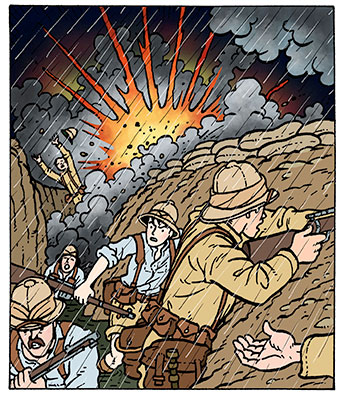
From The Rainbow Orchid volume II, Julius Chancer in the trenches at Gallipoli, partly based on the experiences of my own great-grandfather, Charles Hodgkins.
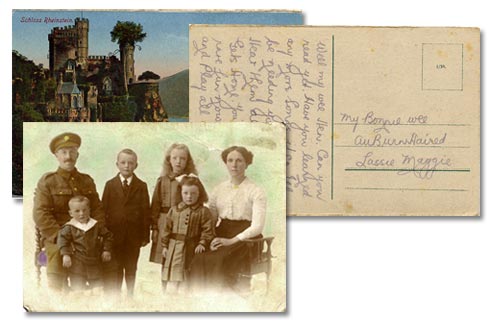
The above postcard was written from my great grandfather while he was on service in Germany in 1919 as a driver in the Royal Army Service Corps. He was writing to my gran (second from the right) when she was 6 - she died just last year, aged 93. He addressed it to "My Bonnie wee auburn haired lassie, Maggie" and says:
"Well my Hen, can you read yet? Have you learned anymore songs? If so I'll be needing you to let me hear them all when Daddy gets home. You'll be having rare fun now. No lessons and play all day. Ta ta xxx Daddy."
Peter McDougall Cameron returned to civilian life later that year to work as a chauffeur in Dundee. Sadly he died only four years later when a routine operation on his appendix went wrong. His last son, David, was born a few months later.
You can see a page dedicated on my website here, with Commonwealth War Graves Commission links for each name [update 2018: it currently contains 31 names]. Not all of these men have been fully researched yet, but one of the latest I have learned about is the last on that alphabetical list, Andrew Phillip Stewart, who was the second eldest son of my gg-aunt Betsy. He is also the only relative I know of (so far) who won a gallantry award, the Military Cross.
Andrew was born in Glasgow in June 1896 to Samuel Stewart (a gymnastics instructor and teacher) and Betsy Phillip (who had worked in her father's home-run market garden store before getting married). When the war came he was already a Private in the 5th Scottish Rifles, and after joining the Expeditionary Force worked his way up to Lieutenant in the 9th King's Own Scottish Borderers. As far as his MC goes, I have found the citation in a supplement to the London Gazette from July 1918, but as yet have no real context (or date) for the action...*
"For conspicuous gallantry and devotion to duty in a difficult rearguard action, when his tactical handling of men caused the enemy to suffer heavy casualties and enabled his own men to withdraw with a minimum of loss. He was wounded just as the last remnant of his command had reached safety."
*Edit: I have since discovered this event took place at Combles on 24 March 1918 and the MC was awarded posthumously.
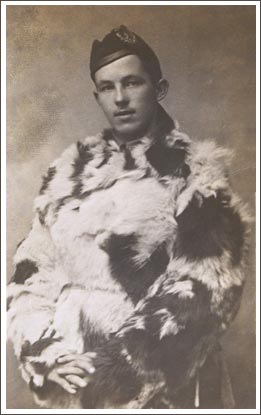
Andrew was invalided home, and after his recovery he made his way to Ireland where he accidentally drowned while bathing in Loch Corrib on 2nd June 1918. He is buried in the Western Necropolis of Glasgow Cemetery. There is a great photograph of Andrew that I came across in my late great-auntie Jean's photo album, which I saw for the first time a few months ago, showing him wearing one of the emergency issue winter goat-skin coats (also known as 'woolly bears') that were first issued in the winter of 1914-15. His cap badge shows this was taken when he was with the Scottish Rifles.
Through researching Andrew, I discovered that his elder brother, Henry (known as Harry) also died in the war, being killed at Gallipoli, while serving with the 5th Battalion Highland Light Infantry, on 14 July 1915.
This is my fifth annual Remembrance Sunday post, you can see the previous years' entries from 2007, 2006, 2005 and 2004.
My mum always told me that she liked the first half of 'Gareth', but not the second, and the second half of 'Darren', but not the first, so she put the two together to come up with Garen (this was 1969). Very recently my aunt told me a different story, that my mum scrambled the letters of her own name (Margaret Anne) and picked out five, producing Garen. Whichever story is true (I think the first) - she made the name up.
I like my name. It's got five letters to match my surname and has a pleasing stamp. Up until I got on the Internet, I thought it was pretty much unique, though someone told me early on that Elvis Presley's twin brother was called Garen (actually his second name and not the same spelling, Jesse Garon Presely, he was sadly still-born).
When I did get on to the internet (in 1997) I found there were other Garens out there and I experienced something of the feeling that all Johns, Daves and Mikes must constantly have... that my name is shared. Most Garens the world over have an Armenian surname, and this does seem to be where its roots lie, although a number of more recent baby-name websites declare it as French, and that it comes from the word 'guard' (erm, which is garde). A friend of mine who recently had a baby, owned a mammoth book of 40,000 baby names, including Garen, of which it said it was English. I can't help but wonder if they got that from typing the name into Google and coming up with my website and looking at where I lived!
I do know of another Garen native to the British Isles. In the late 1990s I did some illustration work assisting comic artist Tony O'Donnell, and when he had a son around that time, he and his wife decided they liked the name Garen, so it became his too. He's not named "after me", as such (I've only actually met Tony once in person), but I feel honoured, all the same, that my name was the origin.
Update: I have since done a little research into the first name Garen, and here are some stats - from 1837-2005 there were 46 Garen births registered in England, Wales and Scotland; the first was in 1952; there were 4 in the 50s, 8 in the 60s (including me), 12 in the 70s, 7 in the 80s and 11 in the 90s. 33 were in England, 11 in Wales, and 2 in Scotland; 10 of those belonged to people with a non-UK heritage (going by surname), of which 5 were Armenian (the others Turkish, Arabian, Latin American, Punjabi and Hindu).
Garen is one of those names people never believe the first time they hear it, so I've always got the script ready to say "it's like Darren but with a G instead of a D", though sometimes I won't bother, and will endure being called Darren, Gary, Gareth or Geraint and on one amusing occasion, Garden. One chap I worked with for a few months even took to calling me Dave because my name just did not compute in his world. The most common mis-spelling is to give it two rs, and it is still sometimes mis-spelt by friends and even family. If I say my own name, Garen Ewing, too quickly, people tend to think my name is that of automobile-songster and pop-pilot, Gary Numan.
One popular use of the name Garen appears to be for fantasy characters in online fiction, as it lends itself to that random interlocking of syllable parts that I know so well from my role-playing game days when I did much the same thing (ah, Dorin Sharpesword, where are you now?) In fact, at the time of writing, the number one Google return is for Garen Muln, a human male Jedi master who "lived during the final decades of the Galactic Republic". Number two is for Garen Boyajian, a Canadian actor (with an Armenian surname) whose "dedication, drive and defiant pursuit of superstardom" I immediately support due to our invisible unusual-name bond (coincidentally, he also works to help raise awareness for Ewing's Sarcoma). As for me, I come in at number four, just after Tarot mistress, Nancy Garen (but I'm not counting the surname). I've seen one female Garen - Garen Thomas, an African-American children's editor and author.
Update: as of Sep 2013 I now come in at number seven, with all the first six (and several after) being for a character called Garen ("The Might of Demacia") from a game called League of Legends.
Despite being one of those names you'll never find on a name-key-ring display in a tacky gift shop, there are a couple of places called Garen. It's the name of a ghost-town to be found on Highway 61 south of Forest Lake, Minnesota, founded in the 1890s. What I find intriguing about this place is that it was born of flame (a cattle-train stop built to placate the local farmers who were the victims of fires started by sparks from passing trains) and it pretty much died by flame (when the old school building burnt down in the 1930s, leaving only a roadside tavern into the 1940s). Garen is also a small town just outside Lindern, Germany ('garen' means 'cook' in German, apparently), and a village in Eidfjord, Norway.
So there you go... though the name has a Western Armenian heritage, in my case my mum just made it up in 1969. Well... you do keep asking!
You can read another blog post about names right here.
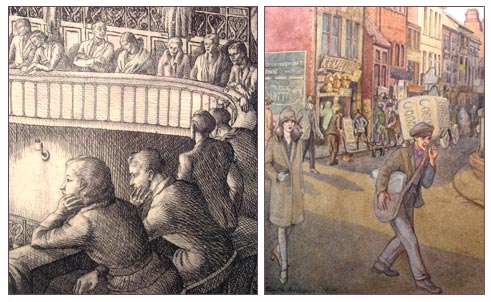
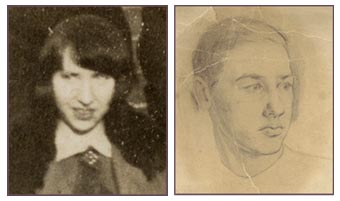
Edyth was the eldest child of a coal miner, and when her talent and ambition became evident, the family put their financial resources into sending her to the Royal College of Art in London - indeed, she was the first girl from Doncaster to go there. In the 1940s she ended up in Shrewsbury and married into an artistic family, the Coles. Her husband's uncle Edwin was quite a famous local artist, and I have mentioned him before, with a gallery of his postcards here. Her husband disappeared one day (it is thought he took his own life when the family business foundered), and she lived the rest of her life struggling to make a living, but did survive thanks to her art.
Detail from a theatre scene and a street scene (Doncaster market)
My great auntie Edith married Edwin's nephew, Duncan. Edith was an artist herself, attending the Royal College of Art in the 1920s, a financial stretch for her parents which necessitated her brother (my grandfather) having to abandon his dreams of becoming a chemist to join his father in the coal pits. Instead, he ran away from home and joined the army, eventually becoming a Major, and resulting in my mum seeing her school days in places such as Tripoli, Libya and Egypt. Artists, eh!?
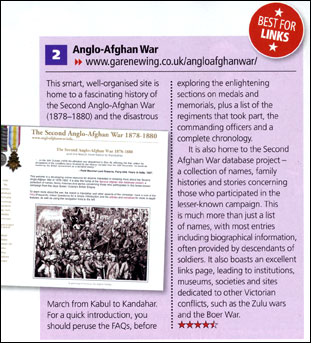
In fact, it was given 4.5 stars (out of 5), which is jolly nice - the National Army Museum website only got 3 stars. They even sent me a complimentary copy, which doesn't always happen with this kind of thing. Not sure about the "disastrous march from Kabul to Kandahar" - they obviously didn't have time to read my site too deeply, as it was actually considered a great military success.
They seemed particularly impressed with my links page, which I have always felt needs to be much more comprehensive, actually. (You know, it always surprises me when comics creators don't link to other creators from their blogs and comic sites - Google likes you if you're well-connected! - not that that's the only reason for linking to friends and acquaintances).
Back to the magazine - I must agree with their Star Site - The Long Long Trail, especially its invaluable Great War Forum - probably the best World War I resource on the net. Another star site would have been regiments.org, which has sadly gone off-line recently, probably for good.
David and John were brothers, both born in Dundee to David Ewing, who worked as a lemonade maker in Magdelene Yard Road, and Jane Gray, who came from Errol in Perthshire. David was the eldest, born in 1886, and John was born 1892. They had two elder brothers as well - James (a school teacher) and George (who followed his father in to the lemonade business). There had also been a middle brother, Alexander born in 1888, but he died of meningitis aged just six years old.
When the First World War broke out, David (a book keeper at Keillers) and John enlisted together at Dundee on 5th November 1914, David being given the number 1692, and John 1695, and both going in to the Royal Army Medical Corps. While I know David was placed with the 3rd Highland Field Ambulance, I am less certain about John as less paperwork has survived, and while it is possible they went in to the same unit, they have different embarkation dates: David on 4 May 1915, and John 1 May 1915.
The 3rd Highland Field Ambulance, as part of the 51st Division, saw action at Festubert in June 1915, the Somme in July 1916, and Beaumont Hamel in November 1916. It was also at Ypres late in 1917, but in February of that year David had been discharged as medically unfit due to dysentery. John, who had also served in France, was discharged in March 1919, suffering a 'broken denture'.
At the moment, I know little about the brothers' lives after the war. Neither of them ever married, and in fact I believe they lived together sharing a flat in Dundee for the rest of their lives - John dying around 1957 (no date for David as yet). Almost exactly a year ago I happened to get in touch with a medal collector who had one each of David and John's WWI medals. He generously offered to give me first refusal should he ever wish to sell them, which he very recently decided to do, and they arrived just a few days ago... a timely acquisition for Remembrance Day.
I did have another great-great uncle who served in the 3rd Highland Field Ambulance, not related to the Ewings, but also from Dundee - Robert Leishman Cameron. He was captured by the Germans and was kept as a prisoner of war at Stammlager Parchim and Stammlager Friedrichsfeld... but that is a story for another day.

Above: John and David Ewing with their mother, Jane, sometime in the 1930s, and David's 1914-15 Star with John's Victory Medal (their other WWI medals are missing).