

This blog began in 1997 as a single news page called Nucelus. In 2005, during a long wait to move into a new house, I decided to learn some php and MySQL and write my own blogging system, which became inkyBlog and which now powers this, my own Webbledegook blog.
Thank you to my brother, Murray Ewing, for help with some of the more challenging aspects!
It should be good for desktops, tablets and phones, so give it a whirl ... and let me know if anything is broken or you spot a typo .... there's always one lurking about somewhere.


Eurocomics comes out to us from Brazil, and while much of their content is in Portuguese and French, my interview is in English. Hope you enjoy it!


I've only been once, a very memorable trip back in 2014, but The Beat has included my brief views as part of their Angoulême Memories piece, including some who have been nearly 40 times (such as Paul Gravett).
For a trip down (my) memory lane you can read my blog report from the time here.

Progress has not exactly been zooming along, but it is being made, even while I'm having a very busy January with other work (I'm doing a lovely project at the moment with the Museum of London - I'll show some when I can).
Don't forget you can help support and encourage such progress by joining my Julius Chancer Patreon page, if you're able to. Thank you!

Though, actually, the blog is older. It started on AOL in 1997 as the news page of my website, called Nucleus (Internet Archive from 1998), and then became a blog called Webbledegook. Not all those early entries were kept, but 15 Dec 2002 is the earliest I still have archived.

Blogs don't seem to be the in-thing any more, with social media (which I'm not very good at) largely taking its place. But it's still my preferred home on the internet - a natural successor to the fanzines I self-published in the 80s and 90s.
I've not been as prolific with it lately, the most lively era, I think, being during the publication of The Rainbow Orchid. But it still serves its purpose, and I still enjoy it, so I'll keep going.
If you're still reading - thank you very much!
Most recently I've uploaded some old audio interviews from around the time of The Rainbow Orchid - one with the Comic Academy, one on BBC Radio 2 with Simon Mayo, and then one on my local radio station, Meridian (there may be a couple more to come).

You'll also find some the Curious Expedition 2 trailers, as well as a handful of drawing videos (I'd like to do more, but am never quite organised enough).
The biggest playlist is the Adventure Films Podcast I did with my brother, Murray. These each have, currently, around 100 views each, except for The Golden Voyage of Sinbad which has 10k! I presume this has been linked from somewhere.

I do plan to get the War Films Podcast episodes up at some point, and more comics and art stuff in the future too - just don't expect a lot in a rush. Subscribe to keep notified of anything new, though.
I'd originally done a basic Y-DNA test with FamilyTreeDNA back in 2018, analysing just 37 markers. It disclosed my haplogroup as R-M269, which wasn't very revealing - it's the most common group in Europe and is estimated to be between 4000-10000 years old.
I actually had more details than this from a couple of other previous DNA tests that included Y-results along with their atDNA analysis. LivingDNA put me into R-L21 with a subclade of R-S3058, and 23andMe gave me R-S190, which was the deepest result. Putting my Ancestry DNA results through the MorleyDNA Predictor also concluded R-S190. The line of descent goes like this ...
R-M269 > R-L23 > R-L51 > R-P311 > R-P312 > R-L21 > R-CTS241 > R-DF21 > R-FGC3213 > R-S3058 > R-S424 > R-S426 > R-S190
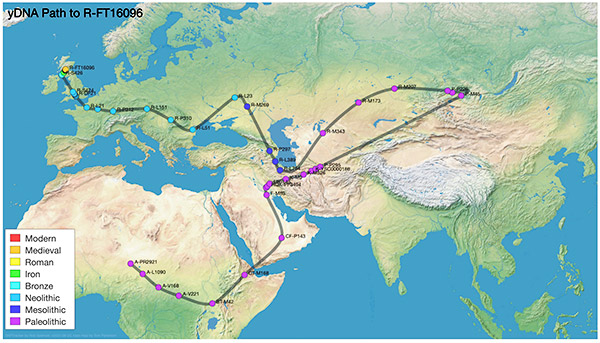
S424 and (particularly) S190 are markers that define a unique family line known as the Little Scottish Cluster (LSC). Anyone who tests positive for these haplogroups shared a common ancestor from somewhere between 1000-1500 years ago in southern Scotland, perhaps around the Perth and Stirling areas. As this was a time before the adoption of surnames, there are a variety of surnames within the LSC (see this paper (PDF) by Steven R. Colson, 2007).
If you really want to get deep into your haplogroup subclades, you can take a 'Big-Y' test, but as this was beyond my finances, I thought I'd never do it, and I was happy enough knowing what I already had. But then my 50th birthday coincided with a generous sale at FTDNA, and I went for it - the Big-Y700 test.
The results of this got me much deeper into the branches, with my new haplogroup terminating at FT16096 ...
S424 > S426 > R-S190 (LSC) > FGC3215 > ZZ23 > Y12464 > Z17998 > FGC3101 > Y16002 > Z17999 > FT16096
Out of just over 400 men who have tested and signed up to the LSC project (not all with Big-Y tests) this put me in a sub-group of about a dozen individuals, though they tested positive for various sub-branches which I didn't, it put my Ewing line out in its own little twig.
So that's where I've been for the past three years until a recent new batch of Big-Y tests were analysed and I was joined on my little FT16096 twig by another individual. Now there's someone to compare me with, the subclade can be better defined. A variant that was once unique to my Ewing line is now shared and can therefore be identified, resulting in a new haplogroup terminus, namely FT173826 - a clade defined by having a derivative A at position 6869996 on the Y-chromosome, instead of the ancestral G.

The common ancestor of this new haplogroup most likely dates to around the year 1350, it could be older, but could also be as recent as 1600 or so. But perhaps the most interesting thing is that this other tester also has the surname of Ewing, suggesting my surname could have been fairly consistent for quite a number of generations.
As a side-note, thanks to the results of the Ewing family DNA project, I know I am not at all closely related to the majority of Ewings there, who are largely descended from Scots-Irish Ewings who left the Emerald Isle for the US a few hundred years ago. This is not surprising - the best and most accessible Y-DNA testing company at present is FamilyTreeDNA, who are American, and as most of their customers are American, it is American Ewings who make up the bulk of the Ewing project.
These Ewings belong downstream of the R-M222 haplogroup, which means our 'common ancestor' clade is R-DF13, dating to around 4,400 years ago. At least I can now definitively say I am no relation to JR and Bobby Ewing from Dallas, the bane of my life in the early 80s! But perhaps it also means I would not strictly be a member of Clan Ewing, said to descend from Ewen of Otter. No Ewing tartan for me! (I jest, though actually I wore McLachlan tartan at my wedding twenty years ago, with a Cameron pin).
So, partly for that reason, at the moment the Little Scottish Cluster holds more immediate interest for me. You can look at a heat-map of the surname Ewing in the UK, and compare it with the general route of migration for my own haplogroup line. My earliest known ancestor, as of this writing, is James Ewan (aka Ewing), born probably around 1765 and living near Perth, shown with the little star on the map below (see my Ewing family history here). It all seems to add up rather neatly (though I'm sure the reality is not quite so tidy as it looks!).

One aspect of Y-DNA I find endlessly fascinating (honestly!) is the short tandem repeats, or STRs, that count the number of repeating alleles at specific locations in the Y chromosome to help pinpoint identification. For instance, a must-have characteristic of the Little Scottish Cluster is having an STR value of 9 at position DYS 590 (TTTTG repeated 9 times). Only 1% of R1b men have 9 here, where it is usually 8 (most members of the Ewing project have 8). And I seem to be unique, at the moment, within the LSC in having a value of 12 at DYS 393, where the majority has 13 (91% of R1b men have 13).
Not a lot can be concluded at the moment, and answers would only really start to come if more Scots Ewings and Ewans did Y-DNA tests. This would doubtless enlarge the tree and help to map Ewings in the LSC, and would also likely reveal other groups, possibly relating to McEwans, MacLachlans, and other Eoghan-related surnames. I'll look forward to the next update ...
There's a bit of a difference with this one as the three new featured characters are all from another computer game called Steamworld Heist, which I'm not familiar with, but had to learn a bit about of course in order to draw them - Piper Faraday, Billy Gill and Valentine Butterbolt.

Other new features include the Naturalist (who can train any animal in the game), the robot chameleon (which was super fun to create), the plasma spiders and the yeti, not to mention a number of new items and bits of equipment, as well as a new location, the old theatre (complete with not-so-hidden Tintin reference).

This DLC features the final bits of art I drew for CE2 towards the end of last year and the beginning of this one. The base game on its own is a very rich experience, but add these modules and its scope just becomes enormous and varied. It's an incredible game and I'm still in awe of how it all came together, and privileged to be a part of it.
The game and its DLCs are available on PC at Steam and GOG, as well as for XBox, PlayStaton and Switch. And if you're quick, they're heavily discounted as I post this!


It's Mr. Arthur Privett, a fellow historical researcher who made an appearance at the beginning of The Secret of the Samurai. He's not as impressive as he likes to think he is!

Here are a few character sketches for the current Brambletye Box scene (the Glinck's auction). If you want to see more behind the scenes work like this then please consider signing up to my Patreon page here - thank you!

 previous