


This blog began in 1997 as a single news page called Nucelus. In 2005, during a long wait to move into a new house, I decided to learn some php and MySQL and write my own blogging system, which became inkyBlog and which now powers this, my own Webbledegook blog.
Thank you to my brother, Murray Ewing, for help with some of the more challenging aspects!
See here for an introduction to Captain Powerchord. In a couple of days I will post the third strip: Big Dudey.

Click to open and read


See here for an introduction to Captain Powerchord. In a couple of days I will post the second strip: Have This Robots.
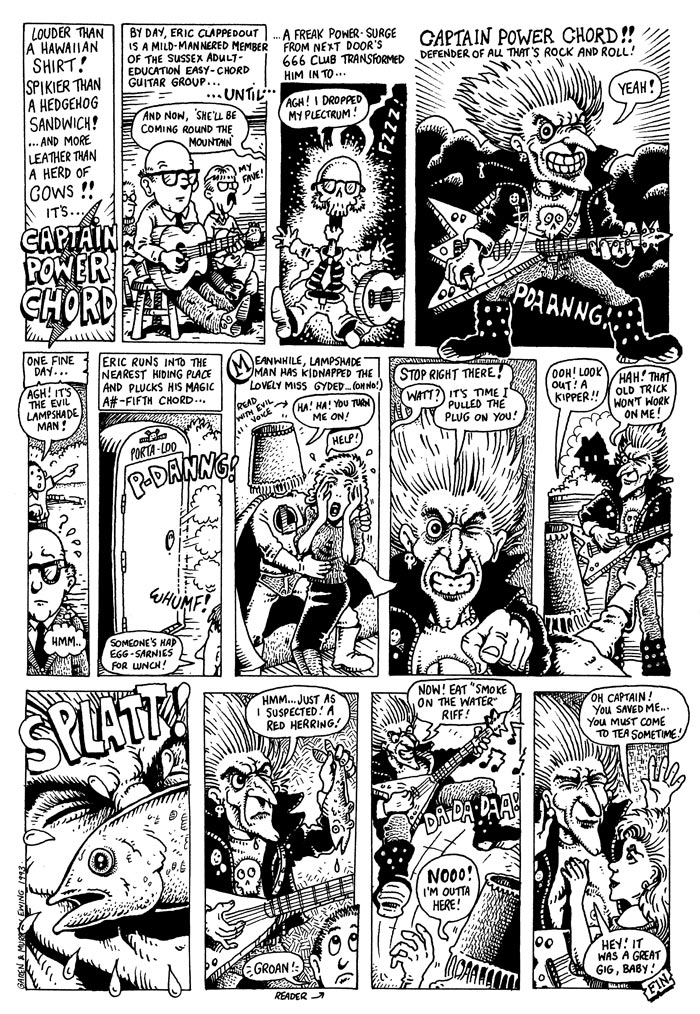
Click to open and read
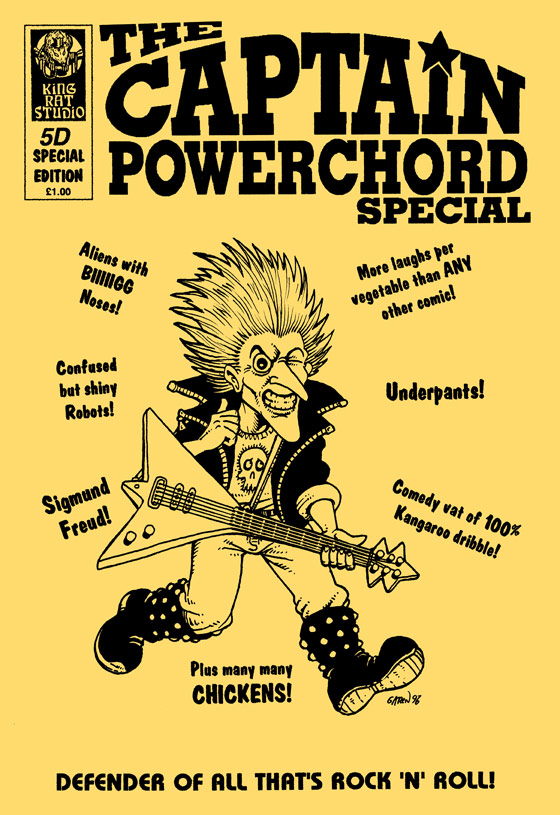
The strip was a music-based humour comic, very much in the British comedy tradition, though my golden rule was to not resort to sexual innuendo or toilet humour, something all too easy to do when you're trying to be funny (I was about 92% successful!). It appeared between November 1993 (in 5D issue 20) and August 1994 (in 5D issue 25). I wrote and drew a further three episodes that did not appear in 5D, but did appear in a small press collection I produced in 1996, of which only 100 copies were printed - long sold-out.
I'll post the first strip next week, then another every two or three days or so. I'll also post up some of the extras that appeared in the collection, which included a theme tune, a board game, puzzles and a poster. In the meantime, here's the introduction as written in 1996...
"Somewhere in the cosmos of comicdom, blown together by the mighty solar winds, where Max Fleischer meets Asterix for a sit-down cup of cocoa, where The Dandy does lunch with Robert Crumb, where Walt Disney goes down the pub with The Goodies and bumps into Woody Allen - who's just joined Spinal Tap - arm in arm with Stan Laurel ... there you will find the origins of Britain's most rock-n-roll superhero. If you look really hard that is."
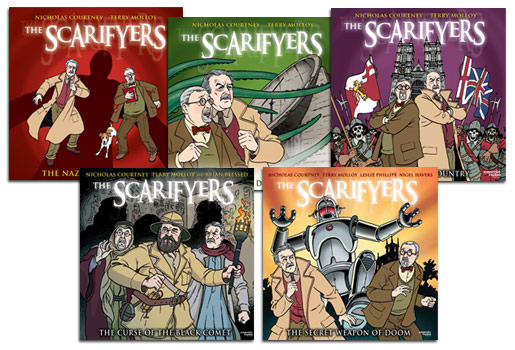
Cosmic Hobo produce the excellent and highly entertaining Scarifyers audio adventures (which you may have heard on BBC Radio), featuring occult investigators ghost-story writer Professor Dunning (Terry Molloy) and his colleague from the Metropolitan Police, Inspector Lionheart (Nicholas Courtney). The five tales (so far) have included a variety of brilliant actors, including Brian Blessed, Leslie Phillips, Nigel Havers, David Benson... and many more. The stories started out brilliant and have just got better with each new release. (If you're wondering what my involvement is, I designed and illustrated the CD inserts for the series).
They also have two other fantastic releases in the form of Peter Cushing's own reading of his autobiography (Past Forgetting) and the never-before released audio version of The Return of Sherlock Holmes, also read by the wonderful Peter Cushing. All marvellous for listening to while spending long hours at the drawing board!
As it currently stands, September is the correct publication date for volume 3. Yes, that's a long way off, and yes, I know for much of 2009 I have been telling people it was to be April or May. So why has the date changed? It's simply because I have taken longer on volume 3 than expected - the script took longer and the art is taking longer. I've also had more interruptions - promotional events took more preparation than I thought they would, I had to take on illustration jobs to have some money coming in, I had some hospital stuff to take care of, and I've had (and continue to have) some quite big creative struggles with RO that have prevented me from zipping along as I would like.
I sincerely apologise for this - I'm very disappointed that I'm not able to be a super-disciplined page-a-day-no-matter-what man and, especially to those of you who have been following RO since the beginning, this must seem a ridiculously drawn out process for what is, essentially, not that big a book. I am so very aware of all that, I promise you!
So anyway, that's the answer - September 2011 will see the conclusion of the story published. To make it up to you, if that's possible, before volume 3 hits the shops, I will be returning Julius Chancer to the web-comic format, possibly sometime in April or May - so there will be new and free material for you to read online well before September. And looking ahead, early 2012 will see publication of The Rainbow Orchid in one complete volume, as always intended.
Working on The Rainbow Orchid over the past 10 years has meant changing some of my ideas and focus, but also keeping to a plot that I created a long time ago and having to see it through to the end. I'm very proud of the work I've done (and am doing) on RO and have learnt a lot about writing and drawing comics in that time, but I don't see it as the pinnacle of my work by any means. The next Julius Chancer book (which will not be in three strung-out parts!) will reap the benefit of my experience thus far and I'll keep learning and growing as I get better and better at what I do.
So here's to 2011, a very happy new year to you, and a big fat thank you for all your support so far - it means a lot and keeps me going.

Top row (l-r): Fiends of the Eastern Front by Gerry Finley-Day and Carlos Ezquerra - I was reading 2000AD at the time this was serialised, but I don't remember it! I'm not generally a big fan of vampires, but the WW2 setting attracted me. The Little Prince adaptation by Joann Sfar - yet to read, but it looks nice. A Distant Neighbourhood, vol. 1 by Jiro Taniguchi - beautiful manga.
Second row (l-r): Ozu: His Life and Films by Donald Richie - I've been getting into Ozu more and more since seeing Tokyo Story at the NFT earlier this year and my DVD pile of his films is growing. The Purple Smurfs by Peyo - I loved the Smurf albums as a youngster so it's nice to have them reissued, albeit in smaller editions (and I could do without the horrible film bumf on the cover). Lords of Death and Life by Jonathon Dalton - a lovely book by one of the best independent creators working in Canada today, Jonathan puts a huge amount of thought and work into his comics, and it shows in his well-researched and well-told stories.
Third row (l-r): There's No Time Like The Present 13 - Paul Rainey completed his excellent down-to-earth-SF-soap-opera earlier this year, a must read of British independent comics. Spandex 3 by Martin Eden - Martin draws the sexiest people in comics with a sublime, intelligent line, terrific stuff. Necessary Monsters by Daniel Merlin Goodbrey and Sean Azzopardi - I find Sean's art in this book genuinely chilling, another great UK independent comic.
Fourth row (l-r): Sgt. Mike Battle by Graham Pearce - still working through this huge tome, but have comics ever been so much mad fun? Starting Point 1979-1996 - essays by Hayao Miyazaki - I've had this for over a year now and keep it by my bed for constant dipping in and out of. Inspirational. Grandville Mon Amour by Bryan Talbot - I put this on my Christmas wishlist so had to wait to read it. Now I have, and it's brilliant - as expected.
Fifth row (l-r): Why Evolution is True by Jerry A. Coyne - I've been curious as to whether creationism has any valid arguments that could deflate Darwinism and have found nothing at all credible (I'll keep an eye out). Evolution, on the other hand, has oodles going for it - the world really is a marvel when you start to look at it with an open and rational mind. Find Chaffy by Jamie Smart - excellent children's book by the UK's premiere comic cartoonist, splendid stuff. Mo-bot High by Neill Cameron - I love all the DFC Library books, but I think this one just inches in as my favourite. I really hope there'll be a volume 2.
I was at The Bookshop to sign and sketch in copies of The Rainbow Orchid, and was accompanied by local musician and author Bonx Trigwell, there to promote his new book The Dorset Arms, a collection of interconnected ghost stories that take place around this locally famous High Street pub - definitely worth a read! (You can read another blog entry featurning Mr Bonx over here).
There were carol singers, roasted nut sellers, shop owners in Dickensian costume, and Meridian FM's Neil Munday and Rosie Mac, broadcasting live to help keep everyone entertained (Bonx and I were both interviewed just before we started signing).
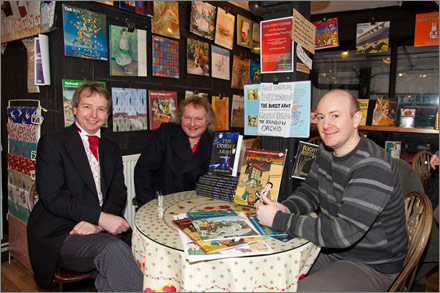
The Bookshop owner John Pye, Dorset Arms author Bonx Trigwell, and Garen Ewing. Photograph reproduced by kind permission of John James O'Brien (visit his website here!)
I must say a very special thanks to John Pye, owner of The Bookshop, and his staff - ever since the book launch I did there last August he has been a valued supporter of The Rainbow Orchid and I've been amazed at the number of copies he's sold from a shop where you might not usually expect big sales of graphic novels. The shop is a fascinating place and well-worth a visit. It keeps a stock of signed Rainbow Orchids and you can pick up Bonx's excellent Dorset Arms book there too. Thank you to everyone who came and bought my book on the day - hugely appreciated, as always!
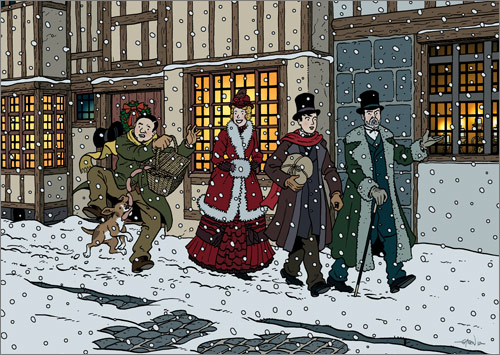
The Sunday Before Christmas event is organised by the High Street traders, many of whom will be going about in Dickensian costume offering mulled wine and mince pies, and maybe even singing a carol or two, I understand! Meridian FM will be broadcasting live from the event and Bonx Trigwell will also be at The Bookshop promoting his new book on The Dorset Arms. East Grinstead has the longest continuous run of fourteenth and fifteenth Century timber-framed buildings in the country and really gives the town a huge part of its character. It'll be fun, informal, and hopefully not too cold, so come along if you can!
Whereas sometimes there are two questions from one person, we'll start off with one question from two people...
Jez Higgins: What's next for Julius?
Jim C: Any plans as yet where to go with it after number 3?
I do have another adventure planned in some detail. RO is a bit of an ensemble piece, I think, but the next story will focus more on Julius, and it will be something of a detective story. It starts with an auction, a theft, and a visit by a childhood friend. It features an ancient ruined house, a stage magician and an uncharted island, and I have an ending in very rough form - and I think that's all I'll reveal for now, apart from the fact that it could all change!

Jonathan King: I'd be interested to know if you pencil-ink-colour each page before moving on, or each stage in batches or... ?
With volume 2 I'd pencil a page, then ink it and then colour it before moving on to the next page. With volume 3 I'm pencilling and inking each page, then I'm going to colour them all together. This is so Egmont can see almost-finished artwork sooner. I can't draw pages out of sequence, I have to do them all in order - just in case I decide to change something, I guess.
bertyH: I've got two - 1) do you see The Rainbow Orchid as a children's book? I bought mine in the children's section of Borders. I'm not a kid myself and don't see it as a kids' book, it seems more sophisticated than Tintin.
While I didn't write The Rainbow Orchid to be specifically for children, I did want it to be accessible to children. In the late 90s, when I conceived the idea, there were very few (if any) adventure comics for kids (actually, there aren't that many now) - comics tended to include quite a lot of violence and sexual content with a 'for mature readers' label, and I wanted to do something that would be okay for kids to read. At the same time, I wrote the story entirely to please myself, I didn't write it with 8, 12 or 14-year olds in mind. I think if I did try and write it for my idea of a certain demographic, it would fail. I don't mind it being marketed as a children's book at all - in fact I'm proud it's a comic that has kids in its sights. I'm also proud that adults get just as much enjoyment out of it as well. As for bookshops, they have to put it somewhere, and are unlikely to be generous enough to put it in several categories on my behalf, unfortunately!

2) what is the language being spoken by Meru and Father Pinkleton in part two?
All I'll say is that it's called Urvatjan, and more will be revealed in volume 3.
Al Power: what inspired you to write The Rainbow Orchid, and did you have the whole story mapped out at the start?
There were a number of inspirations that led to me starting RO that all coalesced around the same time, including the idea of doing a comic that would be accessible to children, as mentioned above. I think the main catalyst for the story was my love of lost world novels, such as those by H. Rider Haggard, Jules Verne and Arthur Conan Doyle. I'd also come to the conclusion that I didn't want to be a work-for-hire comic artist - I didn't have the staying power to invest all that time in another person's vision (which is a failing, I'm sure). Having just done an adaptation of Shakespeare's The Tempest, I wanted a character, or family of characters, that would be my own, and who I could use in several stories. I wanted to work to a classic European model, purely because that is what I enjoyed most, and it was very important that I enjoyed working on this story because I knew it would be a time-consuming and long-term project. The other main element was my interest in the 1920s as a time period - post the immense trauma of the First World War, still within sight of the romantic Victorian era, and with the world just beginning to really open up, albeit with a dark cloud on the horizon.

I did have an ending in mind quite early on, before I started the drawing, and I'll expand on that as it segues nicely with the next question...
Linda Wada: 1) I remember you saying you knew the ending of the story from the start, and worked the story toward that ending. Now that you are actually working on the final part of the story, (and without giving anything away) has that ending changed some, in getting to the ending you first envisioned?
I did indeed have the ending worked out, but it's only through scripting that I discovered how I could actually get there. When you get down to the detail of scripting, panel by panel, it throws up new problems for you to solve, so things inevitably change. It's all very well knowing that you want something to happen, but it's more difficult to come up with convincing motivation for the characters to be manoeuvred into the situation you had planned. In some ways quite a lot has changed within RO since my initial outline, but the overall map, start to finish, has remained fairly well on plan.
2) I know you are still finishing Rainbow Orchid volume 3 at this time, but what are some of the most valuable things you have learned since your book has been published and released?
The newest experience for me has been the wider exposure, and especially exposure outside the comfort, if it can be called that, of the UK comics scene. I think probably the biggest thing I've learned, and am still learning, is to accept that one person hating your book doesn't mean it's rubbish, just as much as one person adoring your book doesn't make it a masterpiece. It's about learning to be comfortable with the work you have done, as it is, and it seeking out its audience, with hits and misses along the way. Related to that is learning to be comfortable with what you do, the way you do it, and not to compare or compete with others. We all have our own unique voice and it is that which people latch on to, not the fact that I'm not as technically masterful as Brian Bolland or as intellectual a storyteller as Alan Moore. This is a Garen Ewing book, and I'm the only person who can do it - for better or worse. Learning to control the usual fears and self-doubt fostered by what is a very personal creative endeavour becomes much harder with that wider exposure, but more important for your own sanity!
The other main thing I've learned is the value of complete rough layouts before I start drawing!
Sarah Neal: Will the Tayaut Twins play a significant role in any future stories? I love the Tayaut family! Is Lily Lawrence a permanent cast member? Thanks for the great books!
Thank you. The Tayauts are part of the family of characters, and are bound to pop up again in a minor capacity, I'm sure. I am playing with the idea of a key appearance by Eloise Tayaut in the next Julius Chancer adventure, but am not sure yet if it's quite right for the story. One thing I definitely want to do, at some point, is a mini adventure focussing purely on the Tayauts, which will probably be published as a web comic. As for Lily, I must admit she does not yet feature very strongly in my plans for the next adventure, mainly because I want to focus on Julius. She does appear, and I still have an idea to give her a bigger role - but as with Eloise, I've not yet solidified my thoughts on the matter.

Mike Dutton: As I do not believe that, while Urkaz Grope is a unique villain, he is a true adversary to Julius Chancer himself, and as such, do you think you'll ever have any major villains for Julius, much like Rastapopoulos in the Tintin stories, and if so, have you had any plans for such a character already?
Hmm, an interesting question. What makes a true adversary? Was Rastapopoulos really one for Tintin? Tintin always got the better of him, and I always felt Rastapopoulos was a bit of a bungler (I haven't actually read a Tintin book for quite a while, so would have to reacquaint myself with his exploits to be sure). Urkaz Grope's power, I think, lies in his authority. He's deluded, which is a weakness, but he has immense influence. However, he doesn't engage Julius directly, so maybe that is where your view of him originates? The rainbow orchid is a side issue for Grope, a nuisance in the way of his bigger plan, so he employs another character, who I think is far more of a problem for Julius and his friends, to do his dirty work for him. Connected to all this is the question of Julius's status as protagonist - he seems a bit indecisive to me at times. Is Julius a worthy hero?

AliBee: Hi Garen - do you use photo reference for figure drawing? Do you draw right onto the page or sketch drawings out first?
I have only used photo reference very rarely for figures, maybe about ten times or less. A good example would be the scene in volume 1 where Julius is taking off his coat before climbing up on the roof of Lord Lawrence's house as I needed to understand how the coat came away from the arms, and the natural position of the arms to carry out that task. I'm not a fan of heavily referenced artwork as it can often, ironically, appear quite dead in the pose. I like understatement in my characters, I'm not from the animation school of hyper-exaggeration, but I also think you need to be a little unrealistic in figure drawing, especially where action, fighting in particular, is concerned. This isn't a badge of honour, by the way, and I'm not at all against photo-ref - whatever it takes to get the job done is fine by me - and I will use it! I do see more and more of an over-reliance on computer manipulation though, and it's my personal preference to be as close to the brain-hand-paper connection as possible.
I rough out my pages before I draw them, and this gives me the opportunity to get down the figure without worrying about any kind of technical perfection, just the general shape. This means when I come to draw the actual panel, part of the thinking has already been done, and I can concentrate on a more polished rendition. Ocassionally I'll do extra sketches before I start on the actual panel, especially if the initial rough turns out to be anatomically impossible, or I need to change angle or pose. One thing I do sometimes struggle with is that there's often more life in my scribbly rough sketch, and trying to transfer that over to the more complete drawing is not an easy thing to do.

enBD_1974: 1) What's your favourite panel in the entire adventure?
Ooh - what a good, and very difficult, question! I can easily point out the multitude of panels that I'm not happy with, but I've never thought about a favourite before. Having just had a look through, I don't think I can confidently pick one, but for now I'll say the Karachi train station scene at the top of page 27 in volume 2 - I don't think there's too much wrong with that, and it gives the right atmosphere with the promise of adventure to come.
2) You do a lot of research to make things in RO as authentic as possible. What authentic details are you most proud of? Is there anything you've got wrong?
I'm very pleased with the Breguet, purely because it's such a relatively rare aircraft. Also the work I put into the Natural History Museum, accurately depicting how it existed in the late 20s. Probably my trump card for research is the use of the Kalasha language at the start of volume 3. This is a language that is only spoken today by about 4000 people, is listed as endangered, and only had a written form of it as late as 2004. Having it appear accurately in a book is a rare thing indeed. Of course I had the generous help of an expert to achieve this, and the same goes for the genuine Ancient Greek that appears in both volumes 1 and 3.
I'm sure there is lots I've got wrong! I ignorantly called Lord Lawrence both Lord Lawrence and the Earl of Baggall, whereas (it was pointed out to me in a rather direct email) he would not, in reality, have both these titles. As the informant was an expert I asked his advice on how my mistake could be made into a legitimate situation, and so now that has become part of Lawrence's back-story. After the publication of volume 2 I learned that snow leopards don't roar, but as my sound effects are more of a loud growl, I think I might get away with that one! One mistake I made on purpose is the presence of the statue of Charles Darwin at the head of the steps in the Natural History Museum. He was actually replaced in September 1927 by a statue of the museum's founder, Richard Owen. The Rainbow Orchid takes place in 1928 (though I don't mention dates in the story), but my ideological preference is for Darwin, so in my universe, he stayed. Of course, Darwin is back there today anyway, since just before his 200th birthday in 2009.

Thank you again to everyone who contributed questions.
And don't forget those CBA auctions - looks like a bit of a bargain on the signed books (vol 1, vol 2, original artwork).
 previous