


This blog began in 1997 as a single news page called Nucelus. In 2005, during a long wait to move into a new house, I decided to learn some php and MySQL and write my own blogging system, which became inkyBlog and which now powers this, my own Webbledegook blog.
Thank you to my brother, Murray Ewing, for help with some of the more challenging aspects!
Jacobs had drawn his last book, Les 3 Formules du Professeur Satō, in 1972 (album, 1977) but the second volume of this adventure remained only in rough form at his death in 1987. It was completed by Bob De Moor and finally published in 1990.
Dargaud bought up the rights to publish Blake and Mortimer in 1992, and within a year writer Jean Van-Hamme and Benoit were meeting at Angoulême to discuss the scenario for a new book. Benoit found the work enjoyable but gruelling, and took three years to produce the album. Their next book (L'Étrange Rendez-Vous, 2001) took five years, and they were beaten into publication by a second creative team, drafted in to keep things on schedule, when Yves Sente and André Juillard brought La Machination Voronov (2000) to the public.

Benoit turned down the invitation to draw another book, though he did offer himself up as a writer, sketching out the plot for an immediately post-Swordfish adventure with the working title of Resurrection (2006), which Dargaud declined. Sente and Juillard went on to produce five more Blake and Mortimer volumes, while Van Hamme teamed up with René Sterne, Chantal De Spiegeleer and Antoine Aubin for two more (a further volume was authored by Jean Dufaux and illustrated by Aubin and Etienne Schréder in 2013).
Benoit did not have to make a great leap to put himself into the style of the series' originator, Edgar P. Jacobs, as he had been a devotee of the ligne claire since the 1980s, inspired after seeing the work of Joost Swarte and joining a new wave of clear-line stylists such as Floc'h and Yves Chaland. Before that he'd been a film student and assistant TV director, turned onto comics by the art of Robert Crumb, and passing through heavy Jean Giraud (Moebius) and Jacques Tardi phases. His clear line creation Ray Banana let him indulge himself in his passion for 1950s Americana.
Ted Benoit's Blake and Mortimer books are masterful and meticulous and he was a very worthy successor to Jacobs' legacy. I saw him speak at the Institut Français in 2008 where he spoke with passion for his love of the comic art form, though I do recall him seeming somewhat weary of the time and effort it took to produce an album, but determined to identify himself as his own man, not merely a supplicant to the might of the likes of Hergé and Jacobs - and he was justified, I think, in having that attitude.
His two Blake and Mortimer albums are published in English by Cinebook as the Francis Blake Affair and The Strange Encounter (both 2008).

 2
2
After many trials of various web-design packages, I've settled back with Adobe, and Dreamweaver. I'm not a 100% coder, but also I need more than just design by WYSWYG - I use PHP and MySQL, but am not an advanced user (I coded this blog from scratch - with occasional help from my cleverer brother).
So I've practiced on a couple of my other pages, getting the hang of CSS and responsive designs, and am now ready to start tackling this one. For now, it's just the blog page, but over the next couple of months I'll gradually update everything (it may take a while - work is particularly busy at the moment).
In the meantime, and to justify this test blog post, here's an illustration/poster I completed a couple of months ago.

I have a number of relatives who were involved in various bits of action, and I'm currently aware of three who died. These were Thomas Sherriff (age 31, Lancashire Fusiliers, killed on the first day of the offensive, his interesting story is detailed here); Arthur Meffan (age 19, Highland Light Infantry, wounded on 16th July at Longueval, and died on 27th July); and David Howarth (age 36, Manchester Regiment, killed on 7th July when his regiment lost nearly 600 men to German machine-gun fire).
You can read more about my family WWI casualties here, and a list of family WWI participants here.

I grew up in the 1970s and even as a kid I was vaguely aware of power cuts, strikes, the IRA, and something called politics, but it was all very distant to a young child who preferred to live in a world of adventure stories, comics and science fiction. In the 1980s however, things changed. The world suddenly seemed a more dangerous place, with the USA and the USSR at each other's throats and nuclear war seeming a very real possibility. We watched Threads at school and I took instructions on how to build a fallout shelter at home very seriously. Mum bought a little store of tinned foods and essentials that she kept in her wardrobe - just in case.
Then came the 1990s. Nelson Mandela was released from prison and Apartheid ended in South Africa. The Berlin Wall came down and Germany was reunified. Margaret Thatcher resigned. Gorbachev was reforming the Soviet Union, and the Communist bloc fell apart. The IRA called a ceasefire. The Israeli Prime Minister shook hands with Yasser Arafat. Of course not everything was rosy, but there was a feeling of optimism, of the possibility that the world might actually be getting better. People were coming together to try and make it happen.
That all pretty much ended on 11 September 2001. It wasn't just the attack on New York, it was the response: war. But worse than that, it was war based on lies. I've always had a strong sense of justice - of believing in what is right. Things should be done for the right reason, people should be treated as fellow human beings. For someone whose childhood was rammed full of war comics and toy soldiers, I ended up as quite the pacifist. Again, that naive idealism - as I was discovering music I was captivated by the Woodstock film and the ideals the movement strained for. I knew they were unachievable, but I couldn't help falling for it.
A week ago, the British public voted to leave the European Union, 52% to 48%, it was a close-run thing, but in a one-person/one-vote poll, the answer is unequivocal - of the people who voted, the majority think we're better off out. As a 'Remainer' (see my last post) I was devastated. Most of my friends have been devastated too, and across social media we've been discussing the fallout, sharing links and trying to understand what happened - and why.
'Leave' voters have often been unsympathetic, confused by our reaction, and even angry at us. Why don't we just accept the will of the people and shut up? Why are we such sore losers? The fact is, it's not about losing - that's fine, I've been on the losing side far more than I've experienced victory - I'm a very good loser.
No, this is the feeling that an injustice has been done. Before the day of the vote it was clear that most people who intended to vote Leave were doing so largely based on lies and misinformation, either distributed directly from the leaders of the 'Out' campaign, or borne of prejudice that had no connection to the EU, as well as ignorance of the EU itself.
£350 million will be saved and will go to the NHS, they said - a lie so often debunked, but repeated and bluffed through right up until voting day (and then brazenly denied after it). Our economy will improve, they said - a prediction that blatantly flew in the face of the advice of almost every financial and business expert out there. We're ruled by an undemocratic elite who impose on us the majority of our laws, they said - a soundbite misunderstanding of a system that is complex, but actually just as democratic as the UK government (if you care to look) and whose laws are not as numerous or binding as is often claimed, many of which greatly benefit us and protect us from greedy government and over-reaching big business.
And then the big one, the issue on which the vote was probably won: immigration. We'll take back control of our borders, they said, we'll stop them leeching off the system and taking over our jobs and towns, we'll stop the hordes of refugees piling into the country. It seemed they were trying to out-Trump Trump. The Remain camp were not effective in getting the truth of the matter out: we already have control of our borders, they are not open like those of countries who are part of the Schengen Agreement; leaving the EU will not curb immigrants and refugees who are not EU citizens; the refugees you saw crossing into mainland Europe will not be coming to the British Isles, Turkey are years away from joining the EU, immigrants contribute more to our economy than they cost; they staff our NHS, our universities, our laboratories, they are our friends and our neighbours.
But prejudice won out. Sometimes the reasoning was genuine but misplaced - there are people with real grievances, who cannot get employment, for instance, but who look to immigrants for blame. Much of the feeling is anti-Muslim, some of it just plain old xenophobia aimed at anyone with a different accent, language or shade of skin tone. It's nothing to do with the EU (unless you believe the conspiracy theories of Eurabia - and many do, just as Anders Breivik did).
The racist group Britain First has seen a huge rise in membership of its Facebook page since polling day, and currently has the support of almost 1.5 million people. The gap between the winning Leave vote and the Remain vote was 1.2 million people. Since the referendum results were announced, UK hate crime has increased by 400% - some of the stories have been heartbreaking.
This was not a General Election. Leaving the EU will have international ramifications, but the epicentre is here in the UK, and those most affected will be the young - many of whom could not vote. The EU has its problems, not everything about it is good - but, in my view, the good far outweighs the bad. It has helped to keep the peace, it has provided a united voice, it has helped countries to raise their game. It was born in the hope of post-war Europe and updated in the renewed hope of the 1990s. Britain was a maverick member, we refused to sign up to everything - we forced compromises. We kept our sovereignty, but we had a voice - and we could have still had a voice in the development of a better EU, one that could have genuinely made the world a better place.
Now the EU hates us - they don't want to give us concessions, it's in danger of falling apart. The far-right have been emboldened across the continent, rubbing their hands with glee at the result in the UK. All the people I admire - artists, creators, authors, scientists and thinkers, said it would be in our best interest to Remain. The Leave camp was full of people who I disliked - people with hateful ideologies, people who lied for their own political gain, people who had a disdain for rationality and the advice of professionals. The aftermath has seen a collapse of our political parties, an abandonment of responsibility, and a power-grab by people who hate the NHS and want to dismantle human rights. The right decision was almost a no-brainer (though I still read around both sides of the arguments as much as possible).
This is the tragedy: the referendum was won on lies and ignorance. It should never have been held (or should at least have had rules for a bigger clear majority). Many, according to reports, are already regretting their 'Leave' vote. We've made the wrong decision for the wrong reasons, and while I hope things will settle down at some point - who knows when - I fear we've taken a big step closer to the possibility of a darker future, not a brighter one. For my children's sake, I really hope I'm wrong.
Further reading:
A Note to My Friends Who Voted Leave by Jeff Lynn
The two campaigns, 'Remain' and 'Leave', have hardly covered themselves in glory when it's come to giving us - the general public - the facts of the matter. To make things worse, the EU is a bit of a mystery to most, often characterised by its more bizarre attributes, either as the butt of a joke or, sometimes, in the form of an outright conspiracy theory.
My general feeling a few weeks ago was that I'd be voting Remain. I like Europe, I like Europeans, I love visiting Europe (as I have luckily had the opportunity to do several times with my book published in a number of foreign editions), and I like Europeans being in my country (I believe diversity does not dilute our culture but enriches it - not to mention the fact that migrants give the UK a £20 billion tax benefit). Most of all, I like the idea of a shared international vision and of being an active part of that vision.
As the date has drawn closer, I've become more interested in the debate, especially in how the result will affect me - both in the things I care deeply about in the wider world, and in my own personal life. The more I've researched and learned about both sides of the argument and about the EU in general, the more I now think a vote to Remain is pretty much the only sane choice. In fact, I think a vote to Leave could be potentially devastating.
I'm not going to write an essay going into all the details and conclusions I've come to, but I would like to present some of the broad strokes, and let you know why I think being part of the EU is a good thing, despite the fact that it, of course, has many problems too.
First of all, I believe the EU is generally a force for good. It was born out of the desire to see lasting peace in Europe, and it has achieved that very well. It promotes cooperation and has what I see as basically a positive Humanist agenda. It also provides a number of checks and balances on our own government who may not always pass laws with our best interests at heart. An example of this would be various directives that serve what I call the 'greater good' - that cover the health of the environment, tackling climate change, defending human and civil rights, limiting the power of private corporations and protecting minorities. The EU does all these things.
Of these I think the question of climate change is the most urgent, and this is something that simply has to be tackled with a united front. We're not doing enough as it is, but if we break from the EU then it will set the progress we have made back by vital years, maybe even decades. A united Europe working together sets an example and raises the game for the rest of the world.
Speaking of which, there has been a lot of fear-mongering about Turkey joining the EU. The fact is, it will be many years before they are able to join, the reason being that they must first fulfil a large number of tests set by the EU. This is because the EU has a moral and technical standard that must be met - the EU makes countries aspire to be better. We don't want Turkey to join as it is now, but a Turkey that eventually passes the EU test will be an asset.
Turkey is just one of the un-facts touted by the Leave campaign, but it is not the only one. Perhaps the most blatant is that the UK "sends £350 million a week to the EU". This figure is false, as we get a substantial rebate (taken off before any money is sent) and we get a lot of money back in various forms of important funding, not to mention the incalculable extra value we get from goods, services and protections by being a paid-up member of the Union. The UK's contribution is only 1.2% of our total government spending.
Boris and his cohorts have said, if we leave the EU, we can use that "£350 million" to use as we wish, and they give the example of "a new hospital every week". The problem is, most, if not all, of the spare cash will be wiped out due to the massive economic downturn we'll experience on Brexit, which may even go as far as a pretty bad recession. And then what will we use to re-make those vanished laws and systems that we'll be 'free' of? The NHS will not get anything - especially from the likes of Boris, Gove and Farage, all of whom are on record as saying they would like the NHS privatised.

Okay ... I'm getting a bit verbose! The economic argument is the one that worries me most on a personal level. Almost every major financial institution predicts a monetary loss for regular families if we leave the EU, and quite likely a return to recession. Even many in the Leave camp agree with this assessment - though they think we can ride it out. Well, I probably won't be able to ride it out. My wife and I are both self-employed and we are just starting to get our heads above water after the hit of the last recession.
I lost clients in the last recession and it's been a struggle to climb back up. As the UK's economy started to improve, so did my own finances - but I am very close to the breadline on a monthly basis, sometimes under, sometimes a little over (illustration is not generally well-paid). Unlike the last recession, I now have two young children, so I'd be punched a lot harder this time. Even on the least-worse predictions I dread to think what our family situation could be if the UK economy shrinks again and businesses stop hiring freelancers like Ellie and me.
The UK is one of the strongest voices in the European Union, along with our allies France and Germany. Together, the 28 countries present a powerful force in the area of trade (giving us international bargaining power), diplomacy (preventing other powerful states from flexing their muscles too readily) and security (with shared intelligence and joined-up reaction to events). Scientific research, resulting in better treatments for disease, the solving of technological problems, and even space exploration, all benefit from EU funding.
The EU is often mischaracterised as undemocratic, yet a close look at the way it actually works shows that it is just as democratic as the UK (despite our unelected House of Lords!). We vote for our MEPs and they have real power to accept, reject or amend European legislation. They can even dismiss the Commissioner, and our Prime Minister and various other UK government ministers hold important positions when it comes to making legislation. The lack of democracy is a myth repeatedly peddled by the leave campaign.
Going back to a more personal level, the EU provides protection for my work and my rights as an author and artist on the international stage. There are a greater number of opportunities for grants and easier access to a wider readership. Membership of the EU has allowed me to easily travel to other countries where my books are published, to get paid more easily, and even to make sure I'll be looked after should I ever fall ill on one of those trips.
On a slightly more negative note, the kind of politicians who I feel most ideologically opposed to are the ones who might come out of a Brexit vote with the greatest amount of power: people such as Boris Johnson (whose main agenda with this referendum is to get himself into No. 10), Michael Gove (who wants to scrap the Human Rights Act) and Nigel Farage (who only turned up to one out of 42 EU Fisheries meetings, despite being an MEP on the Fisheries Commission, showing just how much he cares about British interests). They are on the side of privatisation and less social responsibility, and what they might have in store for us, if given a mandate, worries me greatly.
There may well be some benefits in cutting our ties with the EU, but I have seen none that have convinced me, and none that outweigh the huge number of advantages we get by staying. The vast majority of arguments for leaving have been gut feelings, amorphous patriotic slogans, and - I'm sorry to say - rather a lot of xenophobia.
For me a vote to Remain is a vote for the future, a vote to stay involved and an opportunity to try and make things better. I will be voting to Remain, for me, my children, and for the world. If you're undecided, I urge you to do the same. Please vote.
Mark William Cameron was born at Parkhurst Barracks at the beginning of 1884, his father being a Sergeant in the Seaforth Highlanders, stationed there after returning from service in Egypt and Afghanistan. His mother was only 18 at the time, and had married his father just five days before he was born.
Mark joined the Royal Navy, possibly inspired by his father's tales of campaigning in exotic lands for the British Empire, and perhaps also by distant tales of his great-grandfather, who had battled Napoleon's forces at Waterloo. As the new century began, he found himself as a Boy, 1st Class, aboard H.M.S San Pariel after stints on the Caledonia, Minotaur and Agincourt. In 1910 he married his cousin Margaret, daughter of his uncle Donald who had served abroad with his father in the 72nd Foot. In 1913, with the British and German Navys trying to outbuild each other as European tensions grew, he was in the Gunnery School aboard H.M.S Excellent, before being promoted to Gunner and joining H.M.S Invincible - the world's first battlecrusier - at its commissioning on 3 August 1914.
"The First World War had begun. In the northern mists the Grand Fleet (21 dreadnoughts, 8 predreadnoughts, 4 battlecruisers, 21 cruisers and 42 destroyers) was at its war base in Scapa Flow, under the command of Admiral Jellicoe. Diagonally across the North Sea the German High Seas Fleet (13 dreadnoughts, 16 predreadnoughts, 4 battlecruisers, 18 cruisers and 88 destroyers) were assembling in the River Jade under the command of Admiral Von Ingenohl." - V. E. Tarrant.
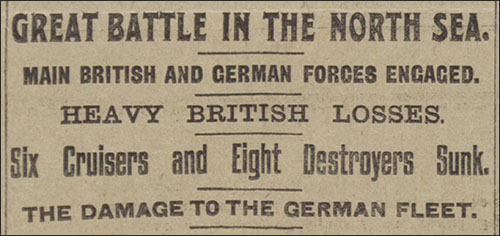
Invincible was involved in three actions. It had a small part to play at Heligoland Bight later in August, and then in December was involved in a naval battle against Vice-Admiral Graf von Spee at the Falkland Islands. But the Invincible will be forever associated with the Battle of Jutland, on the last day of May in 1916, when at 6.34 p.m a salvo from the Derfflinger penetrated the 7-inch armour and causing explosions in the gun-house, turret and the magazine, rent the Invincible in two, sinking it and killing 1,019 men. There were only six survivors, and Mark Cameron was not amongst them.
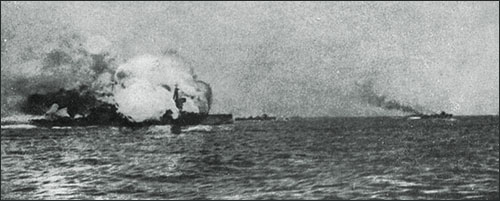
A direct hit on HMS Invincible
To boys who had grown up with the heroic deeds of their grandfathers, fathers and uncles, or the gallant officer adventurers in the novels of G. A. Henty, who had read of the brave thin red or khaki lines defending outposts against Zulus at Rorke's Drift, or Afghans at Kam Dakka, and where casualties rarely exceeded fifty on a bad day, or a few hundred on a disastrous day, the Great War will have come as a shock. Over 21,000 Britons killed in the first day at the Somme in 1916, and 6,000 Britons and 2,500 Germans lost to a watery grave at Jutland is a severe lesson indeed.
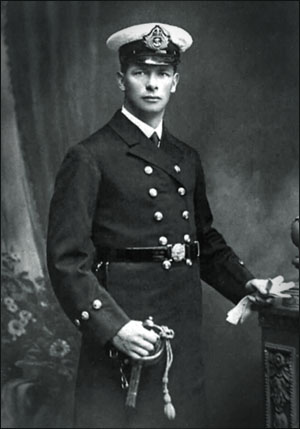
Mark William Cameron, 13 Jan 1884 - 31 May 1916
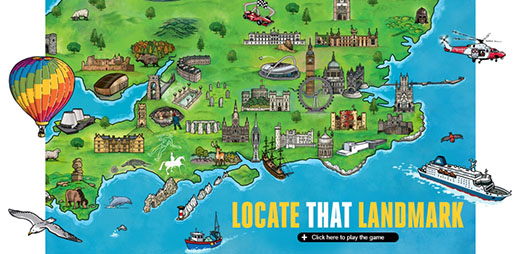
I didn't create the game, that was done by people far cleverer than I - but I did illustrate the map and all 100 locations - rather a mammoth task (especially all those cathedrals!), but enormously interesting, fun, and educational too.
As well as an online game, the map is appearing on JCDecaux digital screens across the nation over the next four weeks - so let me know if you spot one at a train station, airport, shopping mall or bus stop, etc.
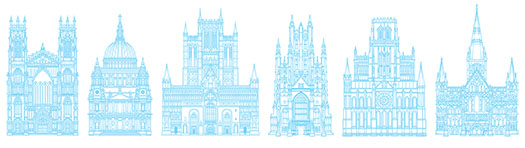
It was very nice to be working with JCDecaux again - you'll remember that I did the Arni comic for them last November (see if you can spot Arni on the map). Both these jobs have been a challenge, but really rewarding, and both have given me the opportunity to up my game and increase my skills - so thank you to Russell Gower and Janet Guest and their team for that!
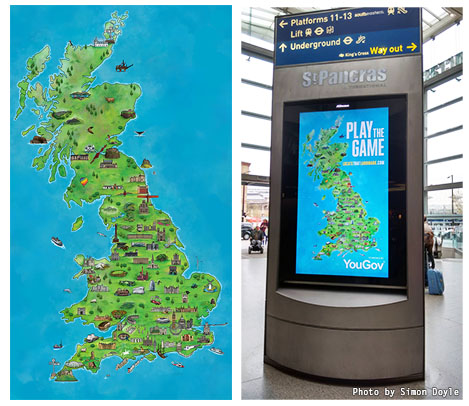
I've had a busy start to the new year, especially with one particular project that I've just completed - hard work, enormous fun, and I'll blog about it more when it sees the light of day later this month.
Julius Chancer has never been far from my thoughts and I've managed to get back to a bit of work on the next book again. It's frustrating (for you and me!) that's it's so slow, but money-earning work has to take priority, and that's not the comics, I'm sorry to say.
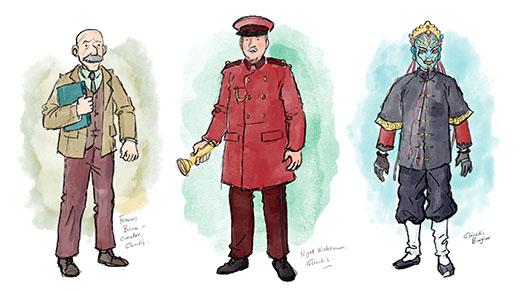
For now, here's some costume colour guide roughs for characters from the opening scene of the new book.
Both were driven by nostalgia to a large degree. We always used to go and see the new Bond film at the cinema ... I particularly recall seeing Moonraker, but I think The Spy Who Loved Me (1977) was the first. But just six months later my life would change, because that is when I went to see Star Wars (at The ABC in Tunbridge Wells, now sadly flattened).

Up until then it was war - comics, toys, models and films - that were my main preoccupation, but I mostly dropped that after Star Wars, and science fiction and adventure became my new obsession.
It was a great time to be a young kid. After Star Wars came Superman, The Empire Strikes Back, Flash Gordon, Raiders of the Lost Ark, Superman II, Time Bandits, Clash of the Titans, E.T, Conan the Barbarian, Blade Runner, Tron, The Dark Crystal, War Games, Indiana Jones and the Temple of Doom, Ghostbusters, and Return of the Jedi, to name a few that have stood the test of time.

And it's nostalgia that is at the heart of The Force Awakens - an aspect that is partly responsible for its huge success, but which has also been one of the main points of criticism of the film.
I enjoyed it immensely, but then perhaps the film was rather aimed at me and those like me, and it pushed all the right buttons. I liked it so much that I started 2016 by going to see it again, and was not disappointed with a second viewing and with the hype somewhat cooled.
It's nice seeing the old faces again, but the best thing about the film is the new faces: Rey is an intriguing and positive main character, Fin is entertaining and hugely likeable, and the dark side offers up a very interesting personality in the guise of Kylo Ren.

Unlike some critics, I didn't mind the plot parallels with the original Star Wars. I think it's a trait of the series (or perhaps the Force) that patterns repeat, and I'm not surprised, after the reception that greeted episodes I-III, that the writers and producers wanted to play it safe to get the new franchise off the ground.
My worry is that the creative team behind episode VIII, slated for late 2017, will give too much attention to the voices of the fans when they come to map out future instalments. While, as I said, I loved every minute of The Force Awakens, it has also, actually, given me a greater appreciation of the originality and vision of George Lucas's prequels.
I re-watched them over the past couple of weeks, for the first time in a long time (in fact, in the case of episode III, for the first time since seeing it just once at the cinema) and was pleasantly surprised. Jar-Jar Binks wasn't as annoying as I, perhaps, mis-remembered, and I even found young 'Anni' likeable and somewhat sympathetic. Certainly the over-baked scenes with Hayden Christensen and Natalie Portman are a bit difficult to watch, but I got a better sense of Anakin's path to the dark side by seeing all three in sequence. I surprised myself by really enjoying the last of the three, even Darth Vader's "Noooooooo!" didn't seem half as bad as I recalled.

The setting of the prequels is a feast for the eyes, and I think the story just about works - especially if you immerse yourself fully into the fantasy. This isn't science-fiction, after all, it's pure space fairy-tale!
Was Lucas largely criticised for being original? For telling the story he wanted to tell, and not the one his films' keenest fans wanted (ie. a more Star Wars-y Star Wars). Are those who are criticising The Force Awakens for being too much like A New Hope the same people who criticised The Phantom Menace for not being 'Star Wars' enough?
I'm not saying the prequels were perfect films, not one bit. I do wonder if, because of what they are, they are put under a great deal more scrutiny than would ever be directed at the original trilogy. Episodes I-III are world-building, background, nerd-notes. I shed myself of some of the internet stigma that has built up around them, and found I enjoyed them more than I thought I would.
We've had our nostalgia moment with The Force Awakens, and that's brilliant. Now let's hope we move forward into new territory, where quality storytelling will prevail over commercial interests and fan pressure. I want to see the new characters grow, and I'd love to see Luke Skywalker - the kid that started it all - used intelligently, with new aspects revealed, giving impetus to the new series, so that a long time ago, in a galaxy far, far away, has a bright, absorbing, and exciting future.


 previous