


This blog began in 1997 as a single news page called Nucelus. In 2005, during a long wait to move into a new house, I decided to learn some php and MySQL and write my own blogging system, which became inkyBlog and which now powers this, my own Webbledegook blog.
Thank you to my brother, Murray Ewing, for help with some of the more challenging aspects!
There was no sign of a husband with her in the 1841 census of Anstruther Wester, where she lived with her two children, and the 1851 census revealed she was a widow. Through the records of the Fife Family History Society I soon found out her husband, John Birrell, had died by drowning in July 1840 - just two years after they were married - the only details being that he was a ship's carpenter, and the locations of the accident ('River Mersay') and his burial ('Stormount').
The only River Mersey I knew was at Liverpool, and the only Stormont I knew was in Belfast - places separated by 140 miles of Irish Sea, but perhaps making sense for a ship en-route from England to Northern Ireland.
Regularly over the next 20 years I would check resources and newspapers to try and uncover any mention of the drowning of John Birrell, with no luck. The closest I came was a boat swamped on the Mersey and in which two of the four mechanics on board were drowned - no names were mentioned, but the date was off of Birrell's recorded death by just two days.
I probably hadn't done a 'Birrell check' for about three years when I decided to try again a couple of days ago, and this time I hit the mark. In that three years, the British Newspaper Archive had added the Shipping & Mercantile Gazette to their library, and in this publication was the following story, syndicated from the Montrose Review:
"MONTROSE - July 24: ... two men belonging to a Montrose vessel, the Mars, Captain Younger, last week met a watery grave. The vessel was then lying at Fleetwood, in Lancashire; and the men, whose names were John Burrell and John Menzies, having gone ashore on Tuesday night, were returning in a small boat, early next morning, when they were drowned. The boat was picked up next day, five miles from the vessel; and the bodies of the unfortunate mariners were also found. Burrell was a native of Anstruther; Menzies, of Montrose, and has left a widow and small family."
The date of death and his place of origin, Anstruther, are correct, though a couple of other details seem odd. Fleetwood is about 30 miles north of the Mersey, so either the place of drowning is not right, or they went for quite a trip. The burial at Stormont makes sense as the next destination of the Mars was Quebec, though the only report I can find so far seems to indicate it sailed from Fleetwood on the 23 July, whereas John's burial is recorded as the 17th. Hopefully, with these new details, I'll be able to get a clearer picture sometime soon.
John was just 22 when he died, but managed to have two children with Peggy (who lived to 79), both of whom would go on to have families of their own. Son Andrew married in 1858 and had two sons, one a school master, the other a soldier and then shale miner, both producing families of their own. The other child, my ggg-grandmother, married in 1859 and had 12 children, a number of them successful in Dundee-based businesses, and most surviving to have families of their own as well.

I visited the grave of Peggy Auchterlonie, at Crail, in 2002 (her actual age was 79)


Murray and I started the War Films series back in 2014 - seven years ago ... and it's only ten podcasts! Well, we did say we wouldn't keep to a regular schedule.
Before that we'd recorded ten podcasts for the Adventure Films Podcast. Those went up much more quickly - ten films from May to December 2011.


This still isn't the 'final' version of the game as new content is still under construction, to be added into the game at various points in the upcoming months - so it's just going to get better and better.
Here's the new January 2021 trailer for the game ...
This the longest I've ever worked on a single commercial project (not including The Rainbow Orchid), so far clocking up over 3000 hours of drawing time - and there's more to go.
You can get yourself a copy of the game over on Steam, and learn more at the Maschinen-Mensch website.

Part of the problem is my own Edwin Cole webpage - with, for instance, ebay sellers misidentifying the signature on the art and then Googling my page and copy-pasting the info on the artist they think they're selling. In all the examples I currently have, Edwin Cole always signed his full name in caps, and often also included the year. Here are some examples from between 1905 and 1925.

Edwin Cole signatures 1905-1925
He also seemed to work exclusively in watercolours for his paintings, and the scenes are nearly all landscape subjects in and around Shrewsbury - but I wouldn't exclude other mediums and subjects coming to light - he was versatile, working with stained glass, metal and wood.
Also coming up for sale, often under the name 'Edwin Cole', are two series of postcards titled the Kitten Series (including 'Miss Vanity', 'The Model' and 'The Destroying Angel') and the Artistique Series (featuring female portraits with epicene names such as 'Sandie', 'Billie' and 'Tommie'), all published by the Pictograph Publishing Co. of London in the 1920s.

Pictograph postcards by Edward Cole
These are not by Edwin Cole but by a Hackney-born artist called Edward Francis Cole. His signature is often 'Edwd Cole' (with a very small second 'd') so can be misidentified without care. Here are some examples - you'll note the long line coming from the end of Cole that was consistent throughout his career.

Edward Cole signatures
Edward was a poster designer before he joined the Surrey Regiment for the Great War, where he made a number of benevolent cartoons of his officers. He created art for the Pictographic postcards and went on to become a highly skilled commercial artist, later moving to and working in South Africa.

Artworks by Edward Cole c.1916-1950s
The vast majority of misidentifications concern a large number of original oil pantings being sold, not only through ebay, but also in auction houses both online and off, with the signature of E. Cole. Some of these, presumably later ones, are signed E. Cole Snr. or E. Cole Jun. (the latter not, as one ebay seller put it, because it was "painted in June").
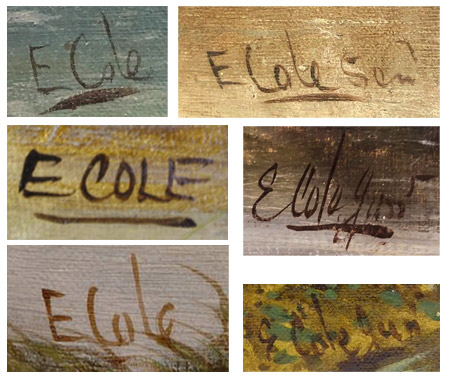
Signatures of E. Cole (senior and junior)
The paintings are well-crafted (Cole senior slightly more professional, I'd say), and out of over 50 examples I've seen, all but a handful feature a country lane and a white-gated cottage (not always the same architecture), sometimes with a river or pond, sometimes with a girl walking in the lane, sometimes with a little stone bridge too. They are certainly nineteenth-century, but so far I have not been able to identify who the two E. Coles are - except they are not Edwin Cole of Shrewsbury.
One auction site has their art expert state "E Cole is probably a grandson of George Cole and a son of George Vicat Cole, both famous painters who made similar work". While the elder George Cole did indeed have a son called Edwin Cole, he was a mariner from the 1850s and my last sighting of him is in Jamaica at the end of 1880s where his Dutch second wife died. I doubt he was the artist, though he can't be fully ruled out just yet. Vicat Cole had four daughters and one son, Rex, also an artist. His daughter Edith Ivy, was probably not the 'E. Cole Snr' - most likely a male artist. But, certainly, the subject matter is thematically in line with that of the Vicat-Coles, including another son, Alfred Benjamin, so the family is worth exploring more fully.

Oil paintings by E. Cole
Finally, another name has been thrown in to the mix, that of Ethel Kathleen Cole (1892-1976), sometimes identified as the painter, mistakenly I think, of one or more of the above E. Cole pieces. I have not been able to find a definite sample of her work online. A webpage of Suffolk artists assigns two paintings to her, one with the usual E. Cole signature (almost certainly misattributed) and another that says 'Cole - Ethel Kathleen' on the reverse - likely not put there by the artist herself, and probably another E. Cole painting by the looks of it.
Part of her biography states that Ethel went to the Slade School of Fine Art, and there is a figure sketch attributed to her from 1912 on the University College London site, though it is signed K. Cole, and a contemporary newspaper article refers to her as Kathleen Cole. The UCL site, confusingly, says Ethel was American and that she died in 1934 after living in Derwentwater. This does not seem to be correct, as census returns say she was born in Beccles, Suffolk, moved with her family to East Grinstead, and worked as an art teacher later in life, dying in Lewis, a spinster, in 1976. An E. Kathleen Cole is recorded as exhibiting at the Royal Academy Summer Exhibition in 1931, 1932 and 1935. Again there appears to be the biographies of more than one candidate conflated.

Ethel's 1912 signature, and a signature on a 1930 sketch I spotted on ebay
The research I've done here is not complete, and I especially hope to eventually identify E. Cole senior and junior. I'll update this as any new information comes to light, but in the meantime I hope it helps to correctly identify what is by Edwin Cole of Shrewsbury, and what isn't.

The Welsh Bridge, Shrewsbury, by Edwin Cole (1905)

The game is currently in Early Access, but you can download a demo from the CE Steam page, read more about the award win here, and see the current trailer here. I can also highly recommend PalicoPadge's playthrough series on YouTube.

Is this a brand new story? No - this is the same story that was serialised in The Phoenix Comic back in 2013 (issues 75-78), though I have re-edited a bit of the text, and re-written and re-drawn large parts of two pages (pages 17 and 22 in the book).
Is this a full-length album? The actual Secret of the Samurai story is 20 pages long, but the album also contains two other short stories I wrote and drew (both of which have been published before): The Sword of Truth (2004, 6 pages) and The Girdle of Polly Hipple (2005, 4 pages). The album is 36 pages in total.

What is the book's availability? I'm not sure on this yet - as I write the album is not currently on the BD Must site. The French language edition is listed on Amazon. A crowdfunder for the French edition was successfully funded back in May on Ulule. I do know the print-run is not large, and that it's smaller for the English language edition. I will update this when I know more.
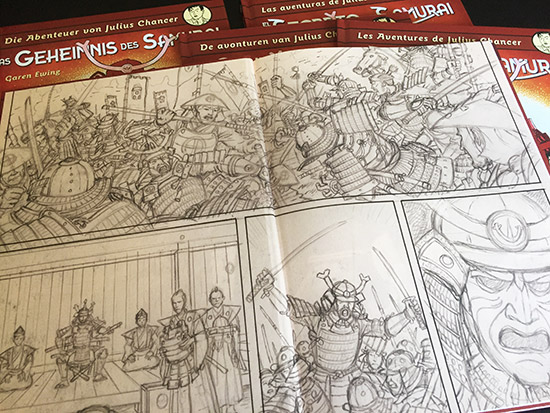
What's the story about? Briefly it's a mystery about the hunt for a missing set of samurai armour, and it takes place before The Rainbow Orchid. For more details and notes you can see some of the blog posts I wrote at the time it was serialised in The Phoenix Comic (note - some of the info in these posts is no longer accurate!): The Secret of the Samurai FAQ, blog post for part 1, blog post for part 2, blog post for part 3, and blog post for part 4.
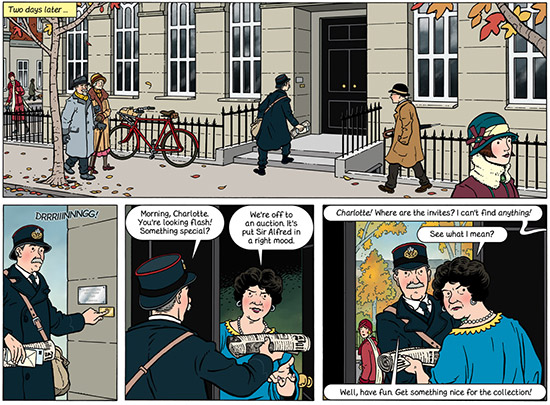
I'll end off on the other question I get all the time (and no, I'm not tired of it, it's lovely), Will there ever be a new Julius Chancer adventure? The answer to this is yes, as long as I don't get knocked down by a bus (or whatever the modern-day equivalent is ... an Amazon delivery robot?). I'm still very busy at the moment working on The Curious Expedition 2, but I haven't forgotten Julius Chancer - the new story is all-plotted, semi-scripted, and drawing started (extract below). I fully intend for this new story to happen ... I just don't want to promise when!
A couple of weeks ago Maschinen-Mensch released Curious Expedition 2 on Steam Early Access, meaning players could have a test run of the still-in-development game, providing feedback to help identify and fix bugs and to be a part of shaping the eventual full release. It's been an enormous relief to see the overall reaction so far has been positive, with a lot of useful feedback from players that I think will only make the game even better as development continues.

Now the game is out in public, I think I can show some of the work I've been doing with the team at Maschinen-Mensch (though see their Twitter feed for much more). It will also interest, I'm sure, a lot of my Rainbow Orchid and Julius Chancer readers, in fact any fans of ligne-claire comic art and adventure stories.
The original Curious Expedition (still available and still supported) is a 'roguelike' expedition simulation set in the late nineteenth century. You have a team of explorers, you have resources, you have a map and lands to explore, and you have goals to attain. Curious Expedition 2 is much the same in principle, but with many improvements in game-play, story, character development and scope.

The biggest outward difference is the graphics. Whereas CE1 is a pixel art game, CE2 is going for a ligne-claire style (think Tintin, Blake and Mortimer, Tardi, Joost Swarte, maybe even a little Moebius), giving it a European bande-dessinée feel. This has also opened up the options for graphic detail, including facial expressions and gestures for the characters, and a whole new arena for animation and interaction.
Maschinen-Mensch started out as two people, Johannes Kristmann and Riad Djemili, and they pretty much created CE1 on their own (Johannes did all the amazing pixel art, which still informs the feel of the sequel). Due to the game's success and support from their new publisher, the Swedish Thunderful Games, they've been able to expand their full-time team to eight people, as well as a coterie of freelancers - including myself. (You can meet the team and see an introduction to the game on this video here).

Although I may be doing a large chunk of the actual drawing for CE2, what you see on the screen is the result of a close and overlapping collaboration between many minds. Johannes is the Art Director - and while I do have some creative input at the concept stage, I'm very much channeling Johannes's strong vision for the game and working closely under his guidance. You could say he's the brain and I'm the hands. Many of the special effects and the wonderful atmosphere applied to the in-game scenes are the work of technical artist (and horse expert) Laura Brosi, and the fantastic (and often funny) character animations are created by animator Katarina Czikorova. But the whole team make contributions in every area, with the end result drawing from every quarter of the production. It's no good just seeing a screenshot of CE2 - the game is the character, interaction, movement, music, feeling and story that all come together to result in the overall experience.
The core of the game is the narrative you create as you play. Characters will form traits and attachments; empathy and cultural respect is encouraged and rewarded. The dice-based combat system is great fun, and there's even a 'saving roll' aspect which especially appeals to me as an old Tunnels and Trolls player. On one of the missions you can even go in search of the rainbow orchid.

Coming from a largely publication-based world, as I do, the learning curve and challenges I've faced on this job have been enormous, but very rewarding. There's a whole host of technical limitations and parameters to take into account, but also, of course, things you can do that you just can't on paper. To see a character I've drawn, with its separate arms, legs and head, come alive after Katarina has been at work on it has seemed like magic at times (and I won't even get into the sorcery of the programming side). Other challenges have included the scale - drawing scenes for 4K (and above) resolutions - and the integration of various changeable elements: 2D characters, scenery and locations in a world with perspective.

While the map is mostly the work of Johannes, I have contributed hand-drawn visuals to that area too, as well as some dice icons and the inventory items - so there's been a wonderful variety of art tasks that have kept me busy over the many months I've been involved. I've had nothing to do with the lovely fin-de-siècle influenced interface, the work of Johannes and Sandrine Dubois.

There has been a little negative reaction to the new art style, of course, and - besides just the normal difference in people's personal tastes - this largely comes from a few fans of CE1 who are very attached to Johannes's pixel art, which is understandable! Of course CE1 is not going anywhere and is still available - but there seems little point in re-making the same game, and it's hoped that the new art style may appeal to a new and wider audience, to whom pixel art may seem less accessible, catering more to a core of retro-gamers. I've seen some comments about the 'vector art' of CE2 - I'll clear that up: it's not vector art. Really, it's still pixel art ... just a lot more of them!

Curious Expedition (no connection with The Lost Expedition card game, by the way) is an enormously ambitious venture, and I've seen some of the blood, sweat, tears and dedication that the whole team have devoted to make it a reality - the work that's gone into it already is mind-boggling. There's still more to do, but you can now give the game a test drive and see it's paid off. I feel incredibly honoured to have a part to play in this project, not to mention the great experience of working alongside Johannes and the rest of the Maschinen-Mensch team. The finished product is going to be awesome.
You can buy Curious Expedition 2 (Early Access) on Steam here.

"The said John Bozell's way of life is mostly in pretending to tell fortunes, and fraudulently getting people's money by telling them, that by giving him such a sum of money, in such a place they shall find a great sum, and has brought a great many ignorant people to ruin."
Although there are other candidates, it's possible his son, John, was the 'Black Jack' Boswell who gave rise to the later famous Derbyshire Boswell clan. But that John was said to be a brother to other well-known Boswells of the period, Lawrence, Bartholomew and Edmond, and there are other names in the ring for their parentage too. But it could at least be said there is a close link with another historic Boswell - Shadrach the soldier, who was likely press-ganged into service as a result of the Vagrancy Act, and fought the French in Canada in 1779 - he may have been a cousin.
It seems fairly well accepted that John and Edmond were brothers and variously went by the name of Boss, sometimes also called the 'Kak' Boswells, on account of a lazy eye, or eyes of a different colour. One daughter went by the title of 'Gall-Eyed Licia', and I tend to blame the Boss family genes whenever yet another photo of me emerges with one of my eyes half-closed.
Edmond was the husband of Eldorai Boss, reputed to be a sister of Shadrach. One of their children was Eliza, and she became the wife of Anselo Boswell (often recorded as Joseph Boss), the son of Edmond's brother John. Anselo's siblings included Viney, Hairy Tom, Black Ambrose and John - the latter, or his father, claimed to be 'The Flaming Tinman' of Borrow's popular Lavengro, but it was more likely to be the son given that his age was "not much under fifty".

Gypsy Tent by Octavius Oakley, who painted a number of scenes and people of the Derbyshire Boswell clan.
John Boss (the father) has been recorded as marrying one Mary Newberry in Loughborough, Leicestershire, in 1780, but this seems unlikely. Mary's maiden name was Wood, and she married the recently widowed William Newberry, a Loughborough butcher, in 1775. They had a daughter, Parnell, in 1776 (she would go on to marry a cavalryman and then work in the Royal household), before William died in 1779. In 1778 he had taken an apprentice, John Boss, most likely his cousin, and it was this John, apprentice butcher, who married the widowed Mary Newberry in 1780. Little of this has the Gypsy stamp upon it.
Anselo and Eliza had a number of children baptised across Derbyshire, Leicestershire, Worcestershire, Lincolnshire and Cheshire. One of these, in 1812, was Mary Ann Tracey, known as Tresi. In 1832 she married William Sherriff at Rugeley, Staffordshire, allegedly a mumper - a slightly derogatory term the Romanies used for someone less than a true Gypsy, a beggar, a vagrant, a hedge dweller. But the Sherriffs themselves have a pedigree of travelling, at least back into the beginning of the 18th century. Some of these Sherriffs married into the Hodgkins and Clayton families, and others into Tresi's Boswell clan.
William and Tresi had a dozen or so children, with several marrying into 'good' families - Claytons, Hollands and Boswells. Youngest son Hope married Trinity Boyling, the daughter of "tale-teller" Absalom 'Appy' Boswell. In 1903 Hope and three of his sons were apprehended for the murder of a policeman - Hope was acquitted but the three sons ended up in prison on a charge of manslaughter. One died during his sentence, while another, Thomas, came out to fight in the Great War, only to be killed on the first day of the Somme.
The Gypsyologist Thomas W. Thompson wrote that "no marriages have been recorded" for four of the Sherriff children - Alfred, William, Lorcni and Joseph. My own research shows that William had a son with an Ann, and then lived for a number of years with an Elizabeth Allen, before being killed in a fight at Ripley. As for Joseph, he was my 3xg-grandfather, and he married Eliza Johnson at Uttoxeter in 1871. Eliza was a widow previously married to Joseph's cousin, Joseph Clayton, son of his aunt Ann Sherriff.
Eliza had three children: Alfred, Mary Ann Tracey (who died age 4), and Charlotte (my gg-grandmother), all born before she married Joseph Sherriff in 1871. But were they the children of Joseph Sherriff or Joseph Clayton? If it's the latter then I am not descended from the Boswells at all, and I'll have no one to blame for my sometimes-lazy eye. Both Josephs were chair makers, and both had fathers called William, also chair makers. Furthermore, daughter Charlotte recorded the maiden name of Claydon on seven of her 11 children's birth certificates.
Although they married in 1871, Joseph Sherriff was with Eliza and the eldest child, Alfred, on the 1861 census. Joseph's age and birthplace are consistent with previous and later census returns to indicate he is the Boswell descendant. Even so, this is thin evidence in the Gypsy world where facts are often made out of nothing better than sand. But further research into first husband, Joseph Claydon, puts it almost beyond dispute. In 1846 Claydon was apprehended for his involvement in a violent house robbery over a year before - he was found guilty and given the harsh sentence of transportation for life. He arrived on the remote Norfolk Island in September 1846, but seven months later he was dead from dysentery. This may explain the late wedding of his cousin to Eliza if they did not know his fate.
My gg-grandmother, Charlotte Sherriff, married William Hodgkins, her first-cousin once-removed (Charlotte's grandmother was also William's aunt), and though they went on to have 11 children, only five survived into childhood, and only three of those into older age.
My great-grandfather, Charles Hodgkins, survived WWI but died a few years later, age 34. He had two daughters by then, including my Granny, May. Both her and her second daughter, my Mum, always claimed their dark hair was a sign of their "True Romany Gypsy" heritage, even though by then the names and stories had been mostly forgotten.
More on my Gypsy family history here.

'The Flaming Tinman' - after his fight with Borrow (E. J. Sullivan) .
One new aspect is a deeper study of the context for my earliest-known Ewing ancestor, James Ewan, probably born sometime around 1765. I look into more branches of the family, including my discovery of an early branch that emigrated to the United States. I examine the Ewing trades a bit more closely - including linen weaving, the grocery business, and those who went to sea. Thanks to better resources for newspaper research I've been able to bring a lot more of the Ewing story to life with some of the more colourful characters who had aspects of their life reported. I also take a general look at what the Ewing DNA is able to reveal.
Writing the history helped to clarify a lot of aspects - the general movement and spread of the family groups, the importance of the trades my forebears worked in, and the backdrop of industrialisation, city life, and social mobility. It's given me a far greater understanding and appreciation of the lines and threads that weave back behind me.
While I'm aware it will have very limited appeal to most people (even my own family members!), you can have a look at it here, if you wish.

My great-grandfather, James Ewing (1882-1960)
 previous