Who Were Donald Cameron's Parents? Part II
by Garen Ewing 07 May 2026
Cameron and Chromosome 13
At the end of my article Who Were Donald Cameron's Parents? I mentioned a DNA puzzle that may hold the key to Donald's ancestry where the genealogical record is missing.
The link became apparent as I started connecting a number of Cameron DNA matches on Ancestry in the 4th-cousin range (23-37 cM), who I could place as descendants of my 3xg-grandparents, Donald Cameron (c.1810-1887) and Catherine Campbell (c.1815-1889), and noted a number of mutual matches in the 17-31 cM range who I could not identify.If this sounds like gobbledegook, let's pause for a quick explanation. Every person has DNA - the genetic code that makes you ... you! You get half from your mother and half from your father. They, in turn got half from each of their parents, meaning that your DNA is also made up of a quarter from each of your grandparents, an eighth (or thereabouts) from your great-grandparents, and so on. The further back you go, the wider the variation in those segments of DNA because inheritance amounts are not precise.
As an example, let's take a fourth cousin - that's someone who shares a set of 3xg-grandparents with you. Mathematically, that would mean you'd each share 3.125% of the 3xg-grandparent's DNA, though the reality, due to the randomness of inheritance at this distance, means it's actually anywhere from 0 to up to around 1.7%. But your 4th cousin will have their own DNA inheritance from this ancestor, which may include some of the same segments you've received, or may not. Many people are surprised to learn that you don't share DNA with everyone you're related to, and you will usually share DNA with only half of your 4th cousins, and 10-15% of your 5th cousins (remembering of course, you'll have many more 5th cousins than 4th cousins). The amount of DNA you share can also be measured in centimorgans (cM), and for a 4th cousin that would be mostly in the 20-85 cM range, averaging about 35cM (0.5%).
Back to the mystery matches ... after some research into their trees, where they had them, I found the majority were descended from one Alexander Lamont (1761-1845) and his wife Eunice Currie (1771-1859) who hailed from Kingsburgh on the Isle of Skye, a completely separate geography from my Perthshire Camerons. The Lamonts had a couple of children on Skye before they emigrated on one of Lord Selkirk's vessels, the Polly, landing at Prince Edward Island in 1803 where they had more children and lived out the rest of their lives.
As my research continued I discovered some of these Lamont/Currie descendants on other DNA platforms that, unlike Ancestry, had chromosome browsing available, where you can see a visualisation of the DNA segment match, so I was able to identify the common DNA segment as being on chromosome 13 (chr13). But how is that useful?
Not including the X and Y sex chromosomes, we each have 22 pairs of 'autosomal chromosomes', the pairs being one maternal and one paternal. In this case the matches are on my paternal chromosome 13.
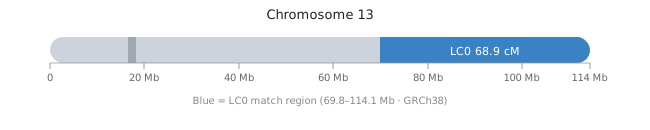
The diagram below represents the full length of my paternal chr13 and the blue area is where my paternal aunt (LC0) matches me on that chromosome - that is to say we share the same sequence of genetic markers in that segment. We're closely related, sharing 24.4% in all (though 38.7% of chr13), the expected amount for an aunt, uncle, grandparent or half-sibling.
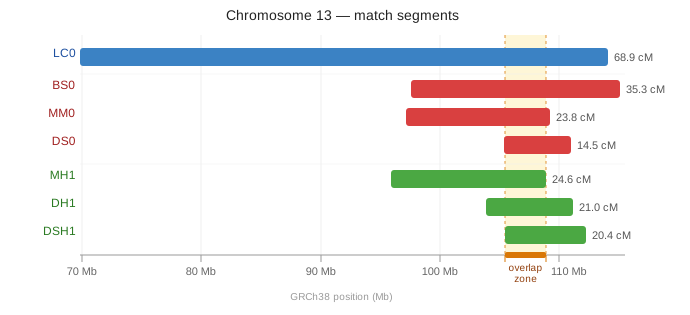
Knowing which chromosome, and where on that chromosome your DNA match coincides can tell you who they're related to. If you know how you're related to a match - in this case my aunt and fourth cousins - then anyone else who matches in that same area will share the same ancestral root. We all received the chr13 segment, in various lengths, passed down through the generations intact from the same person. In other words, we're related. The next thing to work out is how we're related.
I had hoped this would be the break-through moment - perhaps finding that one of the Lamont/Currie parents was a McDonald or a Cameron who had a niece or nephew who would turn up in the Little Dunkeld area of Perth, revealing themselves as one of Donald Cameron's parents. But instead of narrowing down the search, the more I dug, the more chr13 matches I found - currently around 75 - and the wider the pool seemed to get. To add to the pool there are also all the mutual matches on Ancestry where I don't have chromosome data, but who do share DNA and help to confirm the general genealogical picture.
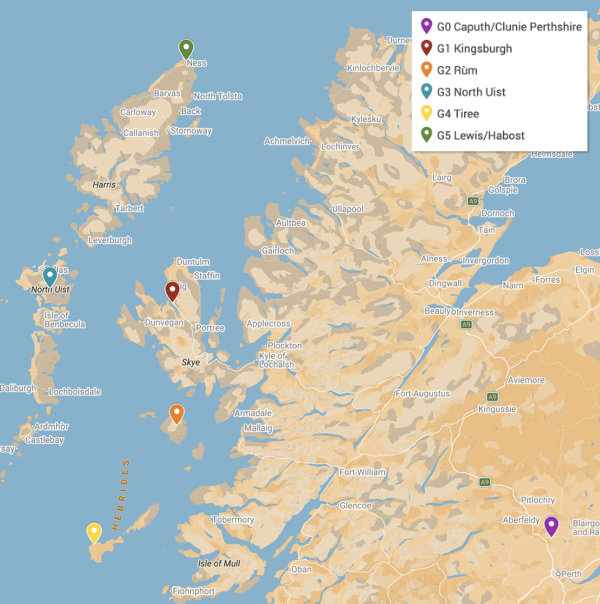
With this data other family groups emerged who have no obvious link to the Lamont/Currie families and after a few years of on-and-off research, I organised these into seven groups (G0-G6), as follows:
Group 0 (G0) - these are my known Cameron cousins, descendants of Donald Cameron (1810) & Catherine Campbell (1815) of Clunie, Perthshire. While I currently have almost 30 Cameron DNA matches, I've only been able to confirm four of them as having the chr13 segment, though there are a handful of others that are mutual matches on Ancestry with members of other groups, mostly G1. Catherine Campbell's DNA will also show up within this group, of course, but I feel fairly confident the chr13 signal comes through Donald as Catherine's ancestry points strongly to Caithness for both parents and Caithness is not a prominent presence in the matching groups - all possibilities remain open, however, so Catherine's ancestry can't be totally dismissed.
Group 1 (G1) - descendants of Alexander Lamont (1761) & Eunice Currie (1771) of Skye that emigrated to Prince Edward Island. This group has some of the strongest cM matches - as high as 31cM (in the 4th-6th cousin zone) - though any common ancestor with my line must predate Alexander and Eunice as they moved abroad well before any of their descendants had families of their own. Some in this group have subsidiary lines that lead into G5 territory. 21 matches so far, with eight confirmed as chr13.
Group 2 (G2) - three descendants (all chr13) of Norman McLean (1792) and Ann McKinnon (1792) of the Isle of Rum, victims of the 1826 clearance who ended up in Cape Breton, specifically Whycocomagh. Another line of this group (for two of the matches) leads to McDonalds of Dull, Perthshire, which feels significant, but might be a red herring.
Group 3 (G3) - descendants of Angus McLellan (1781) & Marion Monk (1795) of North Uist with descendants in both Scotland and Nova Scotia. This is a sparsely matched group (just 5, all closely related to each other, but 4 known to have the chr13 segment) and has other lines that wander into G5 territory, so the group could do with a few more matches to help confirm the right direction.
Group 4 (G4) - nine descendants (four chr13 confirmed) of Allan Cameron (1776) and Mary McLean (1762) of Tiree, Argyll, with emigrant branches ending up in the US and Canada, or staying in Scotland. The Cameron name seems very significant, but, again, could be a red herring. Allan Cameron does have a brother, John Cameron (1778) who would be the right generation to father Donald of Clunie, but so far it looks like he may have married and had family in Tiree - though that's not a solid confirmation, and needs to be kept open. There's also a strong McLean line and the Tiree families are peppered with Lamonts which might point back to G1, but, so far, not obviously so.
Group 5 (G5) - a large endogamous group with multiple common ancestors from the Isle of Lewis, particularly Barvas and Stornoway. Common names include McLean, McKenzie, Morrison, Murray, McDonald, McRitchie, McLeod and Campbell to name a few. An absolute nightmare to sort out when you have, for example, a Norman McLean marrying a Catherine Morrison whose parents were Norman Morrison and Catherine McLean, or a Donald McKenzie of Eorodale who married Margaret McKenzie of Habost, right next to a Margaret McKenzie of Eorodale who married a Donald McKenzie of Habost. Ancestry trees from this group are littered with errors and wrong turns. I've identified 21 matches so far who share various common ancestors in this group, six of whom I've been able to confirm as having the chr13 segment.
Group 6 (G6) - this is populated by any match who I've been as yet unable to home. It includes 45 confirmed chr13 matches, and a large number of Ancestry mutuals.
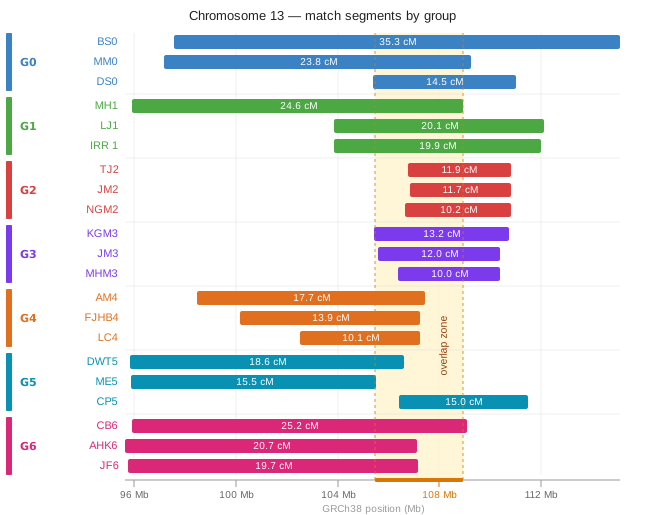
Match segments with my chromosome 13, three from each group
One of the most important things to confirm with these groups is whether or not they triangulate - in other words, not only is the same chr13 segment common to all of them, but do they also match each other at that genetic location? I validated this by creating a match matrix.
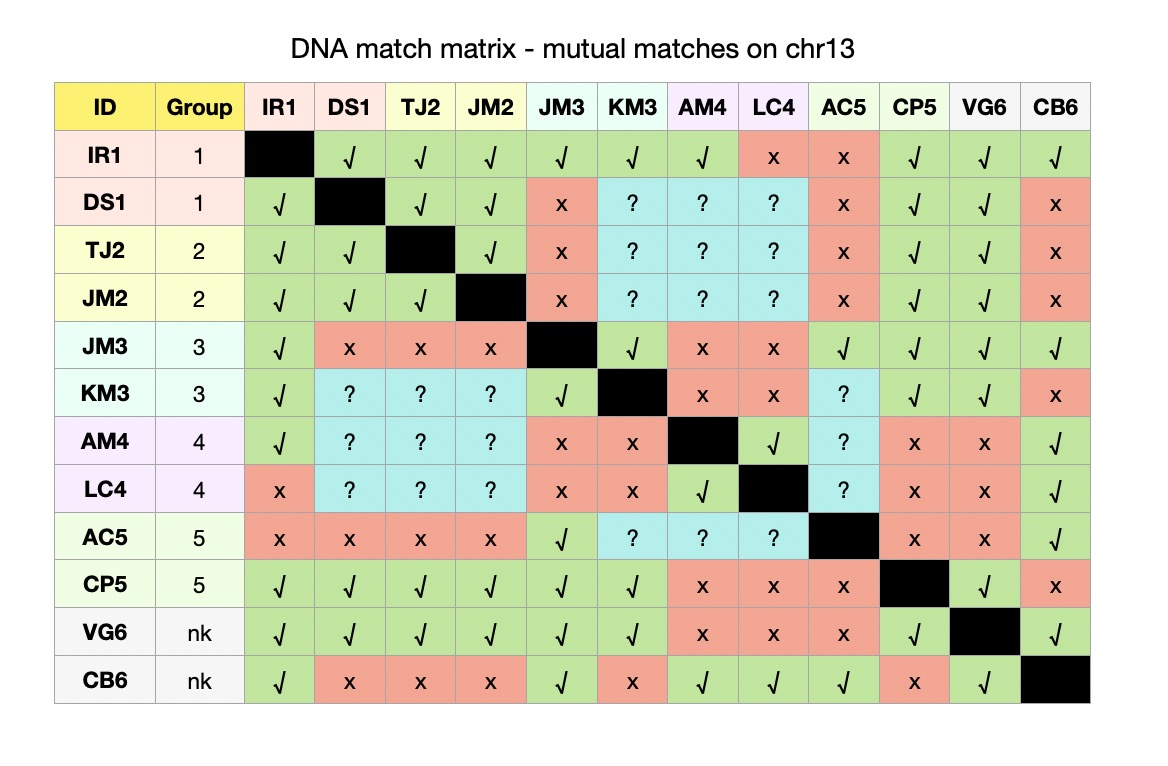 Two chr13 representatives from each group; green (tick) means they match; red (x) means they don't match; and blue (?) means I was unable to compare them due to different platforms
As you can see from the above table, representatives of each group match across all other groups, the conclusion being that, even though I have not been able to link the groups, they must all share a common ancestor, or at least an ancestral population, somewhere back in time.
But having taken many of the groups back to the mid to late 1700s no clear common ancestor has emerged. Hebridean records are very poor, even in the 1800s, and largely non-existent back into the 1700s, so it is pretty much a foregone conclusion that the originator of the chr13 segment that was passed down into all these groups, as well as into my own Cameron line, will remain unknown.
We can guess that any common ancestor to all these groups must be at least a couple of generations before the earliest we have identified, which would place them in the early 1700s, and possibly more safely into the late 1600s. At that distance we'd be looking at matches who are in the 8th or 9th cousin range with very few of them having any shared DNA at all, and only then in tiny segments. Having said that, the likelihood of perceptible DNA showing up is made more possible purely through the sheer number of 8th or 9th cousins that exist - likely in the tens-to-hundreds of thousands.
Another factor that would increase the cM count from such a distance would be endogamy, which is already very apparent in the G5 Isle of Lewis trees where many matches appear with multiple common ancestors - it's a group made up of a number of sub-groups, a well-recognised phenomenon within such a closed geographical kin network that leads to reduced genetic diversity.
In some ways it might seem as though all this research (and it has been a lot) has got us no closer to identifying Donald Cameron's parents, and, while that may be true, it has actually shone a light into a new and significant direction.
We cannot be certain of the names of Donald Cameron's parents, only that his death certificate records them as John Cameron and Ann McDonald and that the accuracy of this cannot be validated. Certainly McDonald is a strong Hebridean name, particularly connected with Skye and Uist, spreading later into Lewis. Cameron features strongly in G4, though it doesn't necessarily mean we're looking at the paternal ancestor here - it is not originally a Hebridean name - and it could just as easily be the female McLean line that passed it down.
But one thing it does tell us, and it is very useful new information, is that Donald Cameron has heritage that originates outside of Perthshire, specifically from a Hebridean ancestral population. One route to Perthshire from the islands might be through the military - especially as we know Donald married a soldier's daughter and it was not uncommon for military families to form connections. But that is just one theory to keep in mind.
As John Donne wrote, "no man is an island", and Donald Cameron did not exist in isolation. Obviously he had parents, and they very likely had siblings, some of whom must have had families. Donald may have had siblings or half-siblings himself, though we can't be sure of that. A footprint must surely lie hidden somewhere awaiting discovery.
I would very much welcome any feedback or comments from my fellow Cameron (or Lamont, Currie, or other Hebridean) researchers. Do you have matches that might appear in any of these groups, or do you have the same chromosome 13 segment appearing in your DNA mutuals?
The search for footprints continues ...